Jewish Museum
Prague, Czech Republic
Explore the Jewish Museum in Prague, Czech Republic, a collection of historic synagogues and the Old Jewish Cemetery preserving centuries of Jewish heritage.
Overview
The Jewish Museum in Prague, nestled within the historic Jewish Quarter (Josefov) of the Czech capital, is not a single building but a poignant collection of historic sites. It serves as a vital guardian of the Jewish cultural heritage of Bohemia and Moravia, preserving a rich history that spans over a millennium. Established in 1906, it is recognized as one of Europe's oldest Jewish museums.
This unique institution encompasses several significant synagogues, the revered Old Jewish Cemetery, the Ceremonial Hall, and the Robert Guttmann Gallery. Together, these sites weave a comprehensive narrative of Jewish life, traditions, and resilience in the Czech lands, offering visitors a profound journey through history.
History & Cultural Background
The story of Prague's Jewish Quarter, also known as Josefov, dates back to the 10th and 11th centuries, though a formal ghetto was established in the 12th and 13th centuries when Jewish people were compelled to reside in this designated area. Over centuries, the community endured periods of persecution, expulsions, and urban renewal, yet it consistently demonstrated remarkable resilience. During the late 19th and early 20th centuries, significant portions of the old ghetto were demolished as part of a modernization drive, but fortunately, many of its most important buildings were saved.
The Jewish Museum itself was founded in 1906 by historian Salomon Hugo Lieben and city councilor August Stein. Its initial purpose was to preserve artifacts from synagogues slated for demolition during the clearance of the Prague Jewish ghetto. A particularly harrowing chapter in its history occurred during the Nazi occupation of Czechoslovakia. Ironically, the Nazis allowed the establishment of a 'Central Jewish Museum' in 1942, envisioning it as a 'Museum of an Extinct Race.' Under this twisted pretext, Jewish liturgical objects, books, and archival documents from across Bohemia and Moravia were gathered in Prague, inadvertently saving an immense cultural treasure from destruction, thanks to the efforts of Jewish curators and staff.
After the war and during the communist regime, the museum faced ideological pressures and state control, limiting its activities. It wasn't until 1994, after the fall of communism, that the museum regained its independence, with its buildings and collections returned to the Prague Jewish community. This marked a new chapter in its mission to research and present Jewish cultural heritage.
What Makes It Special
The Jewish Museum in Prague stands out as an open-air museum complex, with its exhibitions housed within the authentic, historically significant buildings of the former ghetto. This distributed nature offers a deeply immersive experience, allowing visitors to walk through the very spaces where history unfolded. Its collection, one of the largest of Judaica in the world, boasts over 40,000 objects, 130,000 books, and extensive archives documenting the lives of Jewish communities in the Czech lands.
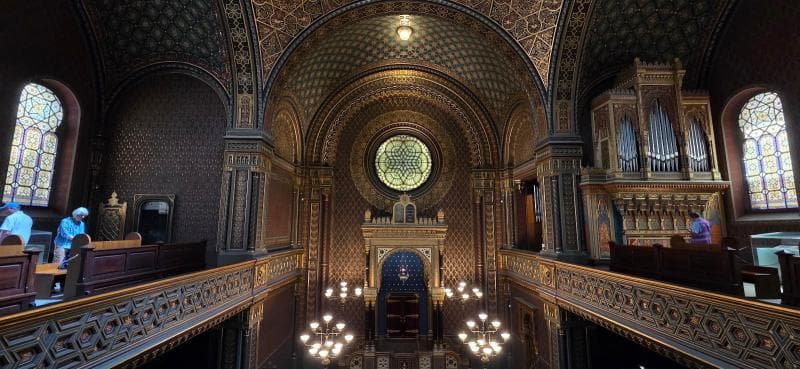
Each site within the museum complex holds unique significance: the Pinkas Synagogue serves as a moving memorial to nearly 80,000 Holocaust victims, with their names inscribed on its walls, and houses an exhibition of children's drawings from the Terezín Ghetto. The Old Jewish Cemetery, with its densely packed, layered graves dating back to the 15th century, is one of the oldest Jewish burial grounds globally, telling a profound story of space constraints and reverence for the deceased. The ornate Spanish Synagogue, often described as one of Europe's most beautiful, showcases the history of Jews in the Bohemian Lands from the 19th and 20th centuries with its stunning Moorish Revival architecture.
Stories, Fun Facts & Local Details
The Jewish Quarter is steeped in legends and meaningful narratives. One of the most famous is the legend of the Golem of Prague, an artificial being said to have been created by Rabbi Loew in the 16th century to protect the Jewish community. The Golem is believed to rest in the attic of the Old-New Synagogue, Europe's oldest continuously active synagogue, which dates back to the 13th century and is separate from the main museum ticket.
Another notable figure connected to this quarter is the celebrated writer Franz Kafka, who was born and lived much of his life in Prague. His spirit, a blend of profound thought and existential questioning, feels intertwined with the historic streets of Josefov. A whimsical statue commemorating him stands near the Spanish Synagogue.
The Old Jewish Cemetery's unique appearance, with thousands of gravestones leaning against each other, is a direct result of historical necessity. As the community was forbidden from expanding the cemetery or burying their dead elsewhere, bodies were buried on top of each other, in layers up to 10 deep, creating an incredibly dense and moving landscape of remembrance.
Visitor Perspective
Exploring the Jewish Museum requires a 'Jewish Town Ticket,' which grants access to most of its sites, including the Maisel, Pinkas, Klausen, and Spanish Synagogues, the Old Jewish Cemetery, and the Ceremonial Hall. The Old-New Synagogue typically requires a separate ticket or is sometimes included in specific guided tours. It is recommended to allow at least two to three hours to visit the sites to fully absorb their significance.
The museum is open year-round, Sunday to Friday, but is closed on Saturdays and all Jewish holidays. To ensure a respectful visit, appropriate attire is requested, with shoulders needing to be covered in all sites. Additionally, men are required to wear a head covering in certain areas, such as the Old Jewish Cemetery and Pinkas Synagogue; kippahs are usually available for loan or purchase. Avoiding the busiest hours, typically between 11 a.m. and 3 p.m., can enhance the experience by allowing for a more serene and contemplative exploration of these deeply resonant historical spaces.
Coordinates: 14.421119, 50.090336
View on Google Maps💬 How Travelers Describe This Place
Based on community votes
Photogenic
623Must See
363Interesting
302Beautiful
250Unique
88
Traveler Stories
Discover memorable experiences shared by travelers who have visited this place.
No traveler stories yet.
Be the first traveler to share what made this place memorable.

Tour
By
Spot
Discover amazing places around the world. Your journey starts here.
Explore
© 2026 TourBySpot. All rights reserved.