Japanese Tea Garden
San Francisco, United States
Discover the Japanese Tea Garden, the oldest public Japanese garden in the United States, nestled in San Francisco's Golden Gate Park. Explore this tranquil oasis of cultural heritage.
Overview
Nestled within the expansive Golden Gate Park in San Francisco, United States, the Japanese Tea Garden offers a tranquil escape, inviting visitors into a meticulously crafted landscape of traditional Japanese beauty. As the oldest public Japanese garden in the United States, it provides a serene oasis of winding paths, ornate structures, and lush greenery. This captivating sub-spot within one of America's most iconic parks is a testament to cultural exchange and enduring design, drawing millions seeking peace and aesthetic inspiration.
History & Cultural Background
The Japanese Tea Garden originated as a 'Japanese Village' exhibit for the 1894 California Midwinter International Exposition, a grand World's Fair held in Golden Gate Park. Its popularity ensured its survival beyond the fair's closure, and Japanese immigrant Makoto Hagiwara was entrusted with its care and development. From 1895 until his passing in 1925, Hagiwara poured his personal wealth and passion into the garden, expanding it from its original one acre to approximately five acres. He imported plants, birds, and koi fish directly from Japan, shaping it into an authentic Japanese stroll garden and incorporating aesthetic principles like miniaturization and asymmetry. The Hagiwara family continued to manage the garden for generations, living on the premises.
However, the garden's history holds a poignant chapter. During World War II, the Hagiwara family, like many other Japanese Americans, was forcibly removed and sent to internment camps under Executive Order 9066. During this period, the garden was renamed 'The Oriental Tea Garden,' and structures were demolished, and its Japanese affiliations were minimized. After the war, the Hagiwara family was not permitted to return to their home in the garden. The city of San Francisco officially restored the garden's original name in 1952 and later, in 1983, acknowledged and offered reparations to the Hagiwara family for their unjust treatment.
What Makes It Special
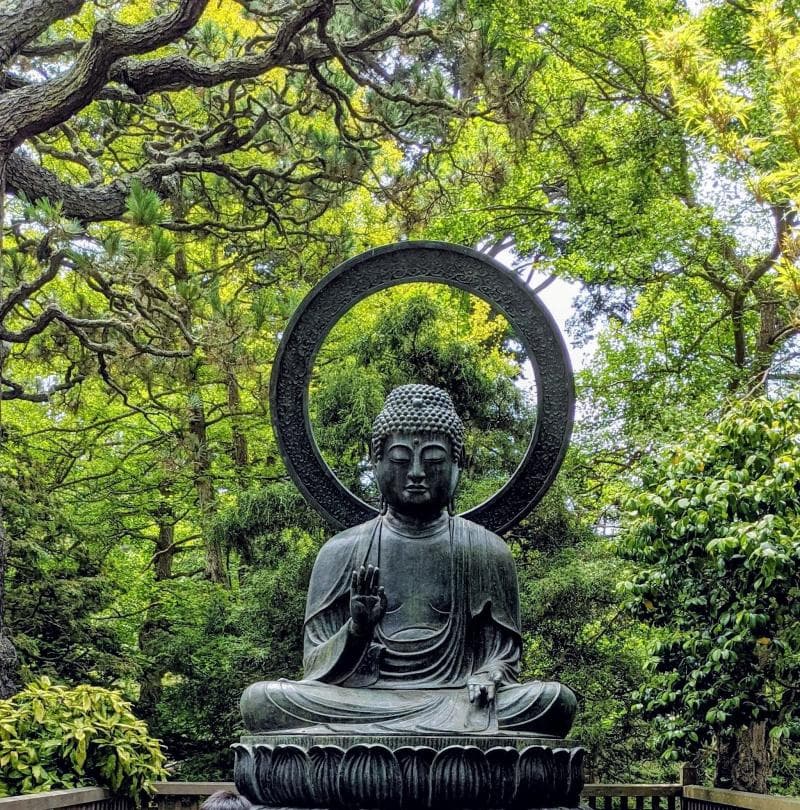
The Japanese Tea Garden is a harmonious blend of natural elements and architectural marvels, designed to evoke tranquility and contemplation. Key features include the iconic arched Drum Bridge (Taiko Bashi), whose crescent shape is said to reflect a full circle in the calm water below. The five-tiered 'Treasure Tower' pagoda, originally built for the 1915 Panama-Pacific International Exposition, stands majestically, representing a Buddhist shrine. Visitors can also admire the large bronze Buddha statue, cast in Japan in 1790 and donated to the garden in 1949, or the 9,000-pound bronze Lantern of Peace, a gift symbolizing friendship between the US and Japan.
The garden's landscape features a 'Karesansui' or dry landscape garden, designed with raked gravel and large stones to represent waterfalls and bodies of water. Throughout the garden, a diverse collection of trees, including flowering cherry trees, azaleas, magnolias, and Japanese maples, create seasonal displays of color. Serene koi ponds with vibrant fish and gently trickling streams further enhance the calming atmosphere, embodying Japanese garden design principles where water plays a significant role in purity and liveliness.
Stories, Fun Facts & Local Details
Makoto Hagiwara's dedication to the Japanese Tea Garden was profound; he personally funded much of its expansion and curated its collections. While often attributed to him, the invention of the fortune cookie in America is a separate, though often associated, San Francisco story. The main entrance gate to the garden is a remarkable piece of traditional Japanese craftsmanship, reportedly constructed without the use of nails. The garden also features a unique clipped hedge shaped to resemble Japan's revered Mount Fuji. Beyond its beauty, the garden serves as a living museum, reflecting the resilience of Japanese American culture despite periods of immense hardship. The efforts to rename it and restore its cultural integrity after World War II highlight the community's fight for recognition and remembrance.
Visitor Perspective
Stepping into the Japanese Tea Garden is an immersive experience designed to slow the pace and encourage appreciation of beauty. Visitors often describe the feeling of being transported to another world, away from the city's bustle. The historic Tea House offers a chance to partake in authentic Japanese teas and light snacks while overlooking a picturesque koi pond. Cherry blossom season, typically in March and April, is a particularly popular time to visit, when the garden is awash in delicate pink blooms. The garden's design with winding paths and distinct 'garden rooms' ensures that there are always new vistas to discover. While it is a popular attraction, moments of solitude can still be found, allowing for quiet contemplation amidst the carefully arranged landscape. The garden is managed by the Gardens of Golden Gate Park, which also oversees the San Francisco Botanical Garden and the Conservatory of Flowers.
Coordinates: -122.470231, 37.770122
View on Google Maps💬 How Travelers Describe This Place
Based on community votes
Beautiful
836Unique
797Photogenic
396Interesting
286Must See
255
Traveler Stories
Discover memorable experiences shared by travelers who have visited this place.
No traveler stories yet.
Be the first traveler to share what made this place memorable.

Tour
By
Spot
Discover amazing places around the world. Your journey starts here.
Explore
© 2026 TourBySpot. All rights reserved.