Interrogation Rooms
Vilnius, Lithuania
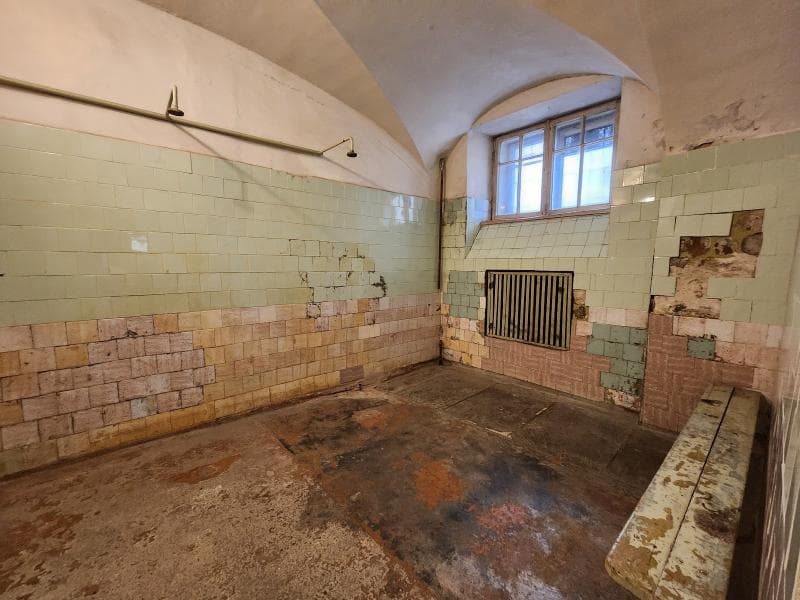
Explore the chilling Interrogation Rooms of the Museum of Occupations and Freedom Fights in Vilnius, Lithuania. Discover authentic KGB cells and learn about Soviet-era repression.
Overview
Deep within the heart of Vilnius, Lithuania, lies the Museum of Occupations and Freedom Fights, a poignant testament to the nation's tumultuous 20th-century history. While the entire museum is a powerful experience, its most evocative and chilling sub-spot is undoubtedly the 'Interrogation Rooms'. Housed in what was once the local headquarters of the Soviet NKVD, NKGB, and later the KGB, these authentic basement cells and chambers offer a stark, unvarnished look into the mechanisms of political repression and resistance during Soviet occupation.
This is not merely an exhibit; it's a preserved historical site where countless individuals, from freedom fighters to ordinary citizens deemed 'suspicious', faced interrogation, torture, and often, death. The museum, sometimes informally referred to as the 'KGB Museum', serves as a vital memorial, ensuring that the stories of those who suffered and fought for Lithuania's independence are never forgotten.
History & Cultural Background
The imposing building housing the museum has a complex past, mirroring Lithuania's turbulent history. Constructed in the late 19th century, it initially served as a courthouse during the Russian Empire. With successive occupations, it became headquarters for various repressive regimes. During World War I, the German Empire utilized it, and in 1941, it housed the Gestapo during Nazi occupation, where opponents were interrogated and imprisoned.
However, it is its role during the nearly 50-year Soviet occupation (1940-1941 and 1944-1991) that most defines the 'Interrogation Rooms'. From the autumn of 1940, the building became the central hub for Soviet security services, including the NKVD, NKGB, and the infamous KGB. Here, anti-Soviet resistance was systematically suppressed, and Lithuanian citizens faced mass arrests, interrogations, and deportations to gulags. The museum was established in 1992, shortly after Lithuania regained independence, to document and commemorate this painful period. Its former name, 'Museum of Genocide Victims', stirred international debate regarding the definition of genocide, leading to its renaming in 2018 to the Museum of Occupations and Freedom Fights, to more accurately reflect its focus on Soviet repression and the Lithuanian resistance.
What Makes It Special
The unique power of the 'Interrogation Rooms' lies in their authenticity. The basement prison cells have been preserved much as they were when the KGB departed in 1991. Visitors walk through the same corridors and step into the very cells where political prisoners were held, offering an almost visceral connection to the past.
Among the grim highlights are the 'boksai' or 'boxes', tiny mini-cells (as small as 1.6 m²) where detainees were forced to stand, sometimes for hours, before processing or interrogation. There are also solitary confinement cells, group cells, and 'water cells' designed to inflict suffering, where prisoners balanced on a small platform in freezing water. A soundproofed cell, where cries of tortured victims would not be heard, further emphasizes the brutality. Perhaps the most harrowing space is the execution chamber in the basement, where over a thousand prisoners were executed between 1944 and the early 1960s. The authenticity of these spaces, with original inscriptions still visible on some cell walls, makes the experience profoundly impactful.
Stories, Fun Facts & Local Details
The walls of these interrogation rooms and cells hold countless silent stories. Inscriptions etched by prisoners, some dating back to the Gestapo occupation of 1942-1944, provide a direct, human connection to those who suffered within these walls. The Soviet-era prison, originally larger with more than 50 cells, was later modified, with some cells converted for KGB archives.
A poignant detail outside the building remembers Petras Vizraras-Vapsva, a partisan who died here in 1953, jumping from the third floor during a KGB interrogation. The original sidewalk tiles mark the spot where he fell. In the execution chamber, objects found in mass graves, such as spent bullet casings, keys, and combs, are displayed under a glass floor, a somber reminder of the victims. After executions, bodies were stacked in the same room before being taken for burial, many in mass graves near Vilnius, including Tuskulėnai.
Visitor Perspective
Visiting the 'Interrogation Rooms' is an intensely moving and often somber experience. The grim, oppressive atmosphere is palpable from the moment one descends into the basement. The minimal and stark exhibits, combined with the raw authenticity of the spaces, force visitors to confront the harsh realities of Soviet repression. It's a journey through a dark chapter of history that provides invaluable insight into the courage of those who resisted and the immense human cost of occupation.
While challenging, the experience is deeply educational, offering a tangible understanding of the institutionalized terror faced by Lithuanians. It's a place for quiet reflection, for honoring the memory of victims, and for gaining a profound appreciation for the freedom that was so hard-won. This museum truly stands as a memorial, ensuring that future generations grasp the importance of freedom and human dignity.
Coordinates: 25.27111, 54.68806
View on Google Maps💬 How Travelers Describe This Place
Based on community votes
Must See
551Interesting
421Photogenic
366Beautiful
298Unique
212
Traveler Stories
Discover memorable experiences shared by travelers who have visited this place.
No traveler stories yet.
Be the first traveler to share what made this place memorable.

Tour
By
Spot
Discover amazing places around the world. Your journey starts here.
Explore
© 2026 TourBySpot. All rights reserved.