Interior Nave
Barcelona, Spain
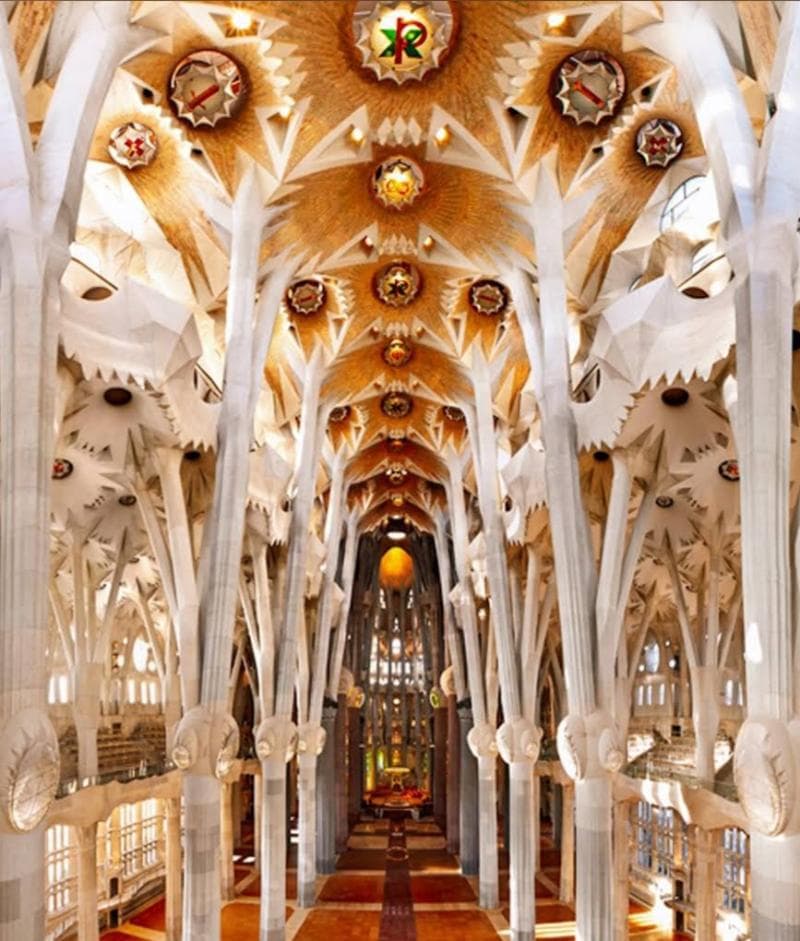
Explore the Sagrada Família's Interior Nave in Barcelona, Spain. Discover Gaudí's unique stone forest, dazzling stained glass, and profound symbolism.
Overview
Stepping into the Interior Nave of the Sagrada Família in Barcelona, Spain, is an experience akin to entering a magnificent stone forest. Antoni Gaudí, the visionary architect, designed this central space to evoke nature's grandeur, blending Gothic and modernist architectural elements into a breathtaking organic structure. The basilica's layout follows the traditional Latin cross plan, comprising a main central nave flanked by two side naves on either side, creating a total of five distinct aisles.
The sheer scale is immediately apparent: the vault of the main nave soars to an impressive 45 meters, while the side aisles reach 30 meters in height. The central nave itself spans 15 meters wide, twice the width of the adjacent 7.5-meter side naves. This harmonious yet colossal design transforms the space into a spiritual realm, inviting visitors to look upwards and contemplate. The meticulous blend of form, light, and symbolism creates an environment that feels both ancient and remarkably contemporary.
History & Cultural Background
Construction of the Sagrada Família commenced in 1882 under architect Francisco de Paula del Villar. However, Antoni Gaudí took over the project in 1883, dedicating the remainder of his life to its realization until his death in 1926. Gaudí’s profound religious faith and deep reverence for nature dramatically transformed the initial neo-Gothic plans. He pioneered a groundbreaking architectural and engineering style, moving beyond traditional Gothic reliance on buttresses and heavy walls. Instead, he developed innovative structural solutions, drawing inspiration directly from natural forms like trees and bones, allowing for an abundance of natural light to flood the interior.
The interior, including much of the nave, was largely completed by 2010. This significant milestone culminated in its consecration as a minor basilica by Pope Benedict XVI on November 7, 2010. The construction of the naves specifically began in 1987, carefully following Gaudí's original models and designs, many of which remarkably survived the Spanish Civil War.
What Makes It Special
The Interior Nave of the Sagrada Família is a testament to Gaudí's genius, characterized by several extraordinary features:
- The Column Forest: Gaudí's signature tree-like columns are perhaps the most striking element. These towering, arboriform columns branch out towards the ceiling, creating a canopy that perfectly mimics a forest, both structurally and aesthetically. This ingenious design distributes the weight of the structure without the need for external flying buttresses, a radical departure from conventional cathedral architecture.
- Dazzling Stained Glass: The stained-glass windows are a masterpiece of light and color. Designed by artist Joan Vila-Grau, they bathe the interior in a constantly shifting kaleidoscope of hues. The coloration is intentional and symbolic: warm tones of yellow, orange, and red dominate the west-facing windows (representing the Passion and resurrection, catching the afternoon light), while cooler blues and greens adorn the east (symbolizing birth and creation, illuminated by morning sun). Gaudí believed light was God's language, and here it actively communicates emotion and meaning.
- Organic Forms and Symbolism: Gaudí meticulously avoided straight lines and conventional angles, infusing the entire space with organic asymmetry found in nature. Every column, vault, and beam carries profound symbolic meaning. For instance, the columns themselves represent saints ascending to heaven, with angels descending to meet them. Even the colors of the stone in the columns are symbolic, with red porphyry for 12-pointed columns and black for 10-pointed ones, indicating structural components and their strength.
Stories, Fun Facts & Local Details
Gaudí's ambition was to create a space that would not just be a church but a metaphorical 'wood' that inspires prayer and facilitates the celebration of the Eucharist. One fascinating detail visitors often discover is the ceramic mosaic with the acronym 'JMJ' (Jesus, Mary, and Joseph) on the floor at the very center of the crossing, echoing its presence on the exterior. The main altar, a focal point of the nave, is remarkably crafted from a massive block of porphyry weighing approximately 7,500 kg, standing as a symbol of steadfast faith.
The height of the vaults progressively increases as one moves from the entrances towards the apse, with all dimensions being precise multiples of 7.5 meters. For example, the central nave reaches 45 meters, while the apse peaks at 75 meters. The church's design also ingeniously incorporates space for a choir capable of holding over 1,500 singers, a testament to its intended role as a vibrant spiritual center.
Visitor Perspective
Visitors consistently describe stepping into the Sagrada Família's Interior Nave as an awe-inspiring moment, often feeling as though they have entered a serene, otherworldly forest rather than a conventional church. Many find the interior to be even more impactful than the famous exterior, thanks to the overwhelming sense of light, color, and scale. Despite the large crowds, a prevailing sense of hushed reverence and peace often fills the space, allowing for deep contemplation.
The constant interplay of light through the stained glass windows is a particular highlight, casting dynamic patterns and colors that shift throughout the day, creating an almost living artwork. For the best experience, many recommend visiting early in the morning to enjoy softer, warmer light and fewer visitors, allowing for a more intimate connection with Gaudí's masterpiece. To ensure a smooth visit, booking tickets online and in advance is highly advised.
Coordinates: 2.1744, 41.4036
View on Google Maps💬 How Travelers Describe This Place
Based on community votes
Unique
826Must See
800Beautiful
387Interesting
242Photogenic
82
Traveler Stories
Discover memorable experiences shared by travelers who have visited this place.
No traveler stories yet.
Be the first traveler to share what made this place memorable.

Tour
By
Spot
Discover amazing places around the world. Your journey starts here.
Explore
© 2026 TourBySpot. All rights reserved.