Inner Chapels
Madrid, Spain
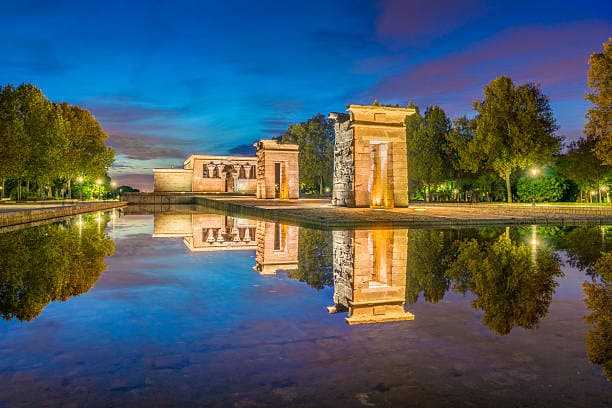
Explore the Temple of Debod's ancient Inner Chapels in Madrid, Spain. Uncover Egyptian history, reliefs, and sacred stories in this unique transplanted temple.
Overview
The Temple of Debod, nestled in the Parque del Oeste in Madrid, Spain, is an extraordinary ancient Egyptian monument with a history stretching back over 2,200 years. It stands as a profound testament to ancient craftsmanship and international cooperation, being one of the rare authentic Egyptian temples found outside of Egypt. Originally constructed in Nubia, south of Aswan, this sacred site was gifted to Spain in 1968 in gratitude for its aid in saving monuments threatened by the Aswan High Dam's construction. The temple's presence in the heart of Madrid offers visitors a unique window into Egyptian history and religious practices, far from its original banks along the Nile. Within its stone walls, the inner chapels reveal intricate details and stories of ancient deities and rituals.
History & Cultural Background
The temple's origins trace back to the early 2nd century BC, when King Adikhalamani of Meroë initiated its construction as a small, single-room chapel dedicated to the Egyptian god Amun. Situated close to the religious center of Philae, dedicated to the goddess Isis, the shrine was later expanded by successive Ptolemaic pharaohs, including Ptolemy VI, Ptolemy VII, and Ptolemy XII, and subsequently by Roman emperors like Augustus and Tiberius, who completed its decoration and further dedicated it to Isis. For centuries, it served as a vital center of worship in Nubia until the 6th century AD, when the region's conversion to Christianity led to its abandonment. The temple's modern journey began in the 1960s, facing submergence due to the Aswan High Dam. Spain's significant contribution to UNESCO's international campaign to save Nubian monuments resulted in Egypt gifting the temple to Madrid. It was meticulously dismantled, transported stone by stone, and then painstakingly reassembled in Madrid between 1970 and 1972, preserving its original east-to-west orientation.
What Makes It Special
What truly distinguishes the Temple of Debod, beyond its remarkable relocation, are its inner sanctums and decorative elements. Visitors can explore the preserved internal structure, including vestibules and chapels that illustrate the evolution of Egyptian religious architecture. Of particular interest is the original 'Adikhalamani Chapel,' considered the oldest part of the temple. Its walls are adorned with reliefs depicting King Adikhalamani making offerings to various Egyptian gods and goddesses, such as Amun and Isis. The central 'Naos' chapel, also known as the Naos Vestibule, housed the sacred image of Isis and was a focal point for religious ceremonies. Another significant internal space is the 'Osiris chapel,' believed to be a roofed chapel located on the temple's terrace, a feature designed to prevent rainwater from entering the sacred space dedicated to Osiris. These inner chapels offer a tangible connection to the spiritual beliefs and practices of ancient Egypt, allowing for a deep immersion into a bygone era.
Stories, Fun Facts & Local Details
The Temple of Debod is steeped in fascinating lore and logistical marvels. Legend suggests that the site where the temple was originally built was believed to be where Isis gave birth to the sky god Horus. The process of relocating the temple was an immense undertaking; it involved cataloging, dismantling, shipping, and rebuilding thousands of stone blocks, some of which were lost or replaced due to the lack of original blueprints. Despite these challenges, the reconstruction aimed to maintain historical accuracy. Today, the temple's reflective pools, when filled, create stunning photographic opportunities, especially at sunset when the monument is beautifully illuminated, casting a magical glow over the water. The Parque del Oeste, where the temple now resides, itself holds historical significance, having been the site of military barracks that played a role in the Spanish Civil War. This blend of ancient Egyptian history with Spanish historical context creates a truly unique cultural landmark.
Visitor Perspective
Exploring the inner chapels and the Temple of Debod provides a profound experience for any curious traveler. Entry to the interior is free, though capacity is limited to around 30 people at a time, with visits typically lasting up to 30 minutes to manage flow and preserve the delicate structure. Inside, visitors can examine the hieroglyphic carvings, ancient reliefs, and informative exhibits that detail the temple's history and its relocation. Audiovisual materials and scale models are often available to enhance understanding of the temple's significance and its decorative motifs. While the exterior, with its picturesque setting and panoramic views of western Madrid, is captivating at any time, arriving near sunset offers an unparalleled spectacle as the temple glows against the evening sky. The Temple of Debod is easily accessible via public transport, making it a convenient and enriching stop on any Madrid itinerary.
Coordinates: -3.71778, 40.4240528
View on Google Maps💬 How Travelers Describe This Place
Based on community votes
Unique
995Photogenic
839Beautiful
603Must See
581Interesting
388
Traveler Stories
Discover memorable experiences shared by travelers who have visited this place.
No traveler stories yet.
Be the first traveler to share what made this place memorable.

Tour
By
Spot
Discover amazing places around the world. Your journey starts here.
Explore
© 2026 TourBySpot. All rights reserved.