Imperial Mausoleum Nearby
Graz, Austria
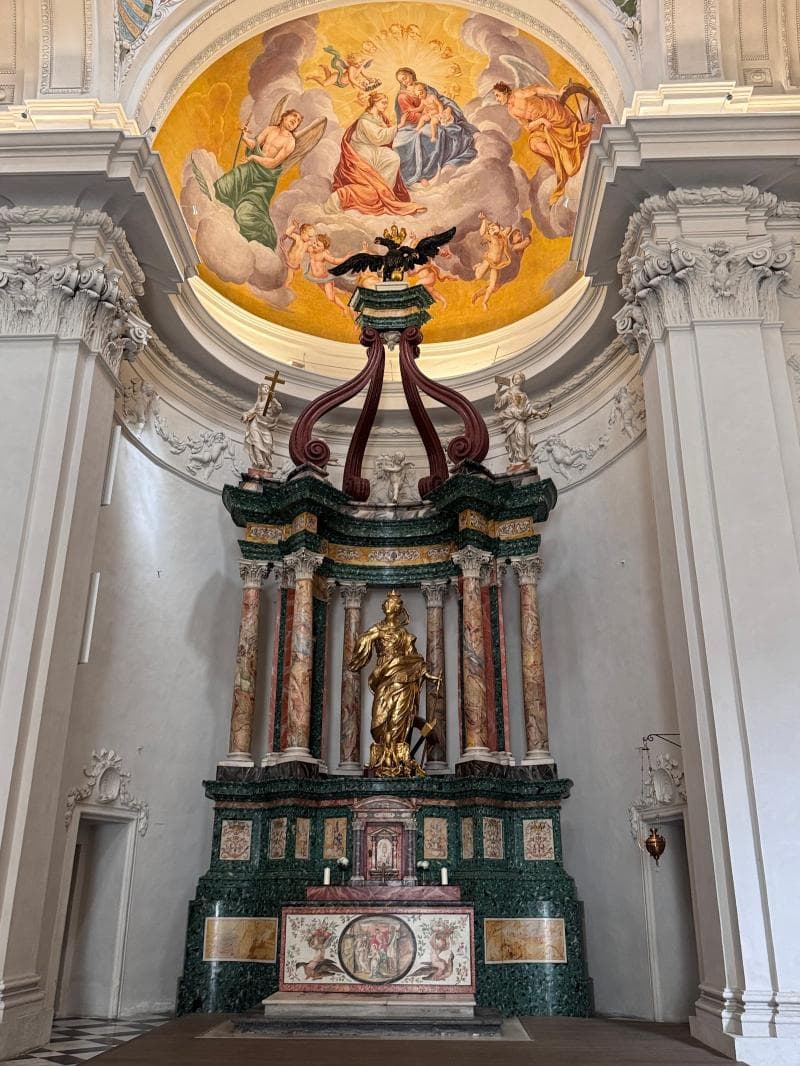
Explore the Imperial Mausoleum of Emperor Ferdinand II in Graz, Austria, a stunning Mannerist and Baroque masterpiece next to Graz Cathedral.
Overview
Nestled beside the revered Graz Cathedral in the historic heart of Graz, Austria, lies the Imperial Mausoleum of Emperor Ferdinand II. This striking architectural ensemble, often simply referred to as the Graz Mausoleum, serves as the final resting place for Holy Roman Emperor Ferdinand II and several members of the Habsburg dynasty. More than just a tomb, it stands as a profound statement of faith and imperial power from the early 17th century. Its distinctive turquoise domes, contrasting beautifully with the Gothic solemnity of the adjacent cathedral, form an integral part of Graz's 'Stadtkrone' or 'Crown of the Town', a landmark that visibly punctuates the city's skyline with its unique blend of Mannerist and early Baroque grandeur. As part of Graz's UNESCO World Heritage Historic Centre, the Mausoleum offers visitors a unique journey through centuries of European history, art, and imperial legacy.
History & Cultural Background
The genesis of the Imperial Mausoleum dates back to 1614, when Archduke Ferdinand II, a staunch proponent of the Catholic Counter-Reformation and future Holy Roman Emperor, commissioned its construction. His vision was to create a dynastic burial site that would also serve as a powerful symbol of renewed Catholic influence in Inner Austria. The architectural genius behind this ambitious project was Giovanni Pietro de Pomis, an Italian court artist and architect, who infused the design with elements characteristic of Southern Mannerism. Construction, however, was not without interruptions. When Ferdinand was elected Emperor in 1619 and subsequently moved to Vienna, the pace of work on the Graz Mausoleum significantly slowed. Consequently, upon his death in 1637, Ferdinand II was interred in a tomb that was still partially unfinished. Decades later, his grandson, Emperor Leopold I, revived the project, entrusting the interior's Baroque embellishment to the young Graz-born architect Johann Bernhard Fischer von Erlach, who would later become a celebrated figure in Austrian Baroque architecture. This protracted construction period, spanning from the early 17th century well into the late 17th century for its interiors, beautifully illustrates the transition from the late Renaissance and Mannerism to the opulent Baroque style.
What Makes It Special
The Mausoleum of Emperor Ferdinand II holds a unique position in architectural history and European heritage for several compelling reasons. Architecturally, it is considered one of Austria's most significant examples of Mannerism, particularly notable for its oval dome above the burial chapel – a design innovation that was the first of its kind to be built outside Italy. This distinctive feature, along with its vivid turquoise domes, makes it instantly recognizable and a focal point of Graz's urban landscape. The ensemble, comprising the Mausoleum and the adjoining St. Catherine's Church (Katharinenkirche), exudes an almost Florentine flair, transporting visitors to a southern European aesthetic amidst the Austrian setting. Beyond its visual appeal, the Mausoleum is a powerful historical artifact. It was conceived as a 'triumphal monument of Catholicism' and a 'symbol of the Counter Reformation,' reflecting Ferdinand II's unwavering commitment to re-establishing Catholic dominance in his lands. This intertwining of religious fervor, imperial ambition, and groundbreaking artistry makes it an unparalleled site for understanding a pivotal era in European history. The interior, completed much later, offers a fascinating contrast, showcasing the transition from Mannerist structure to lavish Baroque decoration, thanks to the contributions of master artists like Giovanni Pietro de Pomis and Johann Bernhard Fischer von Erlach.
Stories, Fun Facts & Local Details
The Mausoleum is rich with stories that bring its historical significance to life. One intriguing detail is that Emperor Ferdinand II, despite commissioning such an elaborate final resting place, was initially laid to rest in a 'half-finished, draughty' tomb, as construction stalled after he became emperor and moved his court to Vienna. It took the dedication of his grandson, Emperor Leopold I, to finally complete the lavish Baroque interiors. The main vault houses the impressive red marble sarcophagus of Ferdinand's mother, Maria of Bavaria, while Emperor Ferdinand's own grave is marked by a surprisingly simple tablet on the wall, highlighting the long, complex journey of the monument's completion. The adjacent St. Catherine's Church was not chosen arbitrarily; St. Catherine is revered as the patron saint of universities, and fittingly, the church overlooks the former Jesuit college where Graz University was founded in 1585. This connection underscores the educational and religious reforms promoted by the Jesuits, strongly supported by Ferdinand II, during the Counter-Reformation. Local lore often refers to the Mausoleum's striking domes as part of the 'Stadtkrone,' a symbolic 'Crown of the City,' alongside the Graz Cathedral and the historic Burg, visually proclaiming Graz's imperial past and its lasting legacy.
Visitor Perspective
A visit to the Imperial Mausoleum offers a profoundly enriching experience for any traveler interested in history, art, and architecture. Situated conveniently next to Graz Cathedral, it forms part of a cohesive historical precinct that can easily be explored together. The exterior immediately captivates with its distinct turquoise domes and intricate Mannerist facade, which some find reminiscent of Italian Renaissance architecture. Inside, visitors are greeted by the solemn grandeur of the burial chapel, adorned with the later Baroque flourishes by Fischer von Erlach, providing a tangible sense of its evolution over time. Entry to the Mausoleum is generally free, making it an accessible historical landmark. While specific opening hours can vary seasonally, it is often open from Tuesday to Sunday, typically from 9 AM to 5 PM, though it is always advisable to check current schedules, especially for winter visits or special events. A thoughtful exploration of the Mausoleum usually takes about 45 to 60 minutes, allowing ample time to appreciate the detailed architecture, the historical narratives within, and the serene atmosphere of this imperial resting place. Combining it with a visit to the adjacent Graz Cathedral makes for a comprehensive dive into Graz's rich cultural tapestry, offering an unparalleled glimpse into a significant chapter of European history.
Coordinates: 15.4422, 47.072
View on Google Maps💬 How Travelers Describe This Place
Based on community votes
Photogenic
915Beautiful
211Interesting
123Unique
74Must See
20
Traveler Stories
Discover memorable experiences shared by travelers who have visited this place.
No traveler stories yet.
Be the first traveler to share what made this place memorable.

Tour
By
Spot
Discover amazing places around the world. Your journey starts here.
Explore
© 2026 TourBySpot. All rights reserved.