House of the Vestals
Rome, Italy
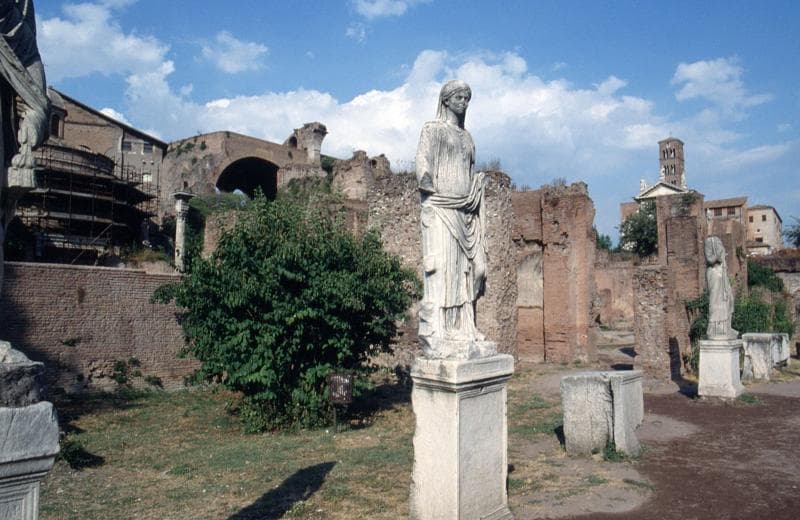
Explore the House of the Vestals in Rome, Italy. Discover the lives of the Vestal Virgins and their vital role in ancient Roman society and religion.
Overview
Nestled within the ancient heart of Rome's Roman Forum, the House of the Vestals, known in Latin as the Atrium Vestae, served as the prestigious residence for the Vestal Virgins. These priestesses were central to Roman religious life, dedicated to the goddess Vesta, the deity of the hearth, home, and family. The House of the Vestals was a sprawling, three-story palace that once comprised around 50 rooms, making it the only permanent residential structure within the bustling Roman Forum. Today, visitors can explore the evocative remains of this significant complex, imagining the daily lives of these powerful women who held immense spiritual and social influence in ancient Rome.
History & Cultural Background
The origins of the Vestal cult and its associated dwelling trace back to Rome's Regal period, with its structure undergoing numerous modifications throughout the centuries, notably under emperors like Augustus and Trajan. The Vestal Virgins themselves were selected at a tender age, typically between six and ten years old, from patrician families. They committed to a sacred 30-year term of service: the first decade dedicated to learning their duties, the second to performing them, and the final decade to teaching new recruits. Their paramount duty was to tend the sacred eternal flame within the nearby Temple of Vesta, a fire believed to symbolize the very continuity and safety of the Roman state. Should this sacred flame extinguish, it was believed to portend disaster for Rome. Beyond fire-keeping, the Vestals safeguarded crucial state documents and revered objects like the Palladium, a statue of Athena believed to protect Rome. Their role afforded them extraordinary privileges, including legal autonomy and the right to own property, unique for women in their era. The complex was extensively rebuilt after the Great Fire of Rome in 64 AD by Emperor Nero, and further renovated and completed by Trajan around 113 AD. The order was eventually dissolved in the late 4th century AD with the advent of Christianity, after which the House served as lodging for imperial and later papal officials before its abandonment in the 11th or 12th century.
What Makes It Special
The House of the Vestals holds a unique place in Roman history as the only permanent residence within the Roman Forum, offering a glimpse into the daily lives of Rome's most influential female priesthood. Its grandeur, with individual residences boasting bathing suites and underfloor heating, highlights the elevated status of the Vestals. The central peristyle courtyard, adorned with statues of former Chief Vestals, creates a poignant atmosphere. These statues, though now disarranged from their original placements, serve as enduring tributes to the women who served Vesta. The site is a powerful reminder of a time when the spiritual well-being of a vast empire was entrusted to a select group of priestesses, making it a cornerstone of Roman religious and civic identity.
Stories, Fun Facts & Local Details
- The Vestal Virgins performed several lesser-known duties, such as collecting ritually pure water from a sacred spring each morning and preparing mola salsa, a special mixture of flour and salt used in various sacrifices.
- They were also entrusted with safeguarding important Roman wills and treaties, acting as a secure archive for significant personal and state documents.
- An intriguing privilege allowed a Vestal Virgin to pardon a condemned criminal if they happened to cross paths, provided the Vestal attested that the encounter was purely by chance.
- Archaeological excavations of the House of the Vestals have unearthed fascinating treasures, including hoards of gold coins from the 5th century CE and even Anglo-Saxon coins from the 9th and 10th centuries, indicating its continued importance and later occupation.
- The statues of the Vestals found in the courtyard were discovered in a pile, meaning their original arrangement and even which pedestal belonged to which statue are now unknown.
Visitor Perspective
Today, a visit to the House of the Vestals offers a tranquil escape within the grand, often bustling, expanse of the Roman Forum. Wandering through the remnants of the central courtyard, surrounded by the evocative statues, one can easily envision the lives of the priestesses who once resided here. The accessible remains allow for contemplation of ancient daily routines, from their private apartments to shared ceremonial spaces. It's a place to connect with the unique history of these powerful women and appreciate their profound impact on Roman society. To fully enjoy your exploration of this site and the wider Roman Forum, it's advisable to wear comfortable shoes, a hat, and sunscreen, as it is an open-air archaeological area.
Coordinates: 12.4868, 41.8914
View on Google Maps💬 How Travelers Describe This Place
Based on community votes
Photogenic
836Must See
287Interesting
255Beautiful
231Unique
86
Traveler Stories
Discover memorable experiences shared by travelers who have visited this place.
No traveler stories yet.
Be the first traveler to share what made this place memorable.

Tour
By
Spot
Discover amazing places around the world. Your journey starts here.
Explore
© 2026 TourBySpot. All rights reserved.