Hollywood Road Façade
Hong Kong, China
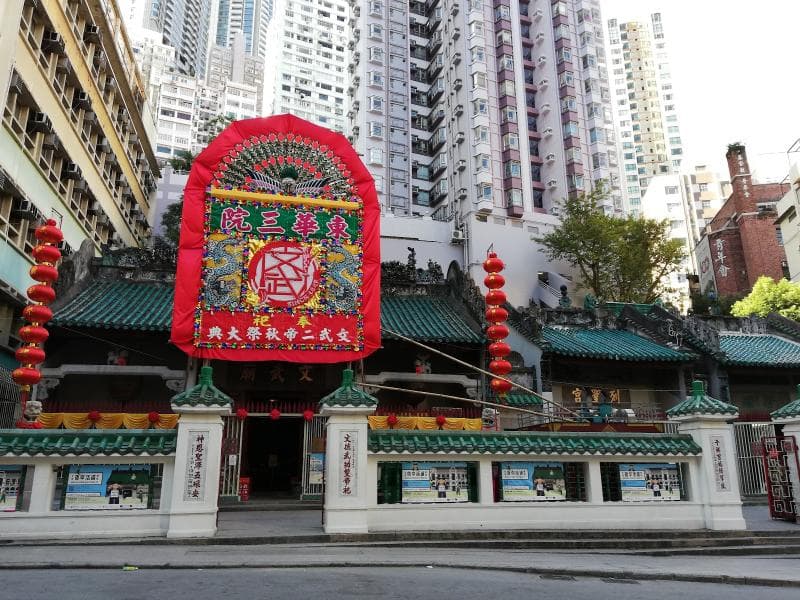

Explore the historic Hollywood Road Façade of Man Mo Temple in Hong Kong, China. Discover its rich history, intricate architecture, and cultural significance.
Overview
The Man Mo Temple, gracefully situated on Hollywood Road in Sheung Wan, Hong Kong, China, stands as one of the city's oldest and most revered sanctuaries. This declared monument is a tranquil escape amidst the urban bustle, embodying centuries of Chinese culture and spiritual practice. The complex itself is not a singular structure but a harmonious trio: the main Man Mo Temple, dedicated to the Gods of Literature and Martial Arts; Lit Shing Kung, a hall for venerating all heavenly deities; and Kung Sor, which historically served as a community assembly hall. The Hollywood Road Façade, therefore, refers to the distinctive exterior that greets visitors, inviting them to step back in time. Its traditional Qing Dynasty architecture, with its iconic green tiled roof and intricate decorations, immediately distinguishes it from the modern skyscrapers that rise around it.
History & Cultural Background
Constructed between 1847 and 1862 during Hong Kong's early colonial period, the Man Mo Temple complex was a vital cultural and spiritual anchor for the growing Chinese community, particularly Cantonese immigrants. Wealthy Chinese merchants funded its establishment, recognizing the need for a place of worship and social support in a foreign-governed territory. Initially managed by local residents, the temple's significance led to its formal entrustment to the Tung Wah Hospital in 1908, under the Man Mo Temple Ordinance. This legal framework cemented its role not only as a religious institution but also as a community and charitable hub. The complex's design, a fine example of traditional Chinese vernacular architecture, reflects the societal values of old Hong Kong, where civil learning and martial prowess were highly esteemed.
What Makes It Special
What makes the Man Mo Temple, and particularly its Hollywood Road Façade, so special is its remarkable preservation and its powerful contrast with modern Hong Kong. The facade itself is a visual feast of traditional Qing Dynasty craftsmanship, featuring a distinctive green tiled roof that gleams under the sun, vibrant red columns, intricately carved granite, wooden plaques, and ornate ceramic figurines that tell stories of Chinese folklore. This sprawling exterior, which subtly divides into three blocks, showcases a two-hall-three-bay structure for the main temple, complete with granite drum platforms. Stepping from the busy Hollywood Road through its ornate entrance is like crossing a threshold into a different era, where the scent of incense replaces the city's sounds, offering immediate sensory immersion.
Stories, Fun Facts & Local Details
The Man Mo Temple is steeped in fascinating stories and local traditions. Its dedication to Man Cheong, the God of Literature, and Mo Tai, the God of Martial Arts, has long made it a pilgrimage site for students and scholars seeking academic success, and for professionals aspiring to career advancement. A particularly resonant tale tells of Lin Sheng, a Qing Dynasty scholar who, after facing repeated failures in his examinations, prayed fervently at Man Mo Temple. He eventually passed, transforming the temple into a symbol of hope for academic achievement. Inside, the temple's most iconic feature is perhaps the thousands of large, spiraling incense coils that hang from the ceiling, slowly burning for days or even weeks. Each coil carries the silent wishes and prayers of worshippers, creating a mystical, smoky atmosphere that is both captivating and deeply spiritual. Historically, the Kung Sor section of the temple was a vital community center where disputes were settled and oaths were taken, sometimes involving ancient rituals like the 'burning of yellow paper' or even the 'chopping off of a chicken's head' to signify the gravity of the declaration. Today, the Tung Wah Group of Hospitals continues to perform traditional Autumn Sacrificial Rites annually, praying for Hong Kong's prosperity.
Visitor Perspective
For any curious traveler, visiting the Man Mo Temple offers a profound journey into Hong Kong's soul. Its accessible location on Hollywood Road, just a short walk from Sheung Wan MTR Station or the Central-Mid-Levels Escalator, makes it an easy cultural highlight to integrate into a day of exploration. Entry is free, allowing everyone to experience its unique ambiance. The moment you approach its distinctive Hollywood Road Façade and step inside, the immediate transition from the modern urban landscape to a serene, ancient sanctuary is striking. The pervasive, earthy scent of incense and the soft glow of light filtering through the temple's interiors create an almost ethereal experience. Visitors can observe locals engaging in traditional rituals, offering a genuine glimpse into living Chinese traditions. It's a place for respectful photography, quiet contemplation, and a deeply meaningful connection to the enduring heritage of Hong Kong, standing as a peaceful counterpoint to the city's dynamic pace.
Coordinates: 114.150181, 22.283884
View on Google Maps💬 How Travelers Describe This Place
Based on community votes
Beautiful
910Must See
755Interesting
658Photogenic
589Unique
374
Traveler Stories
Discover memorable experiences shared by travelers who have visited this place.
No traveler stories yet.
Be the first traveler to share what made this place memorable.

Tour
By
Spot
Discover amazing places around the world. Your journey starts here.
Explore
© 2026 TourBySpot. All rights reserved.