Historic Facade
Odessa, Ukraine
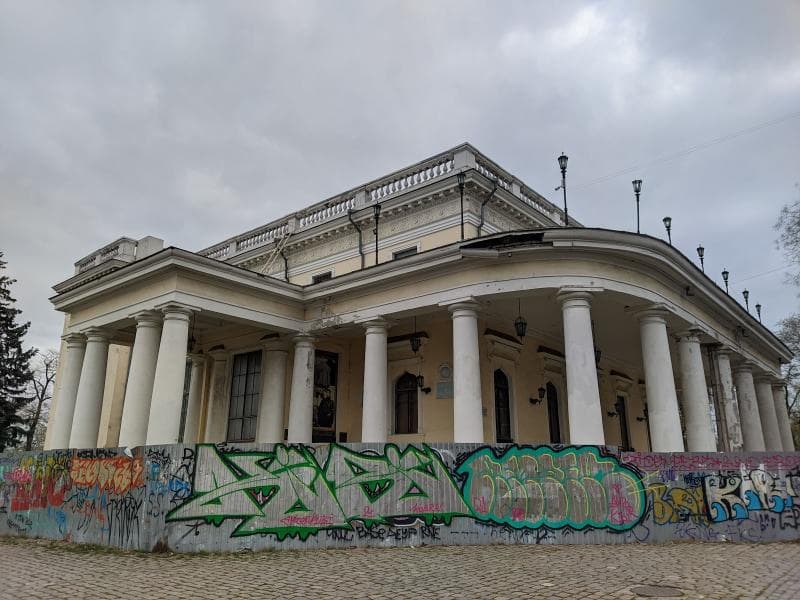
Explore the Historic Facade of Vorontsov Palace in Odessa, Ukraine. Discover its classical architecture, rich history, and stunning Black Sea views.
Overview
Perched majestically at the end of Prymorskyi Boulevard in Odessa, Ukraine, the Historic Facade of the Vorontsov Palace stands as a proud testament to the city's rich past and architectural grandeur. This iconic 19th-century landmark, designed by the celebrated Sardinian-born architect Francesco Boffo, offers a captivating glimpse into Odessa's golden age. Built between 1827 and 1830, the palace was commissioned by Prince Mikhail Semyonovich Vorontsov, the then Governor-General of Novorossiya, to serve as his opulent residence. Its elevated position affords breathtaking views over the Black Sea, making its facade a landmark visible from many vantage points across the coastal district.
The palace complex, originally much larger, now primarily showcases its exquisite main building and the famous Colonnade. This blend of classicism and early romantic influences presents an elegant and refined architectural statement, symbolizing Odessa's burgeoning prosperity and cultural significance during the era. Today, while undergoing periods of reconstruction, the Historic Facade continues to draw the eyes of curious travelers, inviting them to admire its noble outlines and historical charm.
History & Cultural Background
The construction of the Vorontsov Palace between 1827 and 1830 marked a significant period in Odessa's development, replacing a former Turkish fortress on the site. Architect Francesco Boffo, known for many of Odessa's neoclassical masterpieces, imbued the palace with a design reflecting the sophisticated tastes of the early 19th century. It served as the primary residence for the influential Vorontsov family, playing a central role in the city's social and political life.
The palace's facade, however, bears the scars of history. During the Crimean War in 1854, it sustained damage from cannon fire by the Anglo-French fleet. A striking reminder of this tumultuous period is a cannonball still embedded in a wall of what is now the ballet studio on the ground floor. Following the war, the palace was restored, yet its journey through time saw it transform through various roles. In the early 20th century, it housed an engineering school, then became a headquarters for the Soviet Red Guards in 1917, and later, in 1936, was renamed the Children's Palace for the Young Pioneers. Despite these transformations and further damage during World War II, the Historic Facade has largely retained its aristocratic character. Most recently, in 2022, the palace facade and roofing suffered damage from rocket fire, impacting windows and bas-reliefs, underscoring its enduring vulnerability yet also its resilience.
What Makes It Special
The Historic Facade of the Vorontsov Palace is distinguished by its harmonious classical design, featuring graceful lines, arched windows, and intricate decorative details that evoke its illustrious past. The facade, built in the Empire style, was conceived to convey luxury and beauty, a goal masterfully achieved by Francesco Boffo. The carefully planned architectural composition ensures that even today, its noble origins are unmistakable.
Undoubtedly, the most striking feature of the facade is the iconic Vorontsov Colonnade, also known as the Belvedere. This magnificent semi-circular structure, comprising ten pairs of Tuscan order columns, originally served as a greenhouse for growing tropical fruits. It acts as an elegant frame for the panoramic views of the Black Sea and Odessa port, providing an ideal spot for reflection. While much of the original palace complex, such as the Orlov wing, was demolished in 1929, the main facade and its colonnade represent the surviving heart of Boffo's original vision, standing as a testament to early 19th-century architectural prowess in the region.
Stories, Fun Facts & Local Details
Beyond its architectural beauty, the Historic Facade holds many fascinating stories and details. Architect Francesco Boffo's genius extended beyond the palace; he was also responsible for designing Odessa's famous Potemkin Stairs, further cementing his legacy in the city's urban landscape. The palace itself was once home to an exceptionally rich private library, which even the renowned poet Alexander Pushkin utilized during his stay in Odessa. This valuable collection was later donated to the local university, where it remains known as the 'Vorontsov Fund.'
A more contemporary detail can be found in the palace's courtyard: the 'Day and Night' fountain, created by sculptor Mikhail Reva in 1994. Curiously, this sculptural installation has not flowed with water since 1999, adding a touch of enigmatic charm to the grounds. Furthermore, beneath the grand facade lie a network of dungeons, some of which are accessible to visitors through official tours, offering a subterranean adventure into the palace's hidden depths. These layers of history, from its grand design to its hidden corners, enrich the experience of the Historic Facade, revealing the many lives it has lived.
Visitor Perspective
For any traveler exploring Odessa, visiting the Historic Facade of the Vorontsov Palace is an essential experience. It serves as a popular focal point for those keen to immerse themselves in 19th-century architecture and the cultural heritage of the city. The views from the Colonnade are particularly captivating, especially during sunrise or sunset, offering a serene moment to appreciate the vastness of the Black Sea and the bustling port below.
It's important for prospective visitors to be aware that the palace has been undergoing reconstruction. This means that while the majestic exterior remains largely visible and impressive from Prymorskyi Boulevard, interior access may be limited, and parts of the facade might be temporarily obscured by construction fencing. Despite these practical considerations, the enduring beauty and historical significance of the Historic Facade make it a worthwhile destination. It's a place to imagine the opulent balls and political dealings of centuries past, to appreciate the resilience of a structure that has witnessed profound historical shifts, and to simply enjoy a leisurely stroll along one of Odessa's most scenic promenades.
Coordinates: 30.73859, 46.49013
View on Google Maps💬 How Travelers Describe This Place
Based on community votes
Photogenic
753Must See
747Beautiful
302Interesting
172Unique
79
Traveler Stories
Discover memorable experiences shared by travelers who have visited this place.
No traveler stories yet.
Be the first traveler to share what made this place memorable.

Tour
By
Spot
Discover amazing places around the world. Your journey starts here.
Explore
© 2026 TourBySpot. All rights reserved.