Historic Entrance
Split, Croatia
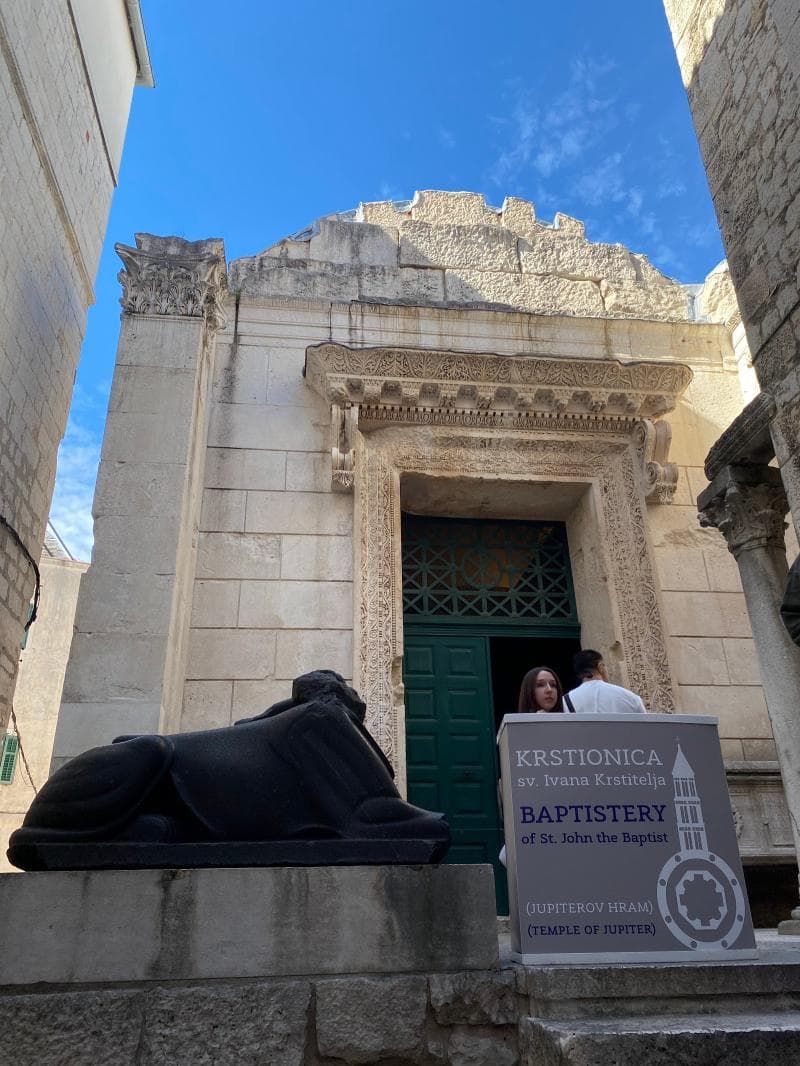
Explore the Historic Entrance of the Temple of Jupiter in Split, Croatia, a marvel of Roman architecture. Discover its rich history and unique sphinx.
Overview
Tucked within the ancient walls of Diocletian's Palace in Split, Croatia, the Historic Entrance to the Temple of Jupiter stands as a remarkable testament to Roman ingenuity and enduring history. This singular entrance leads directly into what was once a grand temple dedicated to Jupiter, the supreme Roman god, and Emperor Diocletian's divine father. Positioned in the western part of the palace complex, adjacent to the bustling Peristyle, this architectural gem offers a direct portal into the spiritual heart of the emperor's retreat. Constructed between 295 and 305 AD, the entrance, along with the temple itself, has witnessed nearly two millennia of transformation, transitioning from a pagan sanctuary to the Christian Baptistery of St. John the Baptist in the 6th century.
History & Cultural Background
The Temple of Jupiter, and by extension its striking entrance, was conceived during the construction of Diocletian's Palace in the late 3rd and early 4th centuries AD. Emperor Diocletian, who viewed himself as a direct descendant of Jupiter, intended this temple as a personal shrine, reinforcing his divine authority and legitimizing his rule. Its strategic placement opposite his mausoleum (today the Cathedral of St. Domnius) underscored this powerful symbolic connection within the meticulously planned palace complex. However, the temple's construction was unexpectedly cut short when Diocletian abdicated in 305 AD, leaving some intricate details unfinished. With the advent of Christianity, the temple underwent a profound transformation around the 6th century, being repurposed as a baptistery. This adaptation marked a significant shift in the religious landscape of Split, reflecting the broader Christianization of the Roman Empire's former territories.
What Makes It Special
The Historic Entrance to the Temple of Jupiter is celebrated as one of the best-preserved Roman temple entrances globally, a true marvel of ancient architecture. Guarding this hallowed threshold is a captivating sphinx, one of twelve brought from Egypt by Emperor Diocletian himself, adding an exotic and ancient mystique to the site. Above the deeply carved doorway, visitors can admire intricate reliefs depicting various Roman gods and heroes, including Victoria, Triton, Helios, Hercules, Jupiter, and Apollo, offering a rich tapestry of mythological storytelling. The doorways themselves are richly decorated, leading into the temple's interior which boasts an impressive barrel-coffered vault. This distinctive ceiling is not only an architectural feat but also notably influenced the early Renaissance art in Dalmatia, particularly the works of artists like Andrea Alessi. The entire structure, particularly its balanced proportions and exquisite details, earned the praise of Scottish architect Robert Adam, who deemed it one of Europe's most beautiful monuments.
Stories, Fun Facts & Local Details
Imagine the spectacle of the sphinx, an ancient Egyptian guardian, standing sentinel at the entrance of a Roman temple in Croatia – a testament to Diocletian's grand imperial vision and his fascination with Egyptian culture. Inside, the temple's transformation into a Christian baptistery introduced new layers of history and artistry. The impressive barrel-vaulted ceiling, admired for centuries, became a source of inspiration for local artists, leaving a lasting mark on regional Renaissance architecture. A fascinating detail inside is the baptismal font, which incorporates an 11th-century altar screen fragment. This font holds a unique distinction as it features one of Europe's earliest known depictions of a Croatian king, possibly King Zvonimir, on a medieval stone sculpture, connecting the Roman past with Croatia's own royal heritage. Additionally, the temple houses sarcophagi containing the remains of Archbishops of Split, Ivan of Ravenna and Lovre, along with a bronze statue of St. John the Baptist by the renowned sculptor Ivan Meštrović.
Visitor Perspective
Approaching the Historic Entrance of the Temple of Jupiter is an immersive journey through time. The elevated podium and the remaining elegant columns of the porch create a sense of anticipation, inviting travelers to step into a space that has silently observed nearly two millennia of human endeavor. As you ascend the worn stone steps, you can almost hear the echoes of Roman citizens who once walked the same path to worship their gods. Today, as part of the UNESCO World Heritage site of Diocletian's Palace, this entrance serves as a poignant gateway, offering a tangible connection to the ancient world. It is a place where every carved stone, every ancient detail, tells a story of empires, beliefs, and artistic mastery, providing a rich cultural experience for anyone curious about Split's layered past.
Coordinates: 16.4396, 43.5083
View on Google Maps💬 How Travelers Describe This Place
Based on community votes
Unique
961Interesting
695Photogenic
605Must See
404Beautiful
336
Traveler Stories
Discover memorable experiences shared by travelers who have visited this place.
No traveler stories yet.
Be the first traveler to share what made this place memorable.

Tour
By
Spot
Discover amazing places around the world. Your journey starts here.
Explore
© 2026 TourBySpot. All rights reserved.