Hercules And Cacus
Florence, Italy
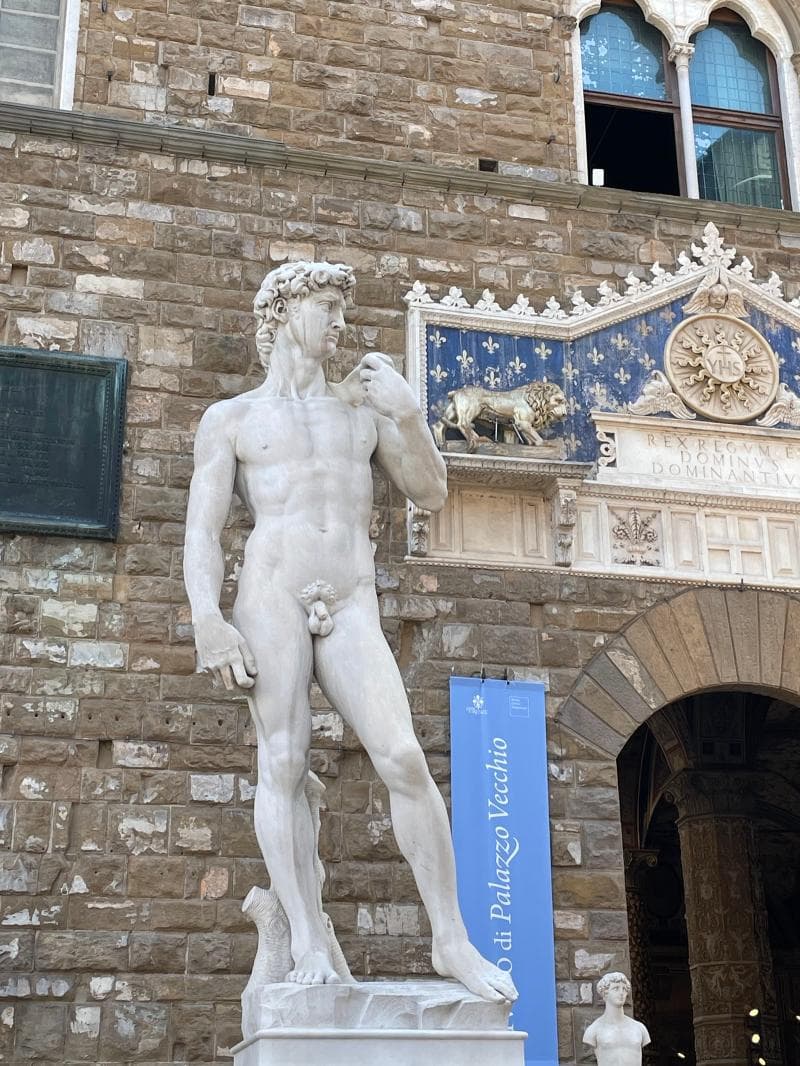
Explore Hercules and Cacus, Baccio Bandinelli's imposing 16th-century marble sculpture in Piazza della Signoria, Florence, Italy. Discover its rich history and political symbolism.
Overview
Positioned prominently at the entrance of the Palazzo Vecchio in Florence's historic Piazza della Signoria, the colossal marble sculpture of 'Hercules and Cacus' stands as a powerful testament to Renaissance artistry and political intrigue. Carved by Baccio Bandinelli between 1525 and 1534, this monumental work depicts the mythical hero Hercules in the act of overpowering the fire-breathing giant Cacus. Standing over five meters tall, the sculpture is a striking presence, often viewed in direct dialogue with Michelangelo's iconic 'David' replica situated nearby, reflecting a complex narrative of power, mythology, and artistic rivalry within the heart of Florence.
History & Cultural Background
The story behind 'Hercules and Cacus' is deeply intertwined with Florence's tumultuous political landscape and the intense artistic rivalries of the 16th century. The commission for a colossal sculpture to complement Michelangelo's 'David' was initially given to Michelangelo himself in 1508 by the Florentine Republic, which had recently expelled the powerful Medici family. This earlier 'David' symbolized republican freedom, and a new work was intended to further solidify this anti-Medici sentiment. However, the large marble block meant for Michelangelo was not delivered until 1525, by which time the Medici had returned to power. Pope Clement VII, a Medici, then intervened, reassigning the prestigious commission to his favored sculptor, Baccio Bandinelli, much to the chagrin of Michelangelo.
Bandinelli's work began in 1525, but was interrupted in 1527 when the Medici were again briefly expelled from Florence during the Sack of Rome. During this republican interlude, there were even attempts to reassign the block back to Michelangelo. However, with the final return of the Medici in 1530 and the installation of Alessandro de' Medici as Duke, Bandinelli resumed work, completing the sculpture in 1534. The sculpture’s subject, Hercules triumphing over the villainous Cacus, was deliberately chosen by the Medici to symbolize their restored power and authority over the city, with Hercules representing the ruling family and Cacus embodying the vanquished republican factions.
What Makes It Special
'Hercules and Cacus' is special not just for its artistic merit, but for its profound political symbolism and its place in the vibrant, competitive atmosphere of Renaissance Florence. Standing as a counterpoint to 'David', it creates an undeniable visual and thematic tension in the Piazza della Signoria.
Artistically, Bandinelli’s work exemplifies the Mannerist style, characterized by its exaggerated musculature, dramatic poses, and a certain theatricality that departed from the more idealized forms of the High Renaissance. Hercules' powerful, almost over-the-top physique, and Cacus's tormented expression convey a raw, physical struggle that was intended to impress upon onlookers the Medici's strength and their resolve to crush any rebellion. The mythological narrative itself, often less known today, was highly relevant in ancient Rome and 16th-century Florence, representing a civilizing hero overcoming chaos and evil.
Stories, Fun Facts & Local Details
The unveiling of 'Hercules and Cacus' in 1534 was met with widespread derision and criticism from the Florentine public and fellow artists. Many viewed it as inferior to Michelangelo's 'David' and as a symbol of the Medici's authoritarian rule rather than a celebration of art. Over a hundred satirical poems were reportedly plastered onto its base, mocking Bandinelli's skill and the sculpture's perceived awkwardness. Even esteemed contemporaries like Benvenuto Cellini and Giorgio Vasari offered unflattering remarks, further fueling the controversy.
One well-known anecdote relates that Bandinelli himself, after seeing the sculpture installed in the vast piazza next to 'David', felt the muscles appeared 'too soft' and later attempted to exaggerate them further, even erecting a screen around the statue to do so. In a 'crazy fact' uncovered during a 1994 restoration, it was discovered that Hercules' original bronze club had been replaced with one made of aluminum. Furthermore, contrary to the ideal of carving from a single block, restorations revealed that Bandinelli's 'Hercules and Cacus' is actually composed of no fewer than twenty pieces of marble, a fact that would have been a point of contention with artists like Michelangelo, who championed the 'ex uno lapide' (from one stone) method.
Visitor Perspective
When you stand in Piazza della Signoria, take a moment to observe 'Hercules and Cacus' not just as a standalone artwork, but as part of a larger historical and artistic ensemble. Located to the right of the Palazzo Vecchio's entrance, it directly faces the replica of Michelangelo's 'David'. Notice the stark stylistic contrast between Bandinelli's more forceful, Mannerist interpretation and the serene, classical balance of 'David'.
Walk around the sculpture to fully appreciate its scale and the intense expressions of the figures. From one angle, you might discern Hercules's triumphant gaze, while from another, Cacus's agony becomes more apparent. The interplay of light and shadow throughout the day can dramatically alter its appearance, particularly in the morning when the square is bathed in sunlight. Engaging with 'Hercules and Cacus' offers a unique opportunity to delve into the complex layers of art, power, and public opinion that shaped Renaissance Florence, inviting you to ponder the messages etched in stone centuries ago.
Coordinates: 11.255459807735717, 43.7696312460687
View on Google Maps💬 How Travelers Describe This Place
Based on community votes
Unique
836Interesting
797Photogenic
286Beautiful
255Must See
86
Traveler Stories
Discover memorable experiences shared by travelers who have visited this place.
No traveler stories yet.
Be the first traveler to share what made this place memorable.

Tour
By
Spot
Discover amazing places around the world. Your journey starts here.
Explore
© 2026 TourBySpot. All rights reserved.