Harpa Facade
Reykjavik, Iceland
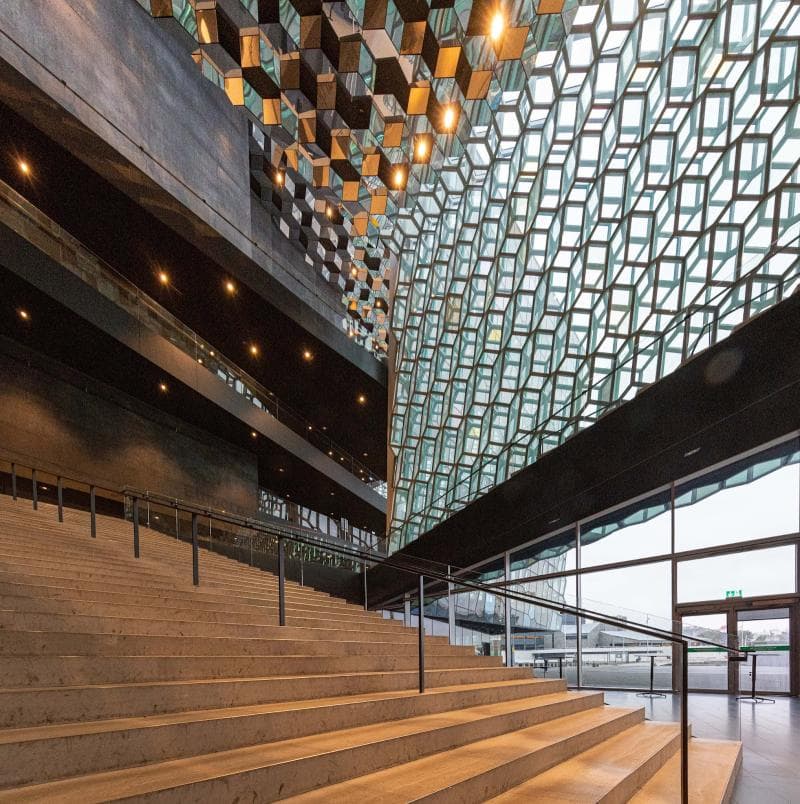
Discover Harpa Facade in Reykjavik, Iceland – a stunning glass masterpiece inspired by basalt landscapes, changing with light and weather.
Overview
The Harpa Facade, an extraordinary architectural marvel, envelops the Harpa Concert Hall and Conference Centre in Reykjavik, Iceland. This striking glass and steel structure is much more than a mere exterior; it is a dynamic work of art that constantly interacts with its surroundings, reflecting the ever-changing Icelandic light and weather. Located gracefully on the waterfront in the heart of downtown Reykjavik, the Harpa Facade offers breathtaking panoramic views of Faxaflói Bay and the majestic Esjan mountain range, creating a seamless connection between urban life, culture, and Iceland's raw natural beauty. Opened in 2011, Harpa quickly became one of Iceland's most iconic landmarks and a vibrant cultural hub. Its unique design has garnered international acclaim, including the prestigious Mies van der Rohe Award in 2013.
History & Cultural Background
The journey to realize a dedicated concert hall in Reykjavik was a long one, with discussions dating back to the late 19th century. Construction of what would become Harpa officially began in 2007. However, the project faced significant hurdles almost immediately when the global financial crisis hit Iceland particularly hard in 2008. For a period, the half-built structure stood as an uncertain symbol, but the Icelandic government and the people made a resolute decision to fully fund and complete it. This commitment transformed Harpa into a powerful emblem of national resilience and recovery, a testament to Iceland's dedication to art and culture even in times of adversity. The building was formally inaugurated on May 13, 2011, and its distinctive glass facade's first public light show graced Reykjavik's Culture Night on August 20, 2011.
What Makes It Special
The Harpa Facade's undeniable uniqueness stems from its innovative design, a collaborative masterpiece by Danish firm Henning Larsen Architects and renowned Danish-Icelandic artist Olafur Eliasson. Eliasson's contribution, specifically the facade's artistic concept, was inspired by Iceland's dramatic basalt landscape, particularly the crystalline, interlocking columnar basalt formations found across the country. The structure comprises thousands of geometric glass panels, termed 'quasi-bricks,' which form a modular, space-filling system. The main south facade alone features over 1,000 twelve-sided quasi-brick units, while the other facades incorporate two-dimensional variations. These quasi-bricks, originally developed by geometer and mathematician Einar Thorsteinn, are polyhedrons with rhomboidal and hexagonal faces that stack without gaps. Each panel is crafted with color-effect filter glass, also known as dichroic glass, which dynamically changes its hue depending on the angle of light and the viewer's position. This creates a shimmering, iridescent appearance that reflects the surrounding environment—the sea, sky, and city—like a giant, ever-evolving kaleidoscope.
Stories, Fun Facts & Local Details
The name 'Harpa' itself holds cultural significance; it is an Old Norse word that refers to the musical instrument, a harp, but also to a month in the Old Norse calendar that signifies the beginning of spring and the first day of summer in Iceland. This dual meaning beautifully links the building's musical purpose with the natural cycles of the Icelandic year. At night, the Harpa Facade truly comes alive. It is embedded with 714 LED lights (486 on the eastern side and 228 on the western side) that illuminate the quasi-bricks in a stunning array of colors and patterns. Olafur Eliasson specifically designed a video work for these lights, and in 2021, for Harpa's 10-year anniversary, he created 12 new light installations, one for each month of the year, ensuring the facade offers a fresh visual experience throughout the seasons. This nightly display transforms the building into a beacon of light, dancing against the dark North Atlantic sky and sometimes even complementing the natural spectacle of the Northern Lights.
Visitor Perspective
For visitors to Reykjavik, the Harpa Facade is an unmissable attraction, offering a constantly fresh perspective depending on the time of day and the prevailing weather conditions. During daylight hours, the facade reflects the Arctic light, clouds, and the harbor, creating stunning photo opportunities and a sense of being 'inside a crystal' when viewed from within. As evening approaches and darkness falls, the integrated LED lights transform the building into a luminous, shimmering spectacle. Many suggest visiting both during the day and at night to fully appreciate its dynamic transformation. Harpa is freely accessible to the public, allowing anyone to step inside and experience the interplay of light and space in its expansive foyer. From the interior, the facade frames the outside world like a living canvas, reflecting the bustling city and the serene bay. Its location by the Old Harbour also makes it easy to combine a visit with other nearby attractions in downtown Reykjavik. The building is not just a visual treat; it's a living part of the city's cultural pulse, often hosting events by the Iceland Symphony Orchestra and other performances that echo its vibrant exterior.
Coordinates: -21.93286, 64.1504
View on Google Maps💬 How Travelers Describe This Place
Based on community votes
Unique
848Beautiful
830Interesting
797Must See
410Photogenic
100
Traveler Stories
Discover memorable experiences shared by travelers who have visited this place.
No traveler stories yet.
Be the first traveler to share what made this place memorable.

Tour
By
Spot
Discover amazing places around the world. Your journey starts here.
Explore
© 2026 TourBySpot. All rights reserved.