Hall Of Prayer For Good Harvests
Beijing, China
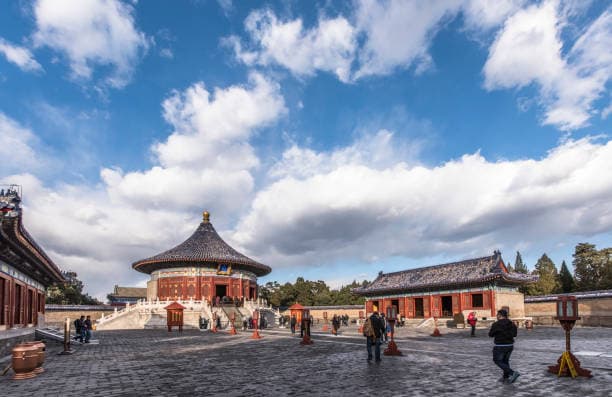
Explore the Hall of Prayer for Good Harvests, an architectural marvel within Beijing's Temple of Heaven. Discover its rich history and cultural significance.
Overview
Nestled within the vast grounds of the Temple of Heaven complex in Beijing, China, stands the magnificent Hall of Prayer for Good Harvests. This iconic structure, known in Chinese as Qinian Dian, is arguably the most recognizable symbol of the entire Temple of Heaven and a marvel of ancient Chinese architecture. It served as the sacred site where emperors of the Ming and Qing dynasties would conduct elaborate ceremonies, praying to Heaven for abundant harvests and national prosperity.
The Hall of Prayer for Good Harvests is a breathtaking triple-gabled, circular wooden building, resting majestically on a three-tiered marble stone base. Its vibrant blue-tiled roof and distinctive conical shape immediately capture attention, embodying a profound connection to celestial reverence.
History & Cultural Background
The story of the Hall of Prayer for Good Harvests dates back to the Ming Dynasty. Construction of the Temple of Heaven complex, including this area, began in 1420 during the 18th year of Emperor Yongle's reign. Initially, the hall was square in shape and used for joint sacrifices to both Heaven and Earth, resembling the Temple of Heaven in Nanjing.
A significant change occurred in 1530 during the Jiajing reign when Emperor Jiajing decreed that Heaven and Earth should be worshipped separately. This led to the reconstruction of the hall into its current circular form, dedicated solely to spring prayers for bountiful harvests and favorable weather, and it was renamed the 'Prayer for Grain Altar'. During renovations in 1751, under Emperor Qianlong, it was officially given its present name, the 'Hall of Prayer for Good Harvests', and all three tiers of its eaves were unified with blue glazed tiles, a design that persists today.
Tragically, the original hall was destroyed by a lightning strike in 1889. However, it was meticulously rebuilt in the following years, largely preserving its fundamental structure and design, a testament to the enduring architectural traditions.
What Makes It Special
The Hall of Prayer for Good Harvests is a masterpiece of wooden construction, famously built without a single iron nail. Its structural integrity relies on an intricate system of wooden mortise-and-tenon joints, showcasing the advanced craftsmanship of ancient artisans. The hall stands 38 meters (125 feet) tall and 36 meters (118 feet) in diameter, built upon a three-tiered circular marble terrace.
Its unique circular form and three-tiered roof are deeply symbolic, reflecting the traditional Chinese cosmological concept of 'Round Heaven and Square Earth'. The circular shape represents Heaven, while the square base of the surrounding complex represents Earth. The three levels of the roof are covered with blue glazed tiles, symbolizing the vastness and depth of the sky.
Stories, Fun Facts & Local Details
The interior of the Hall of Prayer for Good Harvests holds a fascinating layer of symbolism. The structure is supported by 28 massive wooden pillars, each with specific meanings. The four central 'Dragon Well' pillars represent the four seasons: spring, summer, autumn, and winter. The 12 inner pillars symbolize the 12 months of the year, and the 12 outer eave pillars represent the 12 traditional Chinese hours of the day. Combined, the 24 inner and middle pillars also represent the traditional solar terms.
This ingenious numerological symbolism within the architecture demonstrates the profound integration of ancient Chinese religion, philosophy, and astronomical understanding. The absence of crossbeams within the dome, relying instead on interlocking brackets, is another testament to the architectural genius that allowed the structure to withstand centuries.
Visitor Perspective
The Hall of Prayer for Good Harvests is a must-see destination for any traveler to Beijing. It is the focal point of the Temple of Heaven Park, a UNESCO World Heritage site since 1998. Visitors can purchase a combo ticket that includes entry to the Hall of Prayer for Good Harvests, the Imperial Vault of Heaven, and the Circular Mound Altar, offering a comprehensive experience of the complex.
To truly appreciate the tranquility and intricate details of the hall, it is often recommended to visit early in the morning when the park is less crowded, and locals can be seen performing Tai Chi and other activities. The Hall of Prayer for Good Harvests stands as a powerful reminder of China's imperial past, its deep cultural reverence for Heaven, and the incredible ingenuity of its ancient builders.
Coordinates: 116.4066, 39.8822
View on Google Maps💬 How Travelers Describe This Place
Based on community votes
Interesting
836Photogenic
797Unique
255Must See
231Beautiful
86
Traveler Stories
Discover memorable experiences shared by travelers who have visited this place.
No traveler stories yet.
Be the first traveler to share what made this place memorable.

Tour
By
Spot
Discover amazing places around the world. Your journey starts here.
Explore
© 2026 TourBySpot. All rights reserved.