Hall Of Heavenly Kings
Beijing, China
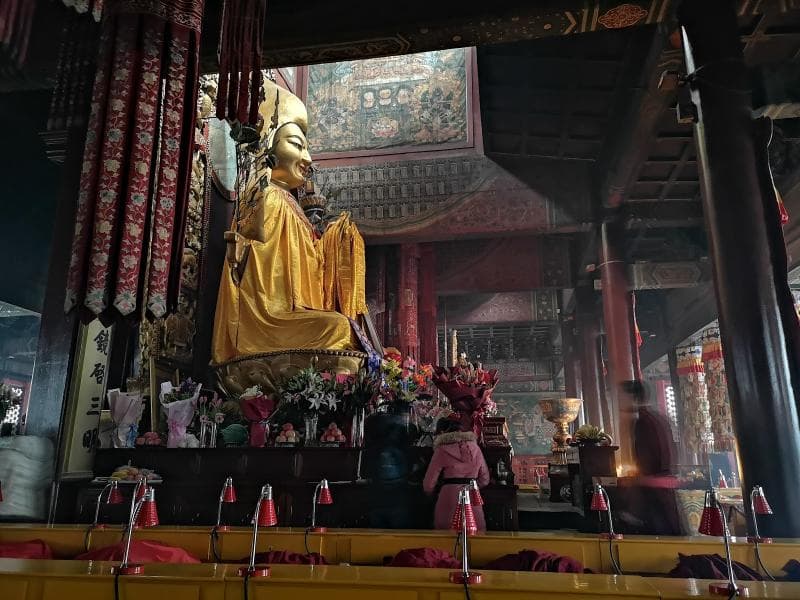
Discover the Hall of Heavenly Kings (Tianwangdian) at Beijing's Lama Temple, an imperial-turned-Buddhist sanctuary with stunning statues and rich history.
Overview
The Hall of Heavenly Kings, known in Chinese as Tianwangdian, serves as the majestic first main hall greeting visitors to the renowned Lama Temple, or Yonghegong, in Beijing, China. As you step through its grand entrance, you are immediately enveloped in an atmosphere of spiritual reverence and historical grandeur. This pivotal hall houses the benevolent statue of Maitreya Buddha, often depicted with a smiling countenance, poised at the center to welcome all who enter. Flanking this central figure are the imposing and colorful statues of the Four Heavenly Kings, also referred to as the Celestial Guardians, each standing watch over one of the cardinal directions. Historically, this hall once functioned as the principal entrance to what was originally an imperial palace, setting a profound tone for the spiritual journey that unfolds deeper within the temple complex.
History & Cultural Background
The Lama Temple itself boasts a rich and transformative history. Its origins trace back to 1694 when it was constructed as the residence for Prince Yong, who would later ascend to the throne as the Yongzheng Emperor during the Qing Dynasty. After his enthronement, the complex underwent a significant metamorphosis, first becoming a temporary imperial palace and then, in 1744 under the reign of Emperor Qianlong, it was formally converted into a lamasery, a monastery dedicated to Tibetan Buddhism. This transformation underscored the Qing Dynasty's strategic efforts to foster stronger ties with Tibetan and Mongolian regions by promoting Tibetan Buddhist practices. The Hall of Heavenly Kings, in particular, was originally designed as the main gateway to Yongzheng's imperial living quarters. The temple's architecture is a fascinating blend of Han Chinese and Tibetan styles, a testament to its dual imperial and spiritual heritage. The distinctive yellow roof tiles, traditionally reserved for imperial buildings, proudly proclaim its past as a royal residence.
What Makes It Special
What truly distinguishes the Hall of Heavenly Kings is its profound symbolic and artistic significance. At its heart, the smiling Maitreya Buddha, often known as the 'Laughing Buddha,' extends a warm welcome, embodying the joy and compassion central to Buddhist teachings. Surrounding Maitreya, the four formidable statues of the Heavenly Kings stand as guardians of the Dharma. Each king is meticulously crafted, holding distinct symbolic objects like a sword, an umbrella, a lute, or a dragon, which represent concepts such as harmonious winds, timely rains, national peace, and public well-being. These intricate details convey deep philosophical meanings to the observant traveler. The hall's ornate roof tiles, rich with traditional Chinese craftsmanship, and its detailed murals further contribute to its unique aesthetic. As the initial major hall, it serves a crucial role in preparing visitors for the spiritual reverence and artistic wonders that await them deeper within the Lama Temple, guiding them from the bustling outside world into a sacred space.
Stories, Fun Facts & Local Details
Within Buddhist cosmology, Maitreya is revered as the fifth Buddha of the current age, destined to appear on Earth to achieve complete enlightenment. His depiction here as the 'Laughing Buddha' adds a touch of relatable humanity and optimism to the spiritual narrative. A fascinating local detail is that the Four Heavenly Kings are sometimes collectively referred to as 'Fēng Tiáo Yǔ Shùn,' which translates to 'Good Climate,' symbolizing their role in ensuring favorable weather and prosperity. The Lama Temple itself holds a unique distinction as the birthplace of Emperor Qianlong, making it a 'blessed land for dragons' – a term that reflects its imperial origins and the auspiciousness associated with two emperors having lived within its walls. Moreover, inscriptions found on stelae throughout the temple, including potentially in this hall, are often carved in four languages – Manchurian, Chinese, Tibetan, and Mongolian – highlighting the diverse cultural influences and the Qing Dynasty's broad imperial reach. The architectural progression through the various halls of the Lama Temple, beginning with the Hall of Heavenly Kings, is intentionally designed to guide visitors on a metaphorical journey from the secular to the sacred, becoming increasingly intimate and serene with each step.
Visitor Perspective
Approaching the Hall of Heavenly Kings, visitors are often first greeted by a pair of bronze lions, traditional guardians at the temple's entrance. Stepping inside, the sheer scale and intricate artistry immediately command attention, inspiring a sense of awe. The tranquil yet powerful presence of the Maitreya Buddha and the formidable gaze of the Heavenly Kings create a solemn and respectful atmosphere, encouraging quiet contemplation from the outset of the visit. Many visitors find the hall to be an essential starting point, not only for its historical significance but also for the spiritual introduction it provides to the broader temple complex. The subtle scent of incense and the occasional sight of prayer wheels turning contribute to an immersive cultural experience that deepens one's understanding of Tibetan Buddhism. The Hall of Heavenly Kings is more than just a building; it is the threshold to an extraordinary journey through faith, history, and art, making it an unforgettable highlight of any visit to the Lama Temple in Beijing.
Coordinates: 116.417222, 39.949167
View on Google Maps💬 How Travelers Describe This Place
Based on community votes
Unique
989Beautiful
613Photogenic
603Interesting
581Must See
207
Traveler Stories
Discover memorable experiences shared by travelers who have visited this place.
No traveler stories yet.
Be the first traveler to share what made this place memorable.

Tour
By
Spot
Discover amazing places around the world. Your journey starts here.
Explore
© 2026 TourBySpot. All rights reserved.