Hall Of Harmony And Peace
Beijing, China
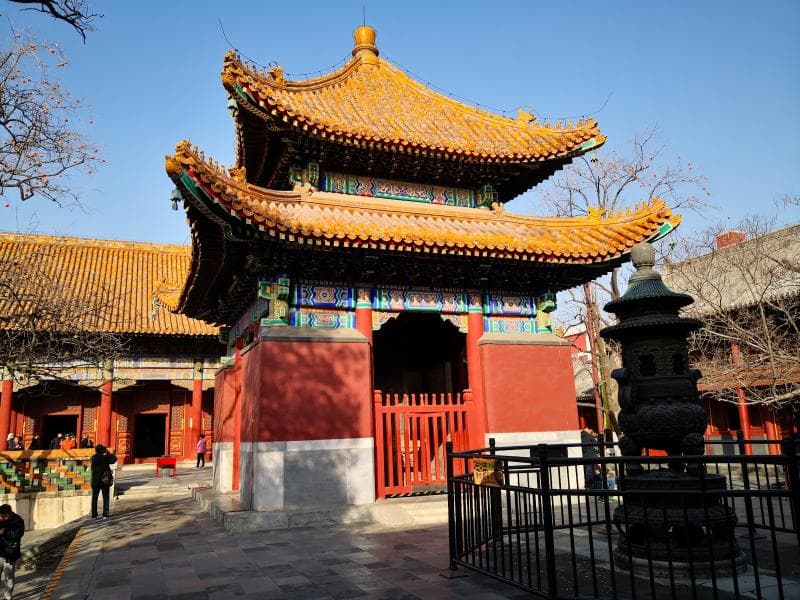
Explore Beijing's Hall of Harmony and Peace inside Lama Temple. Discover its imperial history, Tibetan Buddhist art, and serene atmosphere in China.
Overview
Nestled in the bustling heart of Beijing, the Lama Temple, known locally as Yonghegong, stands as a profound testament to Tibetan Buddhist culture and Chinese imperial history. Within its sacred grounds, the Hall of Harmony and Peace, or Yonghegong Hall, serves as a central and deeply significant structure. This revered site began its life not as a monastery, but as an imperial residence, before evolving into one of the largest and best-preserved Tibetan Buddhist monasteries outside of Tibet. Its unique blend of Han Chinese and Tibetan architectural styles offers visitors a glimpse into a rich cultural tapestry, providing a calm and reflective space amidst the vibrant energy of China's capital.
History & Cultural Background
The story of the Lama Temple, and by extension the Hall of Harmony and Peace, begins in 1694 during the Qing Dynasty, when it was constructed as the residence for Prince Yong, Yin Zhen, the fourth son of the Kangxi Emperor. Upon Prince Yong's ascension to the imperial throne as the Yongzheng Emperor in 1722, his former residence took on heightened significance, becoming a temporary imperial dwelling and shrine.
A pivotal transformation occurred in 1744 under the reign of his son, the Qianlong Emperor. The complex was formally converted into a lamasery, a monastery dedicated to the Gelug school of Tibetan Buddhism. This conversion was not merely a religious act but also a strategic political move aimed at strengthening ties between the Qing court and the Tibetan and Mongolian regions. To underscore its imperial importance, the original turquoise roof tiles were replaced with the distinctive yellow tiles, traditionally reserved for imperial buildings, signifying its elevated status. Over centuries, the Lama Temple flourished, serving as a national center for Lama administration and becoming an active spiritual hub where monks continue to practice and teach. Remarkably, the temple survived the tumultuous Cultural Revolution, reportedly due to the direct intervention of Premier Zhou Enlai, preserving its historical and religious integrity.
What Makes It Special
The Hall of Harmony and Peace (Yonghegong Hall) stands as the principal edifice within the Lama Temple complex, drawing visitors with its profound spiritual and artistic treasures. Inside, one is immediately struck by three magnificent bronze statues representing the Buddhas of the Three Ages. The Gautama Buddha, symbolizing the present, occupies the central position. Flanking him are Dīpankara Buddha, representing the past, on the right, and Maitreya Buddha, the Buddha of the future, on the left. These figures command reverence and embody the cyclical nature of Buddhist philosophy.
Adding to the hall's sacred atmosphere, statues of the eighteen Arhats, revered disciples of Buddha, line the sides, each uniquely expressive. A vibrant mural depicting the bodhisattva Avalokitesvara further enriches the spiritual narrative of the space. Historically, this hall served as a place where Emperor Yongzheng would hold important meetings, infusing it with layers of imperial legacy alongside its religious sanctity. The seamless blend of Han Chinese architectural grandeur with intricate Tibetan Buddhist artistic details makes the Hall of Harmony and Peace a truly distinctive and captivating destination.
Stories, Fun Facts & Local Details
Beyond its grand facade, the Hall of Harmony and Peace and the wider Lama Temple complex are rich with captivating stories and cultural nuances. A fascinating fact is that the Qianlong Emperor, who transformed the palace into a lamasery, was actually born and grew up within these very walls. This personal connection adds a unique layer of imperial history to its spiritual purpose.
Unlike many historical temples in Beijing that have been secularized or converted into museums, the Lama Temple remains a vibrant, active place of worship. Visitors can witness monks engaged in daily rituals and local worshippers burning incense, maintaining a tangible connection to its living spiritual heritage. The air inside the temple often carries the sweet, lingering scent of incense, freely provided to visitors for offerings. For a truly immersive experience, plan your visit for the 1st or 15th day of the lunar month, when monks conduct captivating chanting ceremonies, filling the halls with resonant sounds that transport you to another realm. Look closely at the steles throughout the complex; their inscriptions are often in four languages – Chinese, Manchu, Mongolian, and Tibetan – a powerful symbol of the Qing Dynasty's diverse empire and its efforts to foster unity.
Visitor Perspective
Visiting the Hall of Harmony and Peace offers a remarkably peaceful experience, a welcome respite from the urban clamor of Beijing. Many travelers describe a profound sense of calm that settles upon them as they enter, feeling the history and faith emanating from the ancient walls. To fully appreciate this tranquility and avoid larger crowds, it's advisable to arrive early in the morning. While photography is generally encouraged in the courtyards, it's important to remember that taking pictures inside the sacred halls, especially of the statues, is strictly prohibited as a sign of respect. Dressing modestly is also recommended to honor the temple's religious significance. The Lama Temple, including the Hall of Harmony and Peace, is conveniently accessible via Beijing's subway system, with the Yonghegong Lama Temple Station (on Lines 2 and 5) just a short walk away. Allow ample time to slowly explore, soak in the atmosphere, and perhaps even participate in a small offering, allowing the spiritual essence of this extraordinary place to truly resonate.
Coordinates: 116.411, 39.94562
View on Google Maps💬 How Travelers Describe This Place
Based on community votes
Beautiful
995Interesting
839Must See
603Unique
388Photogenic
289
Traveler Stories
Discover memorable experiences shared by travelers who have visited this place.
No traveler stories yet.
Be the first traveler to share what made this place memorable.

Tour
By
Spot
Discover amazing places around the world. Your journey starts here.
Explore
© 2026 TourBySpot. All rights reserved.