Hadrian’s Gate
Antalya, Turkey
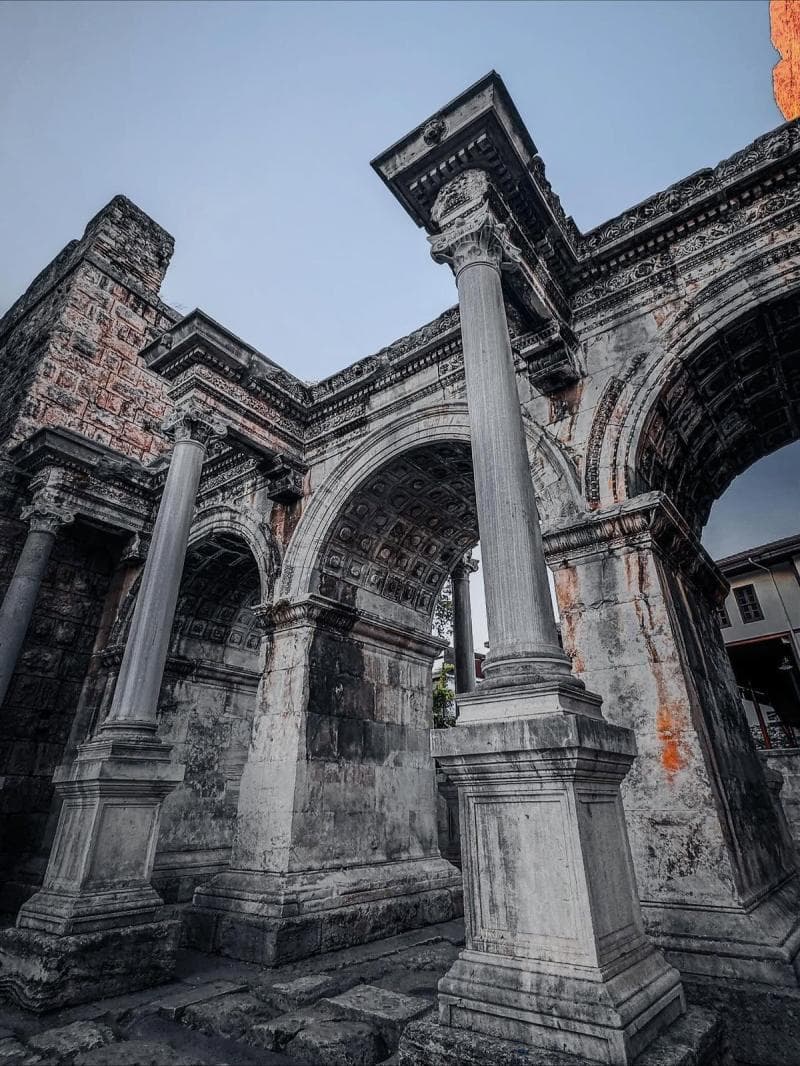

Discover Hadrian's Gate, a magnificent Roman triumphal arch in Antalya, Turkey. Explore the historical entrance to Kaleiçi (Old Town).
Overview
Hadrian's Gate, known locally as 'Üçkapılar' or 'The Three Gates', stands as a majestic entrance to Kaleiçi, Antalya's charming Old Town, in Turkey. This monumental Roman triumphal arch, constructed primarily of gleaming white marble, offers a captivating glimpse into the city's rich ancient past. It is a defining landmark that beautifully bridges the bustling modern city with the serene, historic lanes of Kaleiçi. Visitors stepping through its triple arches are instantly transported through nearly two millennia of history, making it a must-see for anyone exploring Antalya.
History & Cultural Background
The gate was erected in 130 CE to commemorate the visit of Roman Emperor Hadrian to Attaleia, as Antalya was known during that period. It symbolizes the city's prosperity during the Pax Romana, a time when it could afford such grand, ceremonial architecture rather than purely defensive structures. For centuries, Hadrian's Gate was largely hidden and protected within the city walls, which contributed significantly to its remarkable preservation. It was only in the 1950s, when parts of the city walls were removed, that the gate was fully revealed and subsequently restored in 1959.
The two towers flanking the gate offer a timeline of Antalya's layered history. The southern tower, known as the Tower of Julia Sancta, dates back to the Roman era, although it was likely built independently of the arch. The northern tower's lowest section also originates from Roman times, but its upper portion was rebuilt in the 13th century CE during the reign of the Seljuk Sultan Alaeddin Keykubat I, featuring an inscription in Arabic script. This architectural evolution visually narrates the succession of civilizations that have shaped Antalya.
What Makes It Special
What sets Hadrian's Gate apart is its extraordinary state of preservation and its function as the only remaining entrance gate on Antalya's ancient city walls. Its exquisite Roman architecture, characterized by three equally sized arches, is a testament to the skill of ancient builders. The gate features two colonnaded facades, each adorned with four columns that boast composite capitals, combining the volutes of the Ionic order with the acanthus leaves of the Corinthian order.
Above the archways, the barrel vaults are intricately decorated with coffered blocks, each displaying distinct floral motifs and rosettes. The entablature includes a low frieze with floral patterns and a cornice featuring stylized lion heads, showcasing the rich decorative elements typical of Roman triumphal arches. Perhaps one of its most fascinating features for visitors is the glass walkway within the central arch, which allows a view of the original Roman pavement below, complete with deep ruts carved by centuries of passing carts. This offers a direct, tangible connection to the past, letting you walk on history.
Stories, Fun Facts & Local Details
While the gate's history is firmly rooted in fact, some delightful legends have grown around it. One popular but entirely mythical tale suggests that Makeda, the Queen of Sheba, passed through these very arches on her journey to meet King Solomon, who was said to be resting in Aspendos. However, historical records place the Queen of Sheba approximately a millennium before Hadrian's Gate was constructed, rendering the story a charming, yet untrue, local legend.
Another intriguing detail concerns its 'rediscovery.' While the gate was always present, it was the Irish hydrographer Francis Beaufort who documented its existence for the Western world in 1817, publishing a description in his travel diary. Today, some of the original bronze letters from an inscription honoring Hadrian, once part of the gate, are preserved in various museums globally, including the British Museum and the Ashmolean Museum.
Visitor Perspective
Hadrian's Gate is more than just a historical monument; it is a living gateway. It is open 24/7, offering free entry to all, and is beautifully illuminated at night, giving its architectural details a distinct appearance. It serves as the primary and most evocative entrance to Kaleiçi, making it the perfect starting point for exploring the Old Town's labyrinthine streets, traditional Ottoman houses, charming cafes, and bustling shops.
For the best experience, consider visiting in the early morning or late afternoon when the light enhances the marble's intricate carvings and the crowds are thinner. Comfortable footwear is highly recommended, as the cobblestone streets of Kaleiçi are best explored on foot. Standing beneath its arches, you can feel the weight of nearly two thousand years of history and imagine the countless people who have passed through this very spot, connecting their stories to yours.
Coordinates: 30.7087, 36.8853
View on Google Maps💬 How Travelers Describe This Place
Based on community votes
Interesting
539Beautiful
424Photogenic
251Unique
234Must See
30
Traveler Stories
Discover memorable experiences shared by travelers who have visited this place.
No traveler stories yet.
Be the first traveler to share what made this place memorable.

Tour
By
Spot
Discover amazing places around the world. Your journey starts here.
Explore
© 2026 TourBySpot. All rights reserved.