Hadrian’s Arch
Athens, Greece
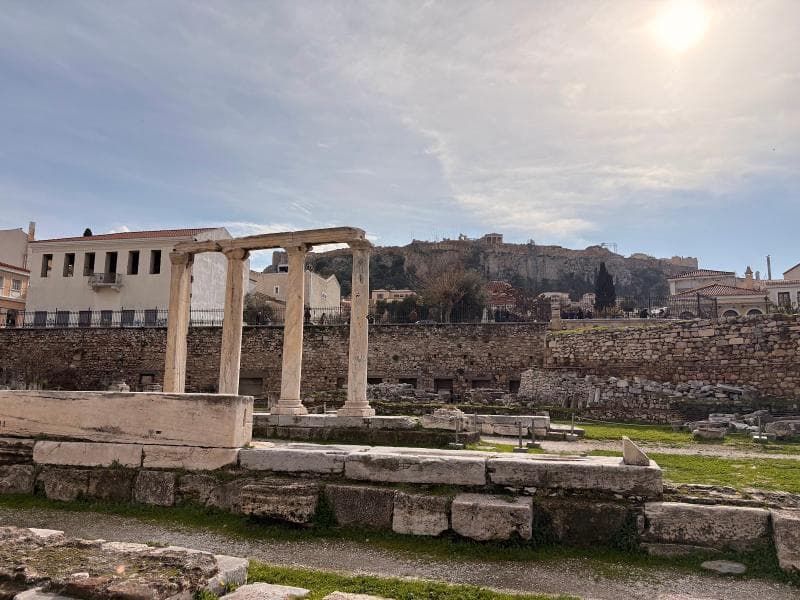
Discover Hadrian's Arch in Athens, Greece, a monumental gateway celebrating Emperor Hadrian's influence and marking a symbolic transition between ancient and Roman Athens.
Overview
Standing proudly in the heart of Athens, Greece, Hadrian's Arch is a monumental gateway that offers a captivating glimpse into the city's rich past. This elegant structure, often referred to as Hadrian's Gate, was erected around 131 or 132 AD to honor the Roman Emperor Hadrian, a notable benefactor of Athens. It marks a significant transition point, physically connecting the ancient city center to the complex of structures on the eastern side, including the grand Temple of Olympian Zeus. Crafted from radiant Pentelic marble, the same material used for the Parthenon, the arch measures approximately 18 meters in height and 13.5 meters in width. Its strategic location and prominent inscriptions invite travelers to ponder the historical interplay between Greek heritage and Roman influence that shaped Athens during Hadrian's reign.
History & Cultural Background
Emperor Hadrian held a profound affection for Athens, earning him the title of a 'philhellene' or lover of Greek culture. His reign (AD 117-138) brought numerous benefactions to the city, including the completion of the colossal Temple of Olympian Zeus, the establishment of Hadrian's Library, and various public works. The citizens of Athens, in gratitude, likely commissioned Hadrian's Arch to celebrate his arrival and acknowledge his extensive contributions. The arch is renowned for its two distinct inscriptions, carved on opposing sides of its architrave. The inscription facing the Acropolis, on the northwest side, proclaims: 'This is Athens, the ancient city of Theseus.' Conversely, the inscription on the southeast side, facing the Roman-built extension of the city, declares: 'This is the city of Hadrian, and not of Theseus.' For centuries, these inscriptions were interpreted as a clear demarcation, separating the ancient Greek city of Theseus from Hadrian's 'new' Roman city, sometimes referred to as 'Hadrianopolis.' However, modern scholarship often suggests a more nuanced meaning. Rather than a strict physical boundary, these words may have served to honor Hadrian as a refounder of Athens, a 'new Theseus,' thereby acknowledging his profound impact on the city's identity and prosperity.
What Makes It Special
Hadrian's Arch stands as a unique architectural marvel, harmoniously blending Roman and Greek design elements. While it shares characteristics with a Roman triumphal arch, such as its grand central opening, its upper section incorporates classical Greek features, including Corinthian pilasters and a pediment-like attic. The choice of Pentelic marble from Mount Pentelicus, the very same quarries that supplied the Parthenon, imbues the arch with a luminous quality and connects it directly to Athens' most iconic classical structures. Its survival through nearly two millennia of history, despite exposure to the elements and various historical transformations, is nothing short of remarkable. The arch is more than just stone; it is a profound symbol of cultural fusion and historical transition, encapsulating Emperor Hadrian's respect for Greek heritage while simultaneously showcasing Roman influence.
Stories, Fun Facts & Local Details
The inscriptions on Hadrian's Arch continue to spark fascinating debates among historians and archaeologists. Was it truly a physical boundary between two distinct parts of Athens, or a grand rhetorical statement celebrating Hadrian's comprehensive refoundation of the city? The ambiguity adds to its intrigue, inviting each visitor to contemplate its deeper meaning. A charming fun fact is that the Pentelic marble used for the arch came from the same source as the marble for the Parthenon, highlighting a continuous thread of artistic and architectural excellence in Athens. Throughout its long history, the arch has served various purposes. During the Middle Ages, there's evidence to suggest it was integrated into a Christian church, possibly even functioning as a bell tower. In the 18th century, it was known as the 'Princess Gate' when it formed part of a defensive wall around Athens. Today, Hadrian's Arch remains an active part of contemporary Athens, occasionally illuminated for cultural events or social causes, underscoring its enduring presence in the city's consciousness. For both Athenians and travelers, it has long served as a natural rendezvous point, a testament to its prominent and cherished place in the urban landscape.
Visitor Perspective
Visiting Hadrian's Arch offers a tangible connection to Athens' layered past. Located conveniently on Amalias Avenue, between the historic Plaka district and the sprawling ruins of the Temple of Olympian Zeus, it's easily accessible and often one of the first ancient sites travelers encounter. As you approach this impressive monument, its elegant silhouette framed against the backdrop of the Acropolis, you can almost feel the weight of centuries. Standing beneath its archway, you find yourself at a crossroads where the classical glory of Greek Athens met the expansive power of the Roman Empire. It’s a perfect spot for reflection and photography, allowing you to capture a moment where history truly comes alive. The arch provides a visual narrative, linking these significant landmarks and enriching your understanding of the city's historical evolution. It's an open, public monument, inviting curious travelers to walk through a piece of history and imagine the emperors, philosophers, and citizens who once passed beneath its grand span.
Coordinates: 23.73203, 37.97018
View on Google Maps💬 How Travelers Describe This Place
Based on community votes
Photogenic
639Unique
421Interesting
366Must See
298Beautiful
212
Traveler Stories
Discover memorable experiences shared by travelers who have visited this place.
No traveler stories yet.
Be the first traveler to share what made this place memorable.

Tour
By
Spot
Discover amazing places around the world. Your journey starts here.
Explore
© 2026 TourBySpot. All rights reserved.