Gyeonghoeru Pavilion
Seoul, South Korea
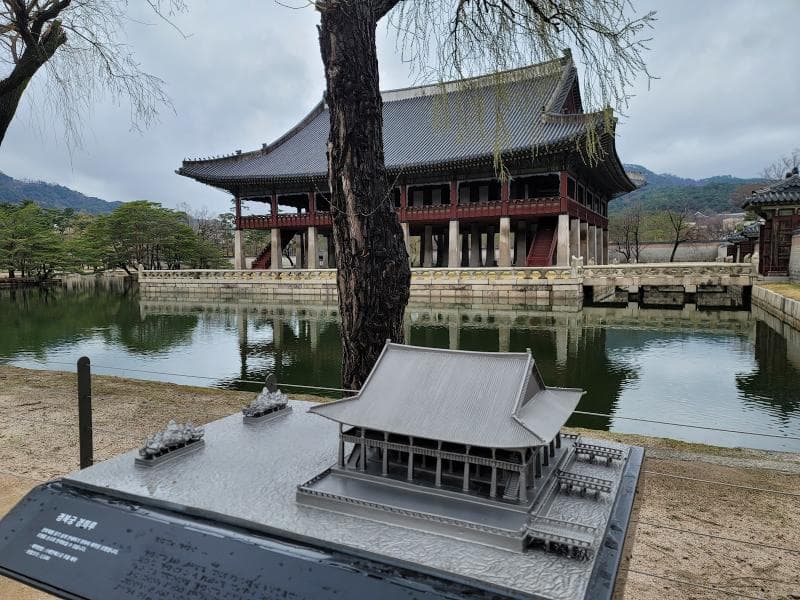
Explore Gyeonghoeru Pavilion, a historic royal banquet hall on a serene pond within Gyeongbokgung Palace in Seoul, South Korea. Discover its rich history and cultural symbolism.
Overview
Nestled within the majestic Gyeongbokgung Palace in Seoul, South Korea, Gyeonghoeru Pavilion stands as a breathtaking architectural masterpiece, seemingly floating on a serene man-made pond. This elegant, two-story structure, a designated National Treasure, was historically reserved for grand royal banquets, significant state events, and diplomatic receptions for foreign envoys. Its name, 'Gyeonghoeru,' beautifully encapsulates a profound meaning: it refers to the king's ability to achieve success and be a great leader when surrounded by wise and virtuous people. As one of Korea's largest elevated pavilions by floor area, its picturesque setting against the backdrop of the palace grounds and the distant mountains offers a truly captivating spectacle.
History & Cultural Background
The origins of Gyeonghoeru Pavilion trace back to 1412 during the reign of King Taejong, when the first two-story pavilion was constructed on this site, expanded alongside an enlarged pond. However, its existence was not without challenge. The original structure suffered significant damage and was eventually burned down during the devastating Japanese invasion of 1592, known as the Imjin War, leaving behind only its stone supports. For nearly 270 years, the pavilion remained in ruins, a poignant symbol of the palace's destruction. It was not until 1867, under the ambitious reconstruction efforts of King Gojong, that Gyeonghoeru was magnificently rebuilt. This period of reconstruction was an immense undertaking, symbolizing the restoration of royal legitimacy and cultural pride after centuries of abandonment. Remarkably, Gyeonghoeru is one of the few structures within Gyeongbokgung Palace that largely withstood the subsequent Japanese occupation from 1910 to 1945, cementing its status as a resilient icon of Korean heritage.
Architecturally, Gyeonghoeru is a marvel of Joseon-era design. The pavilion is supported by 48 stone pillars on its first floor, each believed to symbolize yearly astronomical events. The second floor features bays set at varying heights, reflecting a hierarchical arrangement where the highest-ranking officials sat closest to the center. These central bays are rich with symbolism, representing heaven, earth, and humanity, while surrounding bays denote the 12 months of the year and the 24 seasonal subdivisions. Originally, during King Taejong's era, some pillars were carved with wriggling dragons, a testament to the intricate artistry and symbolism embedded in its construction.
What Makes It Special
Beyond its sheer beauty, Gyeonghoeru Pavilion is remarkable for its profound blend of aesthetic grandeur and symbolic depth. Its unique placement on a man-made island, encircled by a tranquil pond, creates a stunning visual effect where the pavilion appears to float, particularly when reflected in the still waters. This design was not merely for visual appeal but also embraced Confucian ideals of harmony between nature and humanity. The pavilion's resilience through destruction and multiple reconstructions underscores its enduring significance as a cultural and historical landmark. It is also celebrated as the largest elevated pavilion in Korea, offering expansive views from its upper level that encompass the intricate rooftops of Gyeongbokgung Palace to the east and the majestic silhouette of Inwangsan Mountain to the west. The entire structure, built using traditional wooden joinery techniques, surprisingly features no nails, showcasing the advanced craftsmanship of its time.
Stories, Fun Facts & Local Details
Gyeonghoeru is not just a building; it is a repository of captivating tales and fascinating details that breathe life into its royal past. Legend has it that a mystical dragon spirit resides beneath the pavilion, believed to forge a connection between the king and the heavens, bestowing divine power upon him. The serene artificial pond surrounding the pavilion served as a delightful playground for royalty, who would enjoy leisurely boating excursions during the warm summer months. Travelers approaching the pavilion might notice a delightful detail: stone animals adorning the railings of the three bridges leading to the structure. These sculptures were strategically placed to ward off evil spirits, offering protection to the royal gatherings within.
Historically, Gyeonghoeru was an exceptionally exclusive space, often enclosed by gates that permitted entry only to the king and the highest-ranking officials. Its immense cultural value is further highlighted by its past appearance on the Korean 10,000 won banknote. An interesting landscape feature is Amisan, a small hill located behind the pavilion, which was ingeniously formed from the earth excavated during the creation of the pond. In a testament to its continued cultural relevance, the global phenomenon BTS even performed their song 'Mikrokosmos' at Gyeonghoeru Pavilion in 2020, blending ancient heritage with contemporary art.
Visitor Perspective
For today's curious traveler, Gyeonghoeru Pavilion offers a rare and immersive journey into Korea's royal history. While the pavilion's interior is generally closed to the public for preservation, special guided tour programs are periodically offered, typically from April to October. These exclusive tours provide a unique opportunity to step inside the pavilion and appreciate its intricate details up close, an experience not commonly available to general visitors. Due to the limited availability and desire to preserve this national treasure, these tours usually require advance reservations and often have restricted group sizes, with specific slots sometimes allocated for international visitors. Participating in one of these tours is highly recommended for a deeper understanding and appreciation of Gyeonghoeru's historical, cultural, and architectural significance, offering unparalleled views of the surrounding palace complex and the majestic Inwangsan Mountain. Admission to Gyeongbokgung Palace is required, with the Gyeonghoeru tour often included as part of the overall palace experience.
Coordinates: 126.975889, 37.57975
View on Google Maps💬 How Travelers Describe This Place
Based on community votes
Unique
683Interesting
642Photogenic
300Must See
251Beautiful
88
Traveler Stories
Discover memorable experiences shared by travelers who have visited this place.
No traveler stories yet.
Be the first traveler to share what made this place memorable.

Tour
By
Spot
Discover amazing places around the world. Your journey starts here.
Explore
© 2026 TourBySpot. All rights reserved.