Gustave Eiffel’s Office
Paris, France
Discover Gustave Eiffel's secret office inside the iconic Eiffel Tower in Paris, France. Explore its rich history, unique decor, and wax figures of famous guests.
Overview
High above the bustling streets of Paris, nestled within the iconic lattice work of the Eiffel Tower, lies a hidden gem: Gustave Eiffel’s private office. This intriguing sub-spot, situated at the tower's summit, offers a unique glimpse into the world of the visionary engineer who brought the Iron Lady to life. It was never intended as a full-time residence but rather as a personal retreat, a laboratory, and a space to entertain distinguished guests, providing unparalleled views of the city he helped define. Today, visitors can peek into this meticulously preserved historical space, transporting them back to the late 19th century and offering a profound connection to the tower’s creator.
History & Cultural Background
When Gustave Eiffel conceived his monumental tower for the 1889 Universal Exposition in Paris, he deliberately included a private 'apartment' for himself at its highest point. This decision was part of his original agreement and, some accounts suggest, a condition for his substantial financial investment in the project. At the time, the Eiffel Tower was the tallest structure in the world, a marvel of engineering that captivated global attention. Eiffel, already renowned for his work on bridges and the internal structure of the Statue of Liberty, used this elevated space for more than just prestige.
The office served as a practical observatory for meteorological studies and a laboratory for early radio transmissions, demonstrating Eiffel's commitment to scientific advancement. The very existence of this exclusive aerie sparked immense curiosity and envy among Parisian society. Wealthy individuals reportedly offered significant sums to rent the space, even for a single night, all of which Eiffel politely declined, preferring to reserve it for quiet contemplation and meaningful interactions with peers.
What Makes It Special
What truly sets Gustave Eiffel’s Office apart is its blend of historical significance and intimate charm, contrasting sharply with the industrial grandeur of the tower itself. While the tower's steel beams and rivets speak of engineering prowess, the office reveals a more personal side of its designer. It was originally furnished in a comfortable, non-ostentatious style, described as 'simple and dear to scientists'.
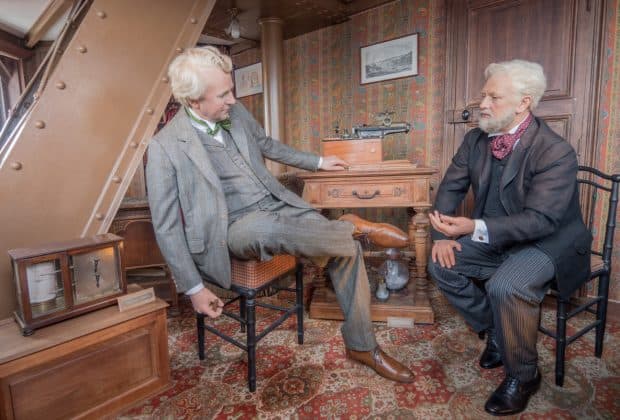
The current restoration captures this essence, presenting a room filled with period furniture, warm wallpaper, and wooden cabinets, evoking a distinctly 19th-century Parisian ambiance. Its location at the summit means it possesses perhaps the most exclusive address in Paris, offering a silent witness to the city's evolution over more than a century. The office stands as a testament to Eiffel’s foresight, not just as an engineer, but also as a scientist and a man who understood the value of a private sanctuary amidst a public spectacle.
Stories, Fun Facts & Local Details
One of the most captivating aspects of Gustave Eiffel’s Office today is the presence of lifelike wax figures, crafted by the famous Musée Grévin. These figures depict Gustave Eiffel himself, engaged in conversation with the renowned American inventor Thomas Edison. In some portrayals, Eiffel’s daughter, Claire, is also present, completing this historical tableau.
This scene commemorates a famous visit Edison paid to Eiffel in 1889, during which they reportedly discussed new technologies, with Edison even gifting Eiffel one of his phonographs. It is a fun fact that despite persistent rumors, Eiffel did not actually live in the tower. The original 'apartment' included a living room, kitchen, and bathroom, but notably lacked a bedroom, confirming its function as a working and reception space rather than a permanent home. After Eiffel’s death, the office temporarily fell out of its original use, eventually being repurposed to house telecommunications equipment for the tower’s growing role in broadcasting. Thankfully, a portion of it has since been lovingly restored for public admiration.
Visitor Perspective
For those ascending to the very top of the Eiffel Tower, visiting Gustave Eiffel’s Office offers a poignant and reflective moment amidst the breathtaking panoramic views. While visitors cannot step inside the office, a clear glass window allows for an intimate viewing experience. You can peer into the room, observe the detailed period furnishings, and imagine the historic conversations that once took place there.
Seeing the wax figures of Eiffel and Edison provides a vivid connection to the past, bringing a human element to the colossal iron structure. It’s a moment to pause and appreciate the genius and personal world of the man behind one of the world's most recognizable landmarks. This small, preserved space enhances the overall Eiffel Tower experience, transforming a mere visit into a journey through history, offering a rare glimpse into the private domain of a public icon. It underscores the tower's dual role as both a monumental achievement and a place imbued with personal stories and scientific endeavors.
Coordinates: 2.2945, 48.8584
View on Google Maps💬 How Travelers Describe This Place
Based on community votes
Photogenic
794Beautiful
785Interesting
571Unique
546Must See
103
Traveler Stories
Discover memorable experiences shared by travelers who have visited this place.
No traveler stories yet.
Be the first traveler to share what made this place memorable.

Tour
By
Spot
Discover amazing places around the world. Your journey starts here.
Explore
© 2026 TourBySpot. All rights reserved.