Guildhalls
Brussels, Belgium
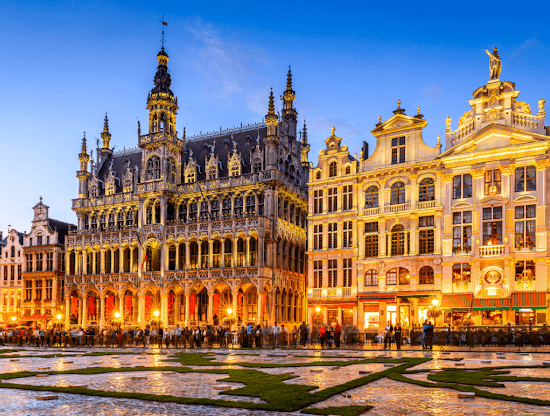
Explore the historic Guildhalls of Grand Place in Brussels, Belgium. Discover their Baroque architecture, rich history, and the stories of the powerful trade guilds.
Overview
The Guildhalls of Brussels, standing proudly on the Grand Place (Grote Markt), are more than just architectural marvels; they are tangible testaments to the city's rich economic power, intricate social structure, and remarkable resilience. This UNESCO World Heritage site, often hailed as one of the most beautiful squares in the world, is framed by these opulent Baroque buildings, each telling a story of the powerful trade guilds that once shaped Brussels. [4, 8, 13] These elaborate structures, with their gilded facades and intricate sculptures, invite travelers to step back in time and imagine the bustling marketplace and civic life that unfolded here for centuries. [2, 12]
History & Cultural Background
The Grand Place's origins trace back to the 11th century as a modest open-air marketplace. By the 13th and 14th centuries, it evolved into the economic heart of Brussels, with merchants and tradesmen establishing themselves around it. [7, 10, 15] The guild system, comprising associations of craftsmen grouped into 'Nations', dominated Brussels' economic life. These guilds played a crucial role, not only economically but also politically and religiously, providing protection, controlling product quality, and participating in city governance. [9, 12]
The current appearance of the guildhalls is largely a result of a tragic event in August 1695. During the Nine Years' War, French troops under King Louis XIV bombarded Brussels, destroying most of the city center and nearly all the buildings on the Grand Place. Only the facade and tower of the Town Hall largely survived. [2, 8, 13] In an extraordinary display of determination and wealth, the guilds and the city meticulously rebuilt the square in less than four years. [8, 23] They reconstructed their headquarters in stone, grander and more ornate than before, ensuring a unified Baroque style, albeit with Flemish influences. [4, 7, 15] This rapid and harmonious reconstruction, overseen by the City Magistrate who approved the facade designs, created the breathtaking architectural ensemble visible today. [2, 23]
What Makes It Special
What truly sets the Guildhalls apart is their unified Baroque splendor, born from destruction. Each guildhall, despite its individual ornate details reflecting the specific trade it represented, contributes to a cohesive architectural masterpiece. [7, 8] The narrow plots, a result of maximizing space for as many guilds as possible directly on the square, contribute to the varied and captivating streetscape. [2] The facades are adorned with rich sculptural decoration, pilasters, balustrades, and lavishly designed gables, often depicting symbols or tools of the respective guilds. [4, 7, 12] For instance, 'Le Cygne' (The Swan) was the butchers' headquarters, and the brewers' guildhall, 'L'Arbre d'Or' (The Golden Tree), still houses a brewers' museum today. [4, 12, 22] This attention to detail and harmonious reconstruction after such devastation is a testament to the pride and skill of Brussels' artisans and guilds. [8]
Stories, Fun Facts & Local Details
The Grand Place and its guildhalls have witnessed centuries of dramatic history. In 1523, the first Protestant martyrs, Jan van Essen and Hendrik Vos, were burned at the stake by the Inquisition on the square. [4, 7, 8] Later, in 1568, two noblemen, Lamoral, Count of Egmont, and Philip de Montmorency, Count of Horn, were beheaded there for opposing King Philip II of Spain, an event that fueled the Eighty Years' War. [7, 8, 19]
Beyond these somber events, the guildhalls hold fascinating anecdotes. For a time, Karl Marx lived in exile in Brussels, reportedly writing parts of 'The Communist Manifesto' in 'Le Cygne', the butchers' guildhall. [19] The Maison du Roi (King's House), located opposite the Town Hall, ironically never housed a king; its Dutch name, Broodhuis (Bread House), reflects its earlier function as a market. [4, 15, 18] Visitors can still see clues to the guilds on the facades today, such as hops and barley on the brewers' guild building. [12] The gold decorations on the buildings shimmer, especially at night when the square is illuminated, creating a magical spectacle. [15]
Visitor Perspective
Standing amidst the guildhalls on the Grand Place is an immersive experience. The sheer scale and intricate beauty of the architecture can feel overwhelming, drawing the eye upwards to the countless sculptures and golden accents. Many of the former guildhalls now house shops, terraced restaurants, and brasseries, allowing visitors to dine or enjoy a Belgian beer in a setting steeped in history. [4] The square frequently hosts festive and cultural events, from the biennial Flower Carpet in August to Christmas markets and light shows, making it a vibrant hub year-round. [4, 8, 13] Taking time to observe the unique details on each guildhall's facade, imagining the bustling life of medieval and Baroque Brussels, offers a profound connection to the city's past and its enduring spirit. [12]
Coordinates: 4.3525, 50.8467
View on Google Maps💬 How Travelers Describe This Place
Based on community votes
Must See
839Interesting
445Photogenic
416Beautiful
289Unique
141
Traveler Stories
Discover memorable experiences shared by travelers who have visited this place.
No traveler stories yet.
Be the first traveler to share what made this place memorable.

Tour
By
Spot
Discover amazing places around the world. Your journey starts here.
Explore
© 2026 TourBySpot. All rights reserved.