Guard House Replica
Berlin, Germany
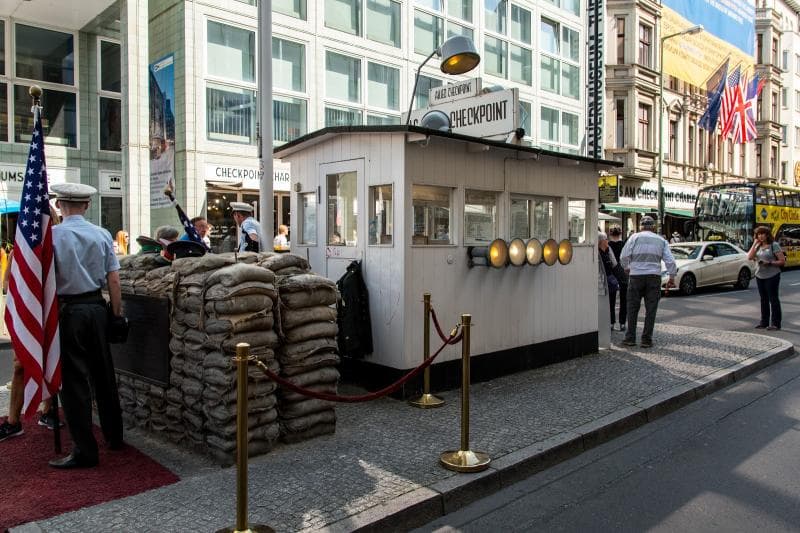
Explore the Guard House Replica at Berlin's iconic Checkpoint Charlie. Uncover the dramatic Cold War history and cultural significance of this former border crossing in Germany.
Overview
Nestled in the heart of Berlin, Germany, the Guard House Replica at Checkpoint Charlie stands as a poignant reminder of a divided past. This unassuming wooden booth, flanked by sandbags and the iconic 'You are leaving the American sector' sign, marks the most famous crossing point between East and West Berlin during the Cold War. While not the original structure, the replica meticulously recreates the look and feel of the first Allied guard house from 1961, inviting visitors to step back in time and contemplate the stark realities of a city bisected by ideology. It serves as a powerful visual anchor for the historical narratives that unfolded at this critical juncture, drawing countless travelers who seek to understand the complexities of Berlin's Cold War era.
History & Cultural Background
Checkpoint Charlie, officially designated as 'Checkpoint C' by the Western Allies, emerged as a symbol of the Iron Curtain shortly after the construction of the Berlin Wall in August 1961. It was one of three major checkpoints, alongside Alpha and Bravo, but gained unparalleled fame due to its location at the intersection of Friedrichstraße and Zimmerstraße, and its role as the sole crossing point for Allied military personnel, foreign diplomats, and non-German visitors. For nearly three decades, this spot was a tangible frontier, dividing families, ideologies, and a nation. The guard house itself was a humble structure, intentionally kept simple by the Americans to underscore their belief that the division of Berlin was temporary and illegitimate. The original wooden booth, hastily assembled in 1961, represented this stance, becoming an enduring image of Cold War vigilance. The area around Checkpoint Charlie was not merely a border; it was a stage where Cold War tensions played out, a place of dramatic escapes, thwarted attempts, and the constant silent standoff between two superpowers.
What Makes It Special
What makes the Guard House Replica particularly special is its evocative power. While the original guard house was moved to the Allied Museum in Berlin-Zehlendorf after the fall of the Wall, the current replica, installed around 2000 or 2001, ensures that visitors can experience the physical presence of this historic boundary. It's not just a prop; it's a carefully reconstructed echo of history, complete with the familiar sign warning travelers they are 'leaving the American sector'. This replica allows for immediate, visceral connection to a period when this spot was a frontline in the Cold War. It highlights the strategic importance of this particular crossing, as well as the fragility of peace during a deeply divided era. Standing before the guard house, one can almost feel the tension that once permeated the air, imagining the countless stories of those who passed through, some with hope, others with trepidation.
Stories, Fun Facts & Local Details
The Guard House Replica is steeped in dramatic stories. Perhaps the most gripping occurred in October 1961, just months after the Wall's construction, when American and Soviet tanks faced off here for 16 tense hours. This standoff, triggered by a dispute over the right of an American diplomat to cross into East Berlin without document checks, brought the world to the brink of conflict. Checkpoint Charlie was also the scene of numerous daring escape attempts from East to West. People used ingenious methods, from hidden compartments in cars and hot-air balloons to tunnels beneath the Wall. Tragically, some attempts ended in failure and death, most famously that of Peter Fechter, a young East German shot while trying to cross in 1962, whose death in the 'death strip' sparked international outrage. A fascinating detail is the image of the American soldier often seen near the replica: it is a photograph of Jeff Harper, a US Army tuba player, part of a series taken in 1994 to commemorate the last Allied soldiers in Berlin. Though no real soldiers guard the checkpoint today, this image, alongside the replica, perpetuates the historical narrative.
Visitor Perspective
Visiting the Guard House Replica at Checkpoint Charlie today offers a unique and often thought-provoking experience. The site is a vibrant, if sometimes crowded, hub of historical interest. Travelers often pose for photographs with the replica and the iconic signs, capturing their moment at a place that once represented a global fault line. While some find the modern commercialization around the site to be a touch jarring, likening it to a 'Cold War Disneyland', the historical significance remains undeniable. The atmosphere is a blend of solemn remembrance and bustling tourism. Adjacent to the guard house, the Checkpoint Charlie Museum (Mauermuseum) further enriches the visit, displaying artifacts and recounting personal stories of those who lived through the division, including various escape devices. The replica is not merely an object; it is a gateway to understanding a pivotal chapter in Berlin's and the world's history, encouraging reflection on freedom, division, and the enduring human spirit.
Coordinates: 13.39035, 52.50745
View on Google Maps💬 How Travelers Describe This Place
Based on community votes
Must See
922Unique
379Photogenic
225Beautiful
183Interesting
19
Traveler Stories
Discover memorable experiences shared by travelers who have visited this place.
No traveler stories yet.
Be the first traveler to share what made this place memorable.

Tour
By
Spot
Discover amazing places around the world. Your journey starts here.
Explore
© 2026 TourBySpot. All rights reserved.