Guard Ceremony Area
Riga, Latvia
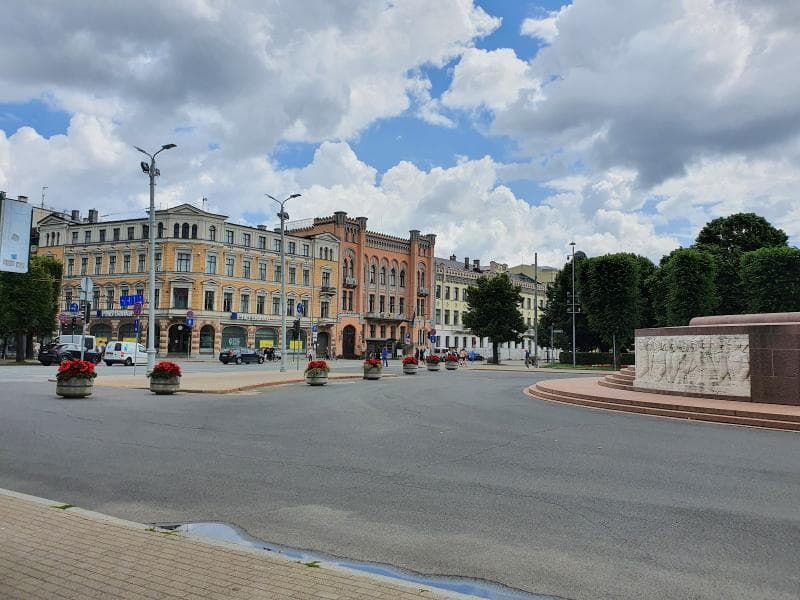
Experience the solemn Guard Ceremony at Riga's iconic Freedom Monument, a powerful symbol of Latvia's enduring independence and national pride.
Overview
In the heart of Riga, Latvia, stands the Freedom Monument, a profound national symbol that encapsulates the country's enduring spirit and resilience. More than just an architectural marvel, it serves as a central point for national celebrations and a silent sentinel guarding Latvia's hard-won independence. At its base, visitors can witness the solemn and precise Guard Ceremony, a poignant tradition that underscores the monument's significance and the nation's respect for its history. This ceremony, performed by members of the Latvian National Guard or National Armed Forces, is a moment of quiet dignity, attracting onlookers who wish to connect with Latvia's patriotic soul. The monument itself rises majestically, a 42-meter high structure of granite, travertine, and copper, crowned by the allegorical figure of Liberty, affectionately known as 'Milda,' holding three golden stars aloft. These stars symbolize Latvia's historical regions, uniting them under a singular vision of freedom. The area around the monument is a pedestrian-friendly space, inviting contemplation and offering a serene transition between Riga's historic Old Town and its modern boulevards.
History & Cultural Background
The Freedom Monument, known in Latvian as 'Brīvības piemineklis', was unveiled on November 18, 1935, a date chosen to coincide with the 17th anniversary of Latvia's independence. Its creation was a testament to national unity, funded entirely by public donations from ordinary Latvians who contributed to build a memorial to their liberation. Designed by sculptor Kārlis Zāle, the monument was conceived to honor soldiers who died during the Latvian War of Independence (1918–1920). The powerful inscription 'Tēvzemei un Brīvībai' ('For Fatherland and Freedom') is carved into its base, articulating the core values it embodies.
Throughout Latvia's tumultuous history, especially during the 51 years of Soviet occupation from 1940 to 1991, the monument faced threats of demolition. Yet, it remarkably endured, becoming an unofficial symbol of resistance. During this period, gathering at its base or laying flowers was an act of quiet defiance, transforming the monument into a focal point for national identity and hope. The guard of honor, a fixture since 1935, was reinstated on November 11, 1992, following Latvia's regained independence, further cementing its role as a living symbol of restored statehood.
What Makes It Special
The Guard Ceremony Area at the Freedom Monument is special not merely for its ceremonial precision but for the deep emotional resonance it holds for the Latvian people. It is a daily, visible reaffirmation of the nation's sovereignty and a tribute to those who sacrificed for its freedom. Unlike a theatrical performance, this is a genuine state honor detail, observed with solemnity and respect by both locals and visitors. The guards, members of the Latvian National Guard, wear traditional uniforms, performing a precise ceremonial drill during the changing of the guard. This ritual transforms a static landmark into a dynamic, living monument, connecting visitors directly to the ongoing narrative of Latvian identity and pride.
Stories, Fun Facts & Local Details
The copper figure atop the monument, officially personifying Liberty or Latvia, is affectionately known by Latvians as 'Milda.' This informal nickname stems from a popular Latvian first name and adds a layer of endearment to the powerful symbol. The three golden stars 'Milda' holds represent the three historical regions of Latvia: Vidzeme, Kurzeme, and Latgale, signifying their unity. During the Soviet era, efforts were made to reinterpret the monument's symbolism; 'Milda' was sometimes presented as 'Mother Russia' and the stars as the Baltic republics, a clear attempt to subvert its original meaning.
An interesting local anecdote suggests that the monument survived potential demolition during Soviet times thanks to the alleged intervention of a famous Soviet sculptor, Vera Mukhina, who was born in Riga and recognized its high artistic value. Another story tells of how a plan to declare the monument unsafe for surrounding traffic was thwarted by Riga's mayor, who instead pedestrianized the area, effectively saving the monument. These tales, while possibly apocryphal, highlight the monument's profound cultural importance and the lengths taken to preserve it. Locals frequently lay red and white flowers at its base, especially on national holidays like Independence Day and the anniversary of deportations, transforming the monument into a vibrant, ever-evolving shrine.
Visitor Perspective
For a curious traveler, observing the Guard Ceremony is an essential part of experiencing the Freedom Monument. The changing of the guard typically occurs hourly, generally between 10:00 and 16:00, and lasts approximately 10 minutes. It is recommended to arrive a few minutes early to secure a good vantage point. There is no designated viewing area, and crowds are usually manageable, allowing for a respectful and intimate experience. Position yourself slightly to the side of the monument for the clearest view of the guards' precise movements. The surrounding area, with its parks and proximity to the Old Town, makes the monument a natural starting or ending point for exploring Riga. Understanding the monument's historical context and its role as an emotional center of Latvian national identity transforms a brief visit into a genuinely moving experience, offering a glimpse into the enduring spirit of Latvia.
Coordinates: 24.113056, 56.951389
View on Google Maps💬 How Travelers Describe This Place
Based on community votes
Photogenic
996Must See
953Beautiful
658Interesting
585Unique
69
Traveler Stories
Discover memorable experiences shared by travelers who have visited this place.
No traveler stories yet.
Be the first traveler to share what made this place memorable.

Tour
By
Spot
Discover amazing places around the world. Your journey starts here.
Explore
© 2026 TourBySpot. All rights reserved.