Grotta Del Buontalenti
Florence, Italy
Explore Grotta del Buontalenti, a masterpiece of Mannerist art within Florence's Boboli Gardens, Italy. Discover its unique history and surreal beauty.
Overview
Tucked away within the magnificent Boboli Gardens in Florence, Italy, lies a true marvel of Mannerist art and architecture: the Grotta del Buontalenti, also known as the Grotta Grande. This extraordinary artificial grotto is much more than a simple cave; it is a meticulously crafted artistic experience, blending sculpture, painting, and architectural elements to create a surreal and captivating space. Situated in the northern part of the gardens, near the entrance to the Vasari Corridor, the grotto stands as a testament to the Medici family's lavish taste and innovative spirit. Visitors stepping into its three distinct chambers are transported into a world where nature and artifice merge, offering a refreshing contrast to the more formal designs found elsewhere in the expansive gardens.
History & Cultural Background
The origins of the Grotta del Buontalenti are rooted in a practical necessity before evolving into a grand artistic statement. Its initial purpose, dating back to 1551, was as part of an aqueduct project designed to supply water from the Ginevra spring to both the Boboli Gardens and the Palazzo Vecchio. This infrastructure included a reservoir, which later lost its primary function. Grand Duke Francesco I de' Medici, however, envisioned a far more ambitious transformation for this utilitarian space. Captivated by art and alchemy, he decided to convert the reservoir into an elaborate grotto, a popular feature in 16th-century Tuscan gardens.
Initial work began in 1557 under Davide Fortini, with Giorgio Vasari later designing the grotto's preliminary facade, including niches for statues of Apollo and Ceres by Baccio Bandinelli. However, it was Bernardo Buontalenti, Francesco I's favorite architect, who took over between 1583 and 1587, and completed the masterpiece that exists today. Buontalenti masterfully modified Vasari's architectural layout and meticulously planned the entire decorative scheme, infusing the grotto with rich symbolism and theatricality that defined the Mannerist style.
What Makes It Special
The Grotta del Buontalenti is a quintessential example of Mannerism, an artistic style characterized by its artificiality, theatricality, and a deliberate blurring of natural and architectural forms. The grotto unfolds across three interconnected rooms, each offering a unique sensory experience. The first, and largest, chamber is designed to mimic a natural cave, yet with a surreal twist. Its walls are encrusted with an astonishing array of stalactites, stalagmites, rocks, shells, and sponges, artfully arranged by Piero di Tommaso Mati to resemble zoomorphic and anthropomorphic figures, creating a pastoral scene of shepherds and sheep. This room famously housed copies of Michelangelo's 'Prisoners' (Slaves) in its corners, with their unfinished quality mirroring the grotto's blend of natural and artificial states. The ceiling, painted by Bernardino Poccetti, depicts fantastical animals, further enhancing the illusion.
The second room presents a more classical composition, featuring Vincenzo de' Rossi's sculpture 'Paris kidnapping Elena' at its center, surrounded by frescoes of Juno and Minerva. The design here, with its sponge-like materials, creates gabled niches and geometric patterns. The third and final room houses Giambologna's exquisite 'Bathing Venus', positioned above a marble basin. Notably, the three rooms are not aligned on a single axis, a deliberate design choice that allows a deeper view into the grotto from the outside, fully appreciating the Venus sculpture at its core.
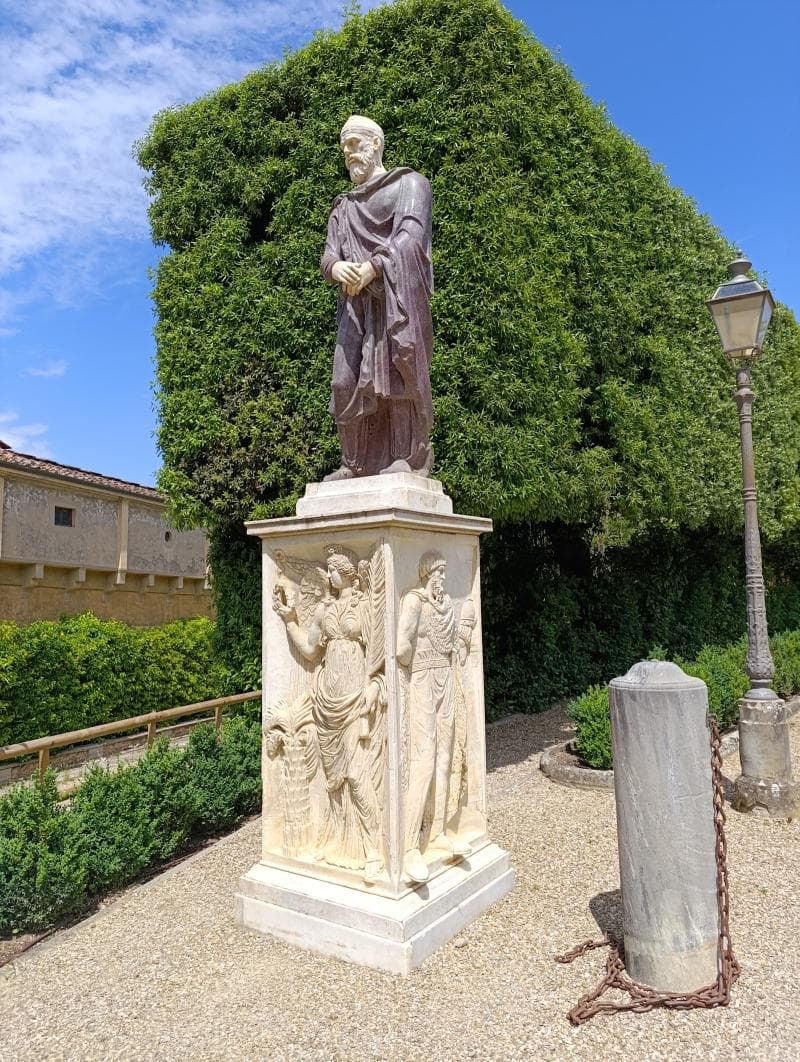
The grotto's exterior is equally captivating, with a wide entrance flanked by columns and architraves, adorned with concrete stalagmites and the original statues of Ceres and Apollo by Baccio Bandinelli. The Medici coat of arms is prominently displayed, surrounded by mosaic frames in vibrant colors.
Stories, Fun Facts & Local Details
The Grotta del Buontalenti holds a special place in popular culture, notably being featured in Dan Brown's bestselling novel 'Inferno', drawing global attention to its mysterious allure. Beyond its literary fame, the grotto embodies a fascinating aspect of Renaissance artistic philosophy. The inclusion of Michelangelo's 'Prisoners', often interpreted as unfinished, aligns with the concept of 'non-finito', where the beauty lies in the work's perpetual state of becoming, a theme subtly echoed throughout the grotto's design. Historically, the grotto was not just an artistic display but also a setting for lavish waterworks. Originally, water cascaded through the grotto, creating optical illusions as light filtered through a central oculus, reflecting on the flowing water and fish that once inhabited the space. These ingenious features served to refresh visitors and perhaps even hosted 'scherzi' or water tricks. The grotto was also known as a romantic rendezvous spot, hinting at the intimate and personal experiences it offered to the Medici court. Bernardo Buontalenti himself was a polymath, known as 'Bernardo delle Girandole' (Bernardo of the Fireworks) for his spectacular pyrotechnic displays, underscoring his talent for theatricality and wonder, which is so evident in this grotto.
Visitor Perspective
Visiting the Grotta del Buontalenti is an unforgettable experience for any traveler exploring the Boboli Gardens. The grotto is accessible with a general admission ticket to the Boboli Gardens, which are part of the Uffizi Galleries complex. While the gardens are typically open daily, it's advisable to check the specific opening times for the grotto itself, as these can vary seasonally and may have limited hours. The grotto offers a welcome respite from the Florentine sun, particularly during warmer months, providing a cool and intriguing environment to explore. As you wander through its chambers, take time to observe the intricate details: the transitions in ceiling texture, the interplay of light and shadow, and the subtle symbolic motifs. It's an immersive journey designed to destabilize expectations and evoke a sense of controlled wonder, truly an artistic argument for how power can be shown through marvel rather than just rigid geometry.
Coordinates: 11.248333, 43.7625
View on Google Maps💬 How Travelers Describe This Place
Based on community votes
Must See
995Unique
929Photogenic
858Beautiful
730Interesting
275
Traveler Stories
Discover memorable experiences shared by travelers who have visited this place.
No traveler stories yet.
Be the first traveler to share what made this place memorable.

Tour
By
Spot
Discover amazing places around the world. Your journey starts here.
Explore
© 2026 TourBySpot. All rights reserved.