Great Stairs
Belgrade, Serbia
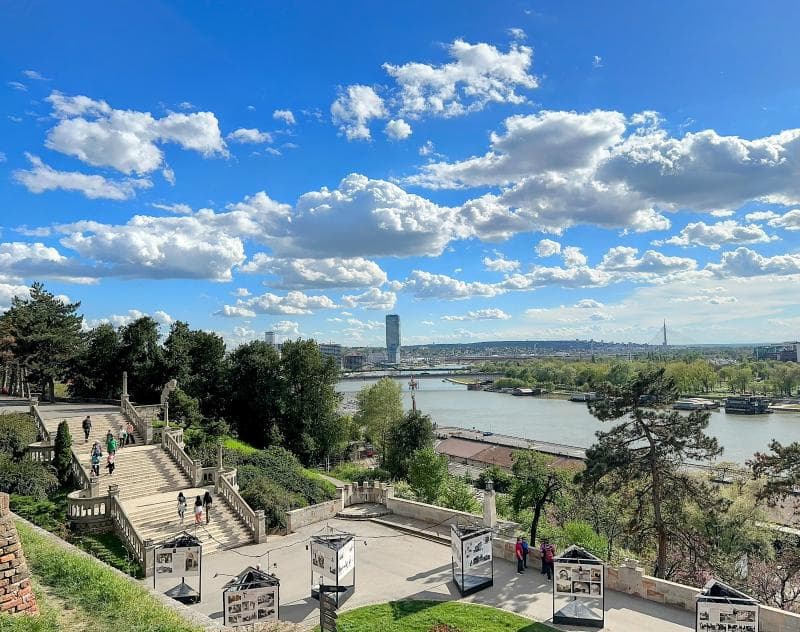
Explore the Great Stairs in Kalemegdan Park, Belgrade, Serbia. Discover its Romanticist architecture, history, and the unique story of the 'Path of the Former Deceased'.
Overview
Nestled within the historic Kalemegdan Park in Belgrade, Serbia, you'll discover the majestic Great Stairs, known locally as Veliko Stepenište. More than just a functional ascent, these stairs stand as a monumental park motif, gracefully connecting different levels of the fortress landscape and offering a picturesque pathway for visitors. Situated in the southwest frontline of the sprawling Kalemegdan Fortress, they provide a scenic vantage point over the confluence of the Sava and Danube rivers, a view that has captivated onlookers for generations.
History & Cultural Background
The Great Stairs were conceived and constructed during a significant period of rearrangement and renovation within Kalemegdan Park. Completed in 1928, their creation marked a notable architectural endeavor in Belgrade's urban development. The initial concept for this grand design originated from Aleksandar Krstić, who was then the head of the parks department in the city administration. The intricate main project was brought to life by the architect Đorđe Kovaljevski.
Crafted in a Romanticist style, the stairs elegantly incorporate elements of the Serbo-Byzantine Revival, reflecting the rich cultural tapestry of the region. However, their history has not been without hardship. The Great Stairs suffered considerable damage during World War II, both from the German bombing of Belgrade in April 1941 and subsequent wartime events.
Following the war, repairs were initially partial, and the stairs faced a period of neglect throughout the 1950s and 1960s. A comprehensive reconstruction project was finalized in 1987, with work commencing in 1989, including the installation of entirely new steps. Unfortunately, the choice of Brač limestone for this renovation proved problematic due to its poor resilience to frost, leading to cracking. Further attempts at renovation in 2006 used unsuitable methods, exacerbating the deterioration. A more substantial reconstruction finally began in March 2019, where the problematic Brač limestone was replaced with more durable Danilovgrad limestone, and nine original stone jardinières that had perished over time were carefully restored.
What Makes It Special
Beyond their practical function, the Great Stairs are a testament to early 20th-century landscape architecture in Belgrade. Envisioned as a three-part structure, they feature two distinct rest areas, or podests, with charming semi-circular expansions. These areas invite visitors to pause, take in the surroundings, and appreciate the craftsmanship. A notable artistic detail is the embellishment of a sculpture of a lying lion by Sreten Stojanović, adding a touch of classical artistry to the natural setting. The original railing was fashioned from sandstone, though the decorative balustrade was regrettably lost during World War II.
The stairs serve as a vital artery within Kalemegdan Park, seamlessly blending the upper fortress areas with the lower promenades. This integration not only enhances the park's navigability but also its aesthetic appeal, creating a harmonious flow between historical fortifications and landscaped greenery. Their design allows for a gradual transition, making the climb or descent a leisurely journey through history and nature.
Stories, Fun Facts & Local Details
Perhaps one of the most intriguing historical details surrounding the Great Stairs involves the unexpected materials used in their surrounding pathways. Concurrent with the stairs' completion, the Old Cemetery from Tašmajdan was being relocated. With a surplus of tombstones, the city administration made the decision to repurpose them for various construction projects within the city, including the pathways connected to the Great Stairs and a path leading down to the Lower Town.
These pathways were paved entirely with tombstones, their inscribed sides turned downwards. This unusual practice led Belgrade chronicler Zoran Nikolić to famously dub it the 'Path of the Former Deceased.' Despite public protests at the time, this was not an uncommon practice in Balkan history, where old, reused materials are known as 'spolia'—a custom evident in numerous Greek, Roman, and Byzantine remains throughout the region. Visitors can still find remnants of this unique construction; one stone bench along the promenade extending from the staircase once clearly displayed the name of the deceased, Aksentije Jovanović, complete with a carved cross and skull and crossbones motif.
Visitor Perspective
For any curious traveler exploring Belgrade, a visit to the Great Stairs offers an enriching experience. As you ascend or descend, you'll be treated to breathtaking panoramic views that stretch across the sprawling urban landscape of Novi Beograd and the historic charm of Zemun, all framed by the majestic confluence of the Sava and Danube rivers. The stairs are an integral part of the Kalemegdan experience, inviting contemplation of the city's layered past. They are a place to connect with Belgrade's history, enjoy moments of tranquility amidst nature, and capture stunning photographs. The journey along these historically rich steps is a reminder of Belgrade's resilience and its enduring beauty, making them a memorable highlight of any visit to the fortress park.
Coordinates: 20.453066, 44.822593
View on Google Maps💬 How Travelers Describe This Place
Based on community votes
Must See
684Beautiful
363Photogenic
302Unique
250Interesting
88
Traveler Stories
Discover memorable experiences shared by travelers who have visited this place.
No traveler stories yet.
Be the first traveler to share what made this place memorable.

Tour
By
Spot
Discover amazing places around the world. Your journey starts here.
Explore
© 2026 TourBySpot. All rights reserved.