Grand Staircase
Vienna, Austria
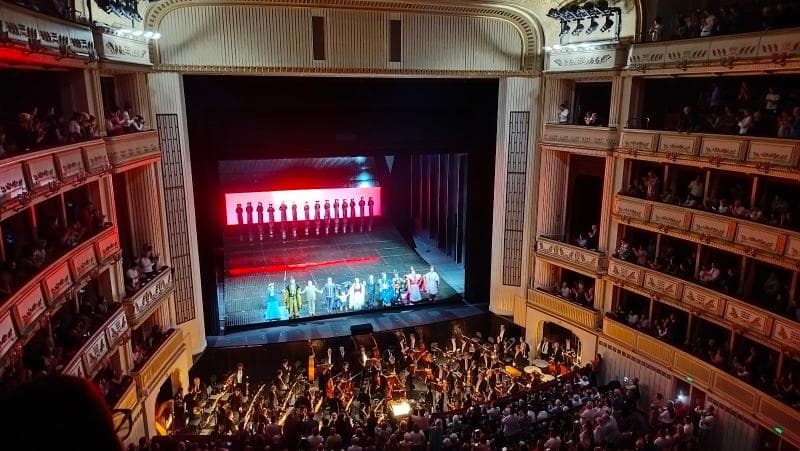
Discover the Grand Staircase of the Vienna State Opera in Vienna, Austria – a Neo-Renaissance masterpiece reflecting centuries of art and history.
Overview
The Grand Staircase, a breathtaking masterpiece nestled within the illustrious Vienna State Opera in Vienna, Austria, is far more than a mere passage between floors. It stands as a profound symbol of the city's rich artistic heritage and architectural grandeur. Designed in the Neo-Renaissance style, this magnificent entry hall, often described as a 'palace of movement,' was intended to be a stage before the stage, preparing visitors for the artistic spectacle that awaited them. Its elegance, marked by gleaming marble, intricate sculptures, and captivating frescoes, immediately transports onlookers to a bygone era of imperial splendor.
Remarkably, while much of the Vienna State Opera suffered severe damage during the bombings of World War II, the Grand Staircase, along with the ornate entrance hall, vestibule, and foyer, miraculously survived, preserving a significant portion of the original 19th-century splendor. Today, it remains a vibrant hub, where visitors can feel the weight of history beneath their feet, walking in the footsteps of emperors, divas, and debutantes who have graced its steps for over 150 years.
History & Cultural Background
The Vienna State Opera, originally known as the Vienna Court Opera, was constructed between 1861 and 1869, making it the first major building to grace Vienna's Ring Road. Architects August Sicard von Sicardsburg and Eduard van der Nüll were responsible for its design, a bold Neo-Renaissance statement in a city eager to showcase its cultural might. The opera house opened its doors on May 25, 1869, with a performance of Mozart's 'Don Giovanni,' in the presence of Emperor Franz Joseph I and Empress Elisabeth of Austria.
Despite its current revered status, the opera house faced initial public criticism, with some finding its exterior austere and its position on the newly raised Ringstraße unfavorable, leading to the architects' tragic deaths before its inauguration. However, the interior, particularly the Grand Staircase, immediately garnered high acclaim. For Vienna's elite society, the ascent of the Grand Staircase was a crucial part of the operatic experience. It was a space where one could see and be seen, a social ritual as important as the performance itself, allowing society to display its refinement and status.
What Makes It Special
The Grand Staircase is an exquisite symphony of marble, art, and meticulous craftsmanship. The sweeping, bifurcated marble steps are bounded by elegant balustrades and crowned with allegorical statues representing the arts. These include Music, Dance, and Drama, often attributed to Josef Gasser, embodying the seven liberal arts.
Above, the ceiling frescoes by Moritz von Schwind depict the triumph of music and poetry, glowing in soft pastels as they did in the 19th century. Mór Than's paintings adorn the gilded coffers, portraying themes like the 'Waking of Music' and the 'Power of Music,' along with the mythological 'Judgement of Tholos,' depicting the contest between Apollo and Marsyas. Gilded elements and lavish chandeliers further enhance the opulence, creating an atmosphere of unparalleled luxury and grandeur. The staircase's survival of World War II bombings stands as a testament to its robust construction and historical significance, preserving its original glory for future generations.
Stories, Fun Facts & Local Details
One poignant detail in the history of the Vienna State Opera and its Grand Staircase is the tragic fate of its architects, August Sicard von Sicardsburg and Eduard van der Nüll. Facing harsh public criticism for the building's design, van der Nüll died by suicide, followed shortly by von Sicardsburg. Neither lived to see their masterpiece inaugurated and become one of the world's most celebrated opera houses, a testament to the intense scrutiny and high expectations placed upon public works during that era.
The mythological narratives embedded within the staircase's artistry offer fascinating details. Mór Than's ceiling frescoes, for instance, not only showcase the 'Waking of Music' and the 'Power of Music' but also depict the dramatic 'Judgement of Tholos' where Apollo triumphed over Marsyas, with accompanying references to Greek deities like Hera, Hades, Zeus, and Poseidon. Along the walls, three scenes connected to the legend of Orpheus unfold: his journey to the underworld, his retrieval of Eurydice, and his ultimate death.
Beyond its artistic merit, the Grand Staircase is inextricably linked to the annual Vienna Opera Ball, a highlight of Vienna's social calendar. During this opulent event, the staircase transforms into a spectacular setting for grand entrances and elegant processions, continuing its role as a 'stage before the stage' where Viennese society traditionally displayed its glamour.
Visitor Perspective
Experiencing the Grand Staircase is an essential part of any visit to the Vienna State Opera. Whether you're attending a performance or taking a guided tour, ascending these marble steps is an immersive journey into Vienna's cultural heart. Visitors often describe feeling dwarfed by its impressive scale and enveloped by an atmosphere of historical elegance and luxury.
For those attending an opera, arriving early allows time to linger beneath the chandeliers and witness the elegant procession of guests, a ritual that has endured for centuries. Guided tours offer a deeper dive into the staircase's history, architecture, and symbolism, providing fascinating insights into its construction and the stories behind its intricate details. These tours, often available in multiple languages, unveil parts of the opera house that regular visitors might not see, making the Grand Staircase even more compelling. Standing at its base and gazing upwards, one can truly appreciate the symmetry, soaring arches, and soft golden light that make this space a prelude to the artistic magic of the opera.
Coordinates: 16.36921, 48.20327
View on Google Maps💬 How Travelers Describe This Place
Based on community votes
Interesting
950Must See
929Unique
858Photogenic
287Beautiful
275
Traveler Stories
Discover memorable experiences shared by travelers who have visited this place.
No traveler stories yet.
Be the first traveler to share what made this place memorable.

Tour
By
Spot
Discover amazing places around the world. Your journey starts here.
Explore
© 2026 TourBySpot. All rights reserved.