Grand Staircase
Madrid, Spain
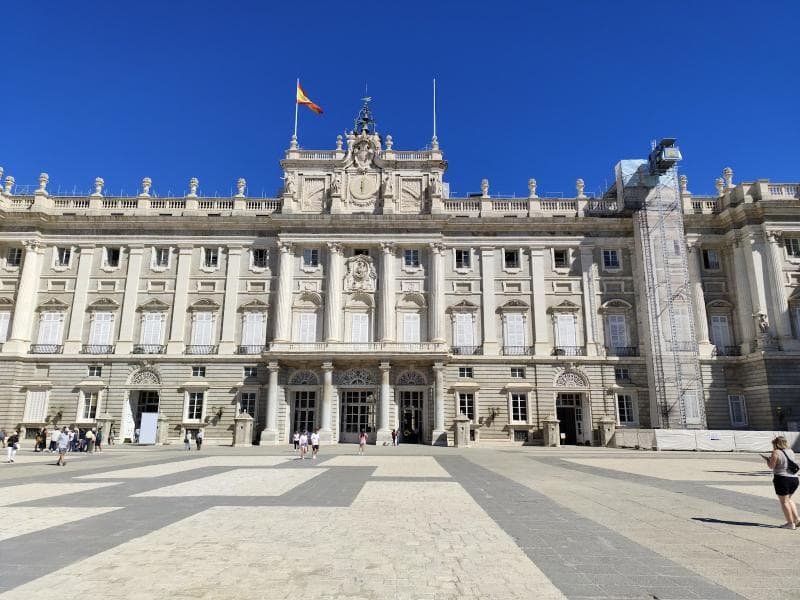
Discover the Grand Staircase of Madrid's Royal Palace, a Baroque masterpiece by Sabatini, featuring stunning frescoes & royal sculptures. Explore history in Spain.
Overview
Nestled within the majestic Royal Palace of Madrid, the Grand Staircase, also known as the Main Staircase, stands as a breathtaking testament to Baroque grandeur and royal extravagance. Designed by the esteemed Italian architect Francesco Sabatini, this architectural marvel is often one of the first magnificent sights to greet visitors, setting the tone for the opulence that lies within the palace. Its sweeping marble steps and intricate ornamentation serve not merely as a functional ascent but as a symbolic journey into centuries of Spanish history and monarchy. The staircase’s design harmoniously blends functionality with artistic splendor, reflecting the power and prestige of the Bourbon dynasty that commissioned it.
Comprising over 70 steps, the staircase unfolds in a dramatic double-flight arrangement, leading up to the palace's principal floors where state rooms and royal apartments reside. Every detail, from the choice of luxurious materials to the allegorical frescoes adorning its ceiling, was meticulously planned to impress and convey a sense of awe. It embodies the late Baroque classicism prevalent during its construction, making it a pivotal piece of the Royal Palace's artistic and historical narrative.
History & Cultural Background
The Royal Palace of Madrid itself rose from the ashes of the old Alcázar, a medieval fortress that tragically burned down on Christmas Eve in 1734. King Philip V, the first Bourbon king of Spain, envisioned a new, grander palace befitting his dynasty. Construction of the present palace began in 1738 and was largely completed by 1755, with King Charles III becoming its first royal resident in 1764.
The Grand Staircase, in its current magnificent form, is largely attributed to the designs and supervision of Francesco Sabatini. While Sabatini was involved in the palace's expansion from 1760, the significant relocation and construction of this particular staircase are often cited as dating to 1789, at the express wish of King Charles IV. This indicates a refinement or complete reconstruction of an earlier version, solidifying its place as a cornerstone of the palace's ceremonial heart. For centuries, this staircase has served as the grand processional route for monarchs, dignitaries, and courtiers, witnessing countless state ceremonies, royal audiences, and historical events, thus deeply embedding it within Spain's cultural fabric.
What Makes It Special
The Grand Staircase's uniqueness stems from its extraordinary artistry and meticulous craftsmanship. The primary material is a lavish, single piece of San Agustin marble for the core structure, renowned for its elegance and durability. Some sources also mention the use of Carrara marble and Spanish marble for various elements.
- Architectural Design: It features a sweeping double staircase that gracefully curves upwards, converging at a central landing, creating a dramatic and symmetrical ascent. The entire design is a prime example of Baroque architecture, characterized by its dramatic curves and ornate details.
- Frescoed Ceiling: Above the staircase, the ceiling is adorned with a breathtaking fresco by the Italian artist Corrado Giaquinto. Entitled 'Religion Protected by Spain' or 'The Triumph of Religion and Spain', this masterpiece vividly illustrates allegorical scenes, symbolizing the power of the monarchy and its divine protection.
- Sculptural Elements: Flanking the lower landing are two imposing lion sculptures, one by Felipe de Castro and the other by Robert Michel, acting as regal guardians. At the ground level, visitors will encounter a statue of King Charles III, depicted in a Roman toga, while a similar statue of Charles IV stands on the first floor.
- Symbolic Decor: Four large cartouches or stone jars are strategically placed around the staircase, representing the four classical elements: water, earth, air, and fire. The bronze handrails are exquisitely crafted with intricate metalwork and decorative patterns, further enhancing the staircase's majestic appeal.
Stories, Fun Facts & Local Details
The Grand Staircase is steeped in fascinating details that bring its history to life. The two lions guarding the entrance are not just decorative; they are said to symbolize the ruling philosophy of 'strength' and 'control' practiced by the Spanish monarchs. The statue of Charles III in a Roman toga is a nod to his dynastic roots and the classical ideals of leadership that influenced his reign.
A lesser-known fact is the 'Camón de la escalera', a designated space across the central landing where musicians would play welcome tunes for arriving dignitaries and royals, filling the grand hall with melodies as guests ascended. The sheer scale and meticulous planning mean that ascending this staircase is not just a walk, but a 'lesson in choreography', where the interplay of light, marble, and bronze guides the eye and naturally encourages a ceremonial pace.
Visitor Perspective
For any traveler to the Royal Palace, the Grand Staircase offers an immediate and profound sense of connection to Spain's royal past. It is intentionally designed as the palace's central axis, providing a dramatic entry point that prepares visitors for the lavish rooms and art collections beyond. As you climb its steps, you become part of a centuries-old tradition, following in the footsteps of kings, queens, and historical figures.
The various vantage points, from the base looking up its full expanse, to the mid-landing aligning with the ceiling fresco, or looking back down from the top, each offer a different perspective of its magnificent design and intricate details. It's an opportunity to appreciate the immense skill of 18th-century artisans and artists. While the primary access for visitors is via these grand steps, the palace thoughtfully provides elevators, ensuring accessibility for all, and allowing everyone to experience the grandeur of this iconic space.
Coordinates: -3.7083, 40.4175
View on Google Maps💬 How Travelers Describe This Place
Based on community votes
Photogenic
886Unique
443Beautiful
310Must See
277Interesting
233
Traveler Stories
Discover memorable experiences shared by travelers who have visited this place.
No traveler stories yet.
Be the first traveler to share what made this place memorable.

Tour
By
Spot
Discover amazing places around the world. Your journey starts here.
Explore
© 2026 TourBySpot. All rights reserved.