Grand Staircase
Salzburg, Austria
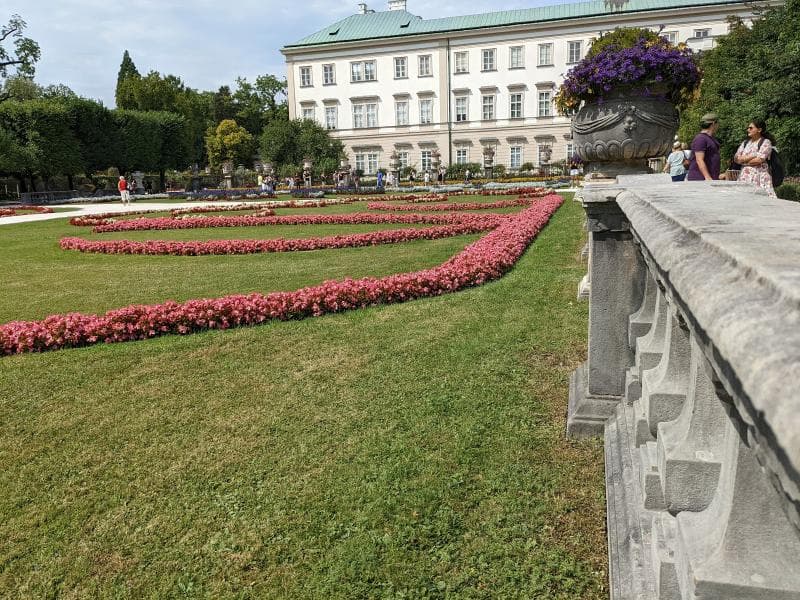
Discover the Grand Staircase, also known as the Angel Staircase, a Baroque masterpiece within Mirabell Palace in Salzburg, Austria. Explore its history and intricate sculptures.
Overview
Deep within the enchanting Mirabell Palace and Gardens in Salzburg, Austria, lies a true Baroque gem: the Grand Staircase. Often referred to as the 'Angel Staircase' (Engelsstiege), this magnificent marble structure is more than just a means to ascend; it is a work of art in itself, captivating visitors with its intricate design and historical grandeur. It serves as a principal access point within the palace, leading to areas such as the renowned Marble Hall, and embodies the lavish architectural spirit of its era.
History & Cultural Background
The history of Mirabell Palace, and by extension its Grand Staircase, is deeply intertwined with the romantic and political narratives of Salzburg. The palace was originally built in 1606 by Prince-Archbishop Wolf Dietrich von Raitenau for his beloved mistress, Salome Alt, and their 15 children, and was then known as Schloss Altenau.
After Wolf Dietrich's downfall, his successor, Marcus Sittikus, renamed it 'Schloss Mirabell', derived from the Italian words 'mirabile' meaning 'wonderful' and 'bella' meaning 'beautiful'. The palace underwent significant reconstruction and redesign between 1721 and 1727 under Prince-Archbishop Franz Anton von Harrach, transforming it into a cohesive Baroque complex. Architect Lukas von Hildebrandt was responsible for much of this Baroque masterwork, including the staircase.
A devastating city fire on April 30, 1818, ravaged much of Mirabell Palace. Miraculously, the Grand Staircase, along with the Marble Hall, survived largely unscathed, preserving these exquisite elements for future generations. Following the fire, Peter de Nobile, an architectural consultant and director of the Vienna School of Architecture, gave the palace its present elegant, neoclassical appearance, while carefully integrating the preserved Baroque elements.
What Makes It Special
What truly distinguishes the Grand Staircase is its masterful Baroque artistry. Crafted from white marble, its balustrade is adorned with a host of charming putti, or cherubs, which lend it the endearing nickname 'Angel Staircase'. These playful figures create an impression of movement and lightness, enhancing the theatricality of the ascent.
Within the niches along the staircase are magnificent sculptures, masterpieces created by the renowned Austrian sculptor Georg Raphael Donner. Donner's work is celebrated for its exceptional naturalistic modeling, capturing emotion and movement in marble, making these sculptures among the finest examples of European Baroque art.
The staircase's design epitomizes the Baroque integration of architectural sculpture, transforming a functional element into an artistic statement that elevates the experience of moving through the palace.
Stories, Fun Facts & Local Details
The Grand Staircase leads directly to the Marble Hall, a room famous not only for its beauty but also for its historical significance. Leopold Mozart and his children, Wolfgang Amadeus and Nannerl, performed here, adding a rich musical layer to the palace's heritage.
Today, the Marble Hall is celebrated as one of the world's most beautiful wedding halls, attracting couples from across the globe. While the staircase itself is not directly featured in the iconic 'Do-Re-Mi' scene from 'The Sound of Music', it leads to the Marble Hall and is part of the larger Mirabell Palace complex, which served as a memorable backdrop for the film.
The palace's name, Mirabell, a blend of 'mirabile' (wonderful) and 'bella' (beautiful), perfectly captures the awe and admiration visitors feel when encountering its beauty, including the splendid Grand Staircase.
Visitor Perspective
For any curious traveler, the Grand Staircase offers a captivating journey into Baroque artistry and history. As you ascend, the meticulously sculpted putti and the grand scale of the marble provide a sense of timeless elegance. Unlike many other parts of Mirabell Palace, which house city administration offices and are not accessible to the public, the Grand Staircase and the Marble Hall are open for visitors.
Admission to the Mirabell Palace and the Angel Staircase is free, making it an accessible cultural experience. It is generally open daily from approximately 8 AM to 6 PM, though visitors should note that the Marble Hall has more restricted hours and may be closed for special events like weddings or concerts. The Grand Staircase provides an excellent photo opportunity and a tangible connection to Salzburg's opulent past and its enduring artistic legacy.
Coordinates: 13.0385, 47.8033
View on Google Maps💬 How Travelers Describe This Place
Based on community votes
Interesting
998Beautiful
817Unique
711Photogenic
641Must See
19
Traveler Stories
Discover memorable experiences shared by travelers who have visited this place.
No traveler stories yet.
Be the first traveler to share what made this place memorable.

Tour
By
Spot
Discover amazing places around the world. Your journey starts here.
Explore
© 2026 TourBySpot. All rights reserved.