Grand Reading Hall
Dushanbe, Tajikistan
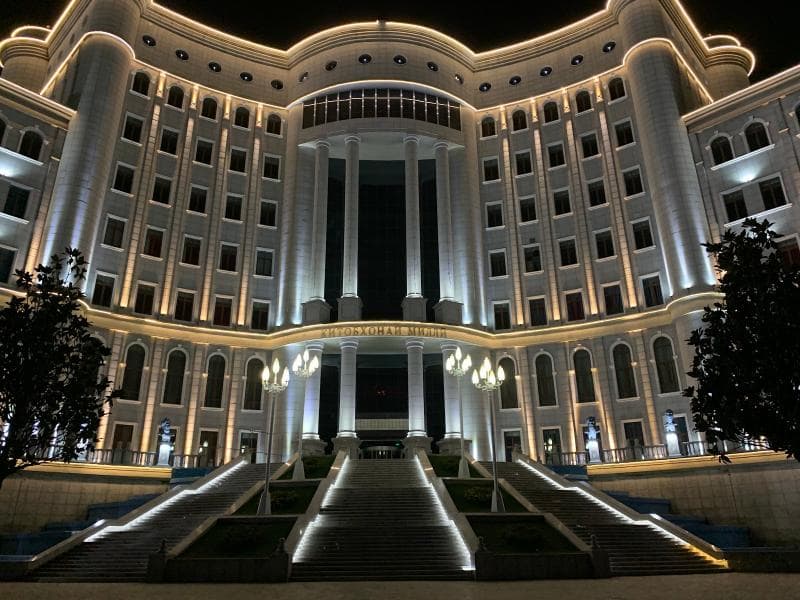
Explore the majestic reading rooms of the Tajikistan National Library in Dushanbe. Discover its open-book architecture, rich history, and vast collections.
Overview
The Tajikistan National Library, located in the heart of Dushanbe, stands as a prominent symbol of the nation's profound reverence for knowledge and its rich cultural heritage. Opened officially on March 20, 2012, this architectural marvel quickly established itself as the largest library in Central Asia. Its striking design, often likened to an open book, immediately conveys its purpose as a gateway to learning and intellectual exploration. The building itself is an impressive nine stories high, measuring 167 meters in length and 52 meters in height, encompassing a total area of approximately 45,000 square meters. [3, 11, 12, 13]
While there isn't a single sub-spot officially designated as the 'Grand Reading Hall,' the library houses an extensive collection of numerous and diverse reading rooms that collectively embody a sense of grandeur, catering to scholars, researchers, and curious visitors alike. These spaces are thoughtfully designed to foster deep study and quiet contemplation, providing an inspiring environment for all who enter. [12, 17]
History & Cultural Background
The roots of the National Library trace back to January 1933, when it was first established as a city library in Stalinabad (now Dushanbe). A year later, in 1934, it was named after the classical Persian poet Abulkasim Ferdowsi, a testament to the region's deep literary traditions. The library gained its national status in 1993, reflecting its growing importance as a custodian of Tajik culture. The commissioning of its spectacular new building in 2007 by President Emomali Rahmon marked a significant milestone, leading to its grand inauguration in 2012. [7, 8, 11, 15, 21]
This modern edifice replaced the former Ferdowsi Library, conceived not merely as a functional space but as a powerful national symbol. Its very existence and design emphasize Tajikistan's commitment to intellectual growth and the preservation of its literary and cultural legacy. The library's significance is so profound that it even features on the Tajik 200 somoni banknote, underscoring its iconic status within the national consciousness. [3, 12]
What Makes It Special
Beyond its sheer scale as the largest library in Central Asia, what truly distinguishes the Tajikistan National Library is its architectural symbolism. The nine-story structure, shaped like an open book, is an artistic representation of knowledge unfolding, inviting everyone to delve into its treasures. This monumental building is not only a functional research and reading space but also a proud emblem of national identity. [3, 12]
The library's exterior features 22 busts of prominent figures from Tajik history, literature, science, and culture, adorning the facade and honoring the nation's intellectual heritage. Inside, the institution embraces modern technology with a digital catalog, an electronic library, and access to advanced information and communication technologies for its visitors. It boasts a vast collection, including ancient manuscripts, rare books, and a comprehensive array of resources in Tajik, Russian, and other languages, totaling over three million items. [3, 7, 10, 11, 13, 18, 19]
Stories, Fun Facts & Local Details
The 'open book' design of the library is more than just an architectural feature; it is a powerful national narrative, embodying Tajikistan's dedication to enlightenment. Its depiction on the 200 somoni banknote serves as a daily reminder of the value placed on education and cultural preservation. [3, 12]
Interestingly, the new building's foundation stone was laid on September 4, 2007, and President Emomali Rahmon subsequently declared September 4th as the 'Day of the Book' in Tajikistan, further cementing the library's role in the nation's cultural calendar. [21] The library also ensures a comfortable microclimate within its walls, allowing readers to feel at ease even during hot summer days. [10] It actively fosters international cooperation, collaborating with over 60 foreign institutions and organizations, and more than 20 large libraries worldwide. [8]
Visitor Perspective
The library is exceptionally well-equipped for visitors and researchers. It features between 25 and 27 reading rooms, providing ample space with 274 to 1500 workstations for readers. [7, 10, 11, 17] For Tajik citizens, access to the library is often free with a passport, highlighting its accessibility as a public institution. [15, 19] Guided tours are available, which can be an excellent way to explore the facility and learn about its extensive collections, though a nominal fee may apply depending on nationality. It is advisable to inquire about tours upon arrival, as self-guided exploration might require an access card or guide. [5]
Visitors are encouraged to dress modestly, respecting the library's status as a cultural institution. Weekdays, particularly mornings, are often recommended for a visit to avoid potential crowds and allow for a more peaceful exploration of the reading rooms and exhibitions. The library's central location on Rudaki Avenue also makes it convenient to combine a visit with other nearby attractions in Dushanbe. [5, 9]
Coordinates: 68.78833, 38.57222
View on Google Maps💬 How Travelers Describe This Place
Based on community votes
Photogenic
551Interesting
547Unique
336Beautiful
219Must See
186
Traveler Stories
Discover memorable experiences shared by travelers who have visited this place.
No traveler stories yet.
Be the first traveler to share what made this place memorable.

Tour
By
Spot
Discover amazing places around the world. Your journey starts here.
Explore
© 2026 TourBySpot. All rights reserved.