Grand Dome
Bucharest, Romania
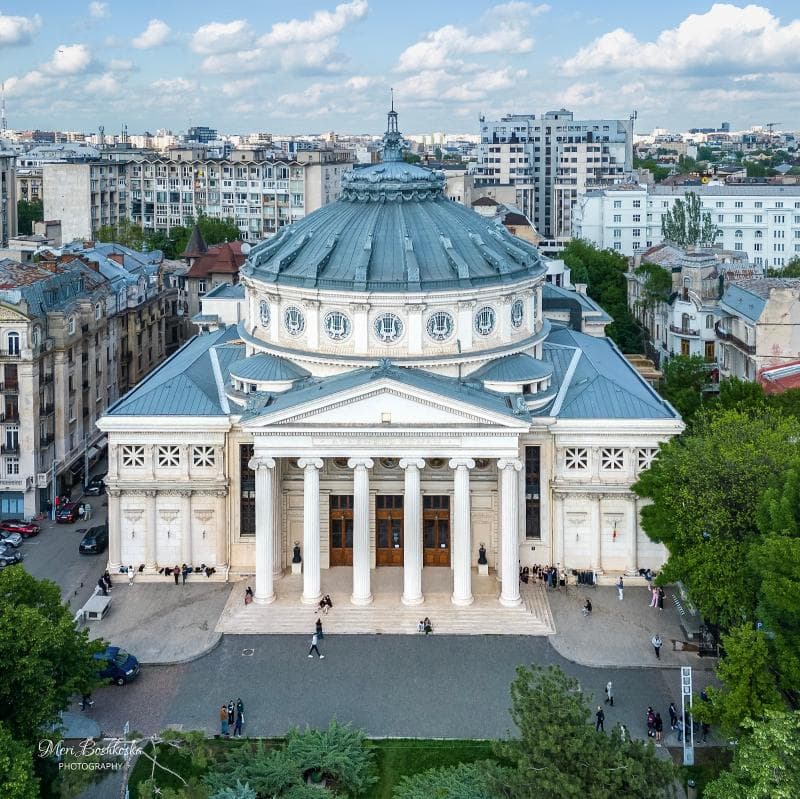
Explore the Grand Dome of the Romanian Athenaeum in Bucharest, Romania. Discover its stunning architecture, historical fresco, and rich cultural significance.
Overview
Nestled in the vibrant heart of Bucharest, Romania, the Romanian Athenaeum stands as a profound symbol of the nation's cultural aspirations and artistic heritage. This architectural masterpiece, often referred to for its striking 'Grand Dome,' is not merely a building but a living monument dedicated to art and science. Home to the George Enescu Philharmonic Orchestra, it is celebrated globally as one of Europe's most prestigious concert halls, renowned for its exceptional acoustics and breathtaking interior. Its elegant neoclassical design, characterized by a majestic dome and intricate columns, makes it an unmissable landmark in the Romanian capital, drawing visitors into a world where history and music intertwine.
History & Cultural Background
The story of the Romanian Athenaeum began in 1865 with the founding of the Romanian Athenaeum Cultural Society by prominent figures such as Constantin Esarcu. Their vision was to create a dedicated space for cultural and scientific endeavors. Construction, based on the designs of French architect Albert Galleron, commenced in 1886 and the building was inaugurated in 1888, though work continued until 1897. A significant portion of the funds required for its construction was raised through an extraordinary public subscription campaign that lasted 28 years, immortalized by the enduring slogan: 'Donate one leu for the Ateneu!'. This collective effort underscores the deep national pride and commitment to culture that the Athenaeum embodies. Beyond its artistic role, the Athenaeum holds immense historical significance; notably, on December 29, 1919, it hosted the conference where leading Romanians voted to ratify the unification of Bessarabia, Transylvania, and Bukovina, laying the foundation for Greater Romania.
What Makes It Special
The 'Grand Dome' is the centerpiece of the Romanian Athenaeum's appeal, encompassing its magnificent circular concert hall. This auditorium, with a seating capacity of approximately 794 in the stalls and boxes arranged in an amphitheater style, is acclaimed for its warm and spectacular atmosphere and its superb acoustics. The most captivating feature within this space is the monumental fresco that encircles the interior just below the dome. This continuous 75-meter-long (or 70-meter-long), 3-meter-wide painting, created by Romanian artist Costin Petrescu between 1933 and 1939, vividly depicts 25 significant moments in the history of the Romanian people, presented in a nationalist narrative. The building's neoclassical style, featuring a portico with six Ionic columns, lends it a temple-like appearance, elevating its cultural purpose to a revered status.
Stories, Fun Facts & Local Details
An intriguing aspect of the Athenaeum's design is its circular shape, which ingeniously derives from its foundation upon the site of a former American circus. This unique origin contributed to its distinct architectural form. The fresco by Costin Petrescu serves as a visual encyclopedia of Romanian identity, illustrating key historical events from the ancient Dacians and Romans, through medieval battles, to the 1918 Great Union. Beyond the fresco, the ceiling vault itself is adorned with golden polychrome reliefs of anthropomorphic, zoomorphic, and phytomorphic motifs inspired by Romanian folk stories. Each motif guards a cartouche bearing the name of a major Romanian cultural personality. The Athenaeum is also the esteemed venue for the George Enescu Festival, one of Europe's most significant classical music festivals, occurring biennially. Outside, visitors are greeted by a small park featuring a statue of the revered Romanian poet Mihai Eminescu, adding another layer of cultural significance to the site.
Visitor Perspective
Visiting the Romanian Athenaeum offers a deeply enriching experience, whether attending a world-class concert or exploring its architectural grandeur on a guided tour. While concerts offer the full auditory and visual spectacle, guided tours provide insight into its history and artistic details, including the magnificent fresco. Access for general visits is typically via the side entrance, also known as the Musicians' Entrance, while concert-goers use the main entrance. Tickets for tours are usually purchased on-site, though it is highly recommended to check the official George Enescu Philharmonic website for the most current visiting hours and schedule, as these can vary due to rehearsals and performances. The Athenaeum is conveniently located in central Bucharest, near Revolution Square, making it easily accessible by foot or public transport, with the nearest metro station being Piata Romana. Allow at least 30 minutes to an hour for a non-concert visit to fully appreciate its splendor.
Coordinates: 26.097305, 44.441363
View on Google Maps💬 How Travelers Describe This Place
Based on community votes
Photogenic
989Must See
791Interesting
613Beautiful
514Unique
207
Traveler Stories
Discover memorable experiences shared by travelers who have visited this place.
No traveler stories yet.
Be the first traveler to share what made this place memorable.

Tour
By
Spot
Discover amazing places around the world. Your journey starts here.
Explore
© 2026 TourBySpot. All rights reserved.