Government Palace
Helsinki, Finland
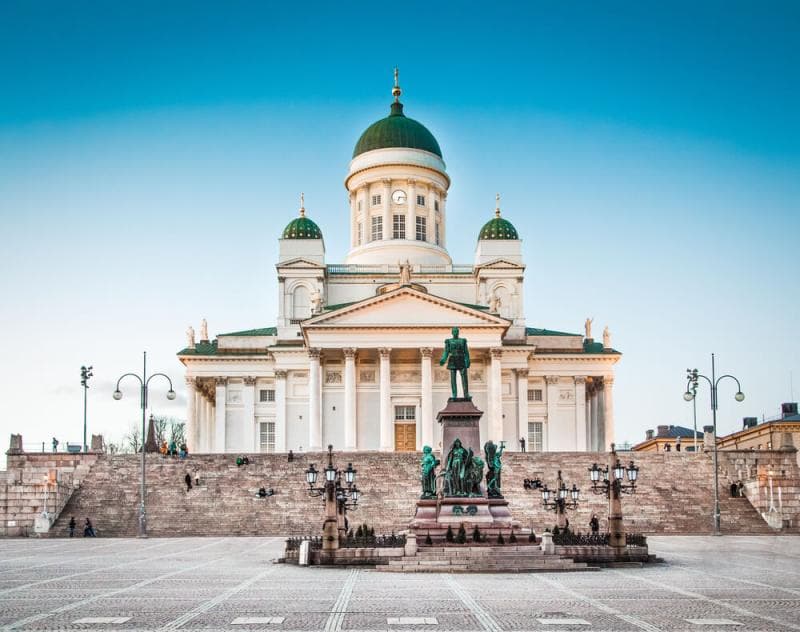
Explore Helsinki's Government Palace, a neoclassical landmark in Senate Square. Discover its rich history, Carl Ludvig Engel's architecture, and its role as the heart of Finnish governance.
Overview
Standing majestically on the eastern side of Helsinki's iconic Senate Square, the Government Palace is a monumental symbol of Finnish governance and history. This stately neoclassical edifice, known in Finnish as Valtioneuvoston linna, currently serves as the primary executive office building for the Government of Finland. It houses the crucial offices of the Prime Minister, the Office of the Chancellor of Justice, and several departments of the Ministry of Finance, making it the heart of the nation's administration. Its prominent position within the meticulously planned square makes it an unmissable landmark, integral to the city's historical and architectural identity.
History & Cultural Background
The story of the Government Palace begins in the early 19th century, a period of significant change for Finland. Following the Finnish War and the transfer of Finland from Swedish to Russian rule in 1809, Helsinki was designated as the capital of the newly formed Grand Duchy of Finland. The construction of the Palace commenced in 1818, with its main wing completed and occupied by the Senate in 1822. It was meticulously designed by the renowned German-born architect Carl Ludvig Engel, whose neoclassical vision shaped much of central Helsinki's grand aesthetic.
Originally known as the Senate House, or Senaatintalo, the building was conceived as a powerful symbol for the Grand Duchy. Engel's design employed the Neoclassical Empire style, drawing inspiration from antiquity, reflecting ideals of stability and rational governance. In its early years, the building was a hub of public life, accommodating not only the Senate but also various important public agencies such as the predecessor of the Bank of Finland, the Postal Directorate, the Customs Board, and even the National Archives. The University of Helsinki also temporarily operated within its walls before its own dedicated main building was completed. With Finland's declaration of independence in 1917 and the subsequent formation of the Finnish Government in 1918, the building transitioned from the Senate House to its current designation as the Government Palace, continuing its role as the seat of national administration.
What Makes It Special
What truly sets the Government Palace apart is its profound architectural and symbolic significance. It stands as a prime example of Carl Ludvig Engel's mastery of the Neoclassical style, characterized by its symmetrical, restrained facade, pale yellow exterior, and classical columns. Engel purposefully designed the building's facade with Corinthian columns to visually communicate its status as an office of power and administration, creating a dialogue with the Ionic columns of the University of Helsinki's main building across the square, which symbolized education. This deliberate architectural language contributes to the Senate Square's status as an internationally significant and well-preserved urban artistic creation.
The Palace forms a crucial part of the cohesive architectural ensemble that defines Helsinki's historical core. Beyond its external grandeur, the building houses exceptionally well-preserved interiors, with the main staircase and the former Senate Assembly Hall, now known as the Presidential Room, noted as its most architecturally valuable parts. These elements offer a glimpse into the original design and the rich history embedded within its walls.
Stories, Fun Facts & Local Details
The Government Palace is not just a building; it is a repository of fascinating stories and pivotal moments in Finnish history. Perhaps one of the most dramatic events occurred in 1904 when Eugen Schauman assassinated Governor-General Nikolai Bobrikov on the main staircase of the building. This act of defiance against Russian rule remains a potent symbol of the era's political tensions.
In its early days, the Palace served a surprisingly diverse range of functions, even housing a public library and a university library, underscoring its role as a central civic institution. An annex in the courtyard was added in 1860 to house the Senate printing press, highlighting the breadth of activities conducted within its block. Today, the building holds the portraits of all the Presidents of Finland within its Presidential Room, subtly connecting the nation's past leaders to its present governance. While typically not open to the public, the Palace occasionally opens its doors for special events like Helsinki Day or European Heritage Days, offering guided tours that provide a rare look inside this working government building. Visitors embarking on these tours can often trace the path of history, including the very staircase where the dramatic events of 1904 unfolded. The building is slated for an extensive renovation between 2026 and 2030, ensuring its continued preservation for future generations.
Visitor Perspective
For the curious traveler exploring Helsinki, the Government Palace offers a profound sense of connection to Finland's past and present. While its primary function means it is generally not open for casual public access, its imposing presence on Senate Square invites admiration and contemplation. Observing its stately facade from the square, one can appreciate the architectural harmony it creates with the surrounding buildings, including the Helsinki Cathedral and the University's main building. The pale yellow exterior and classical lines evoke a sense of dignified authority and historical continuity. For those fortunate enough to attend one of the infrequent open days, stepping inside is a journey through corridors steeped in two centuries of national decision-making and dramatic events. It's an opportunity to feel the weight of history and to understand, on a deeper level, the foundations of Finnish democracy. Even from the outside, the Government Palace serves as a powerful reminder of Helsinki's rich heritage and its enduring role as a capital city.
Coordinates: 24.95444, 60.16944
View on Google Maps💬 How Travelers Describe This Place
Based on community votes
Photogenic
996Unique
494Interesting
193Beautiful
125Must See
82
Traveler Stories
Discover memorable experiences shared by travelers who have visited this place.
No traveler stories yet.
Be the first traveler to share what made this place memorable.

Tour
By
Spot
Discover amazing places around the world. Your journey starts here.
Explore
© 2026 TourBySpot. All rights reserved.