Gothic Facade
Riga, Latvia
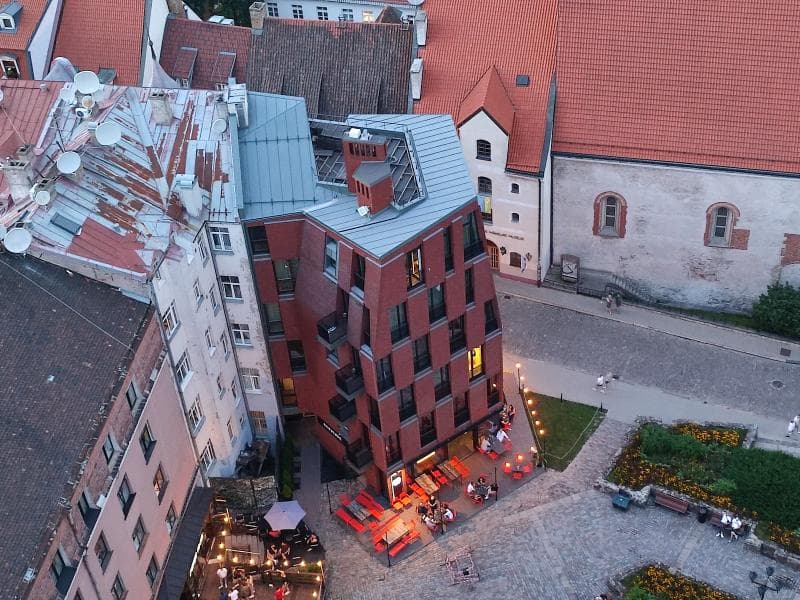
Explore the enduring Gothic facade of St. Peter's Church in Riga, Latvia. Discover its medieval origins, architectural evolution, and historical significance.
Overview
St. Peter's Church in Riga, Latvia, stands as a magnificent testament to medieval architecture, renowned for its enduring Gothic facade that captures centuries of history and artistic evolution. While its soaring spire often steals the spotlight, the church's exterior, particularly its older sections and structural elements, exhibits profound Gothic characteristics that date back to its very foundations. This architectural marvel, first mentioned in 1209, has witnessed numerous transformations, yet its underlying Gothic identity remains a cornerstone of Riga's Old Town, a UNESCO World Heritage site. It is not merely a single, unified front but rather the collective Gothic expression found across its nave, chancel, and the rear aspects of its structure, providing a vivid glimpse into the city's rich past.
The grandeur of St. Peter's Church is deeply embedded in its brick Gothic style, a distinctive regional interpretation of Gothic architecture characterized by the use of bricks, often seen in the Baltic Sea region. As you approach, you'll observe how the robust masonry and intricate detailing of its walls tell a story of resilience and adaptation through various periods of construction and reconstruction.
History & Cultural Background
The origins of St. Peter's Church trace back to the early 13th century, with its first recorded mention in 1209. Initially, it began as a smaller structure, but it soon underwent significant extensions in the Gothic style during the 13th and 14th centuries. The construction of the original, early Gothic church was completed around 1234.
The most substantial Gothic developments occurred in the 15th century, transforming the church into the imposing three-aisled basilica we recognize today. Master Johannes Rumeschottel from Rostock, drawing inspiration from St. Mary's Church in Rostock, supervised the construction of the chancel between 1408 and 1409, a period that cemented the church's Gothic identity. This era saw the creation of its mighty basilica form with vaulted ceilings and the completion of its eastern parts.
Despite its predominantly Gothic foundation, the church has experienced a complex architectural biography. Fires, wars, and the prevailing styles of different epochs led to several reconstructions. Notably, the western facade, which serves as the church's main entrance, underwent significant alteration in the late 17th century. During this period, it was adorned with reddish limestone and decorated with Baroque elements such as volutes, pilasters, cornices, and vases, layering a Baroque aesthetic over its Gothic base. However, parts of the nave and the chancel still clearly exhibit their original Gothic appearance, particularly from the rear.
What Makes It Special
The 'Gothic Facade' of St. Peter's Church is special not as a monolithic design, but as a living record of architectural history etched in stone and brick. It represents a continuous dialogue between the original medieval Gothic design and subsequent historical layers. The external walls of the side areas and some of the interior pillars are remnants from the 13th century, providing a direct link to its earliest Gothic construction.
The church's chancel, with its ambulatory of chapels, and the nave have largely retained their Gothic appearance. This includes the prominent use of brick, characteristic of Baltic Gothic, and features like pointed arcades, two-stage buttresses, and large, ogival windows. These elements highlight the verticality and intricate craftsmanship inherent in Gothic architecture. The sheer scale and enduring presence of these Gothic sections make the church a prime example of medieval monumental architecture in the Baltic States.
Furthermore, St. Peter's Church symbolizes Riga's resilience. It has been destroyed and rebuilt numerous times, notably during World War II, yet its core Gothic elements have either survived or been painstakingly restored, allowing visitors to trace its evolution through the centuries.
Stories, Fun Facts & Local Details
One fascinating aspect related to the church's exterior, particularly its spire, is the enduring presence of the weathervane rooster. While not strictly part of the Gothic facade itself, the rooster has become an iconic symbol atop the tower, which crowns the church's overall appearance. Since the 15th century, there have been a total of seven roosters, each facing its own set of challenges. Stories recount how roosters were bent by storms, blown down, or simply collapsed, mirroring the church's own turbulent history of destruction and rebirth. The current rooster, a precise reproduction, was placed in 1970 and later gilded.
Historically, St. Peter's Church also housed one of the oldest schools in the city, recorded as early as 1353 and 1391, emphasizing its role not just as a spiritual center but also as a hub of civic and intellectual life in medieval Riga. The church's Gothic grandeur wasn't just aesthetic; it embodied its central importance to the Riga bourgeoisie during the Middle Ages.
Visitor Perspective
For a curious traveler, observing the Gothic facade of St. Peter's Church is like walking through a living history book. From the rear, where the original Gothic architecture is more apparent, one can distinctly appreciate the medieval craftsmanship and design. This provides a striking contrast to the more Baroque-influenced western facade, allowing visitors to ponder the architectural layers accumulated over eight centuries.
While the internal experience offers rich architectural details from various periods, it is the exterior that truly showcases the church's evolution from its 13th-century Gothic foundations. The intricate brickwork, the soaring lines of its older sections, and the sense of enduring history emanating from its walls invite contemplation. Standing before its enduring Gothic elements, one can easily imagine the bustling medieval city life that once unfolded around this monumental structure, making it a compelling stop for anyone interested in the layers of European history and architecture.
Coordinates: 24.1093, 56.9475
View on Google Maps💬 How Travelers Describe This Place
Based on community votes
Photogenic
556Must See
422Beautiful
394Unique
269Interesting
145
Traveler Stories
Discover memorable experiences shared by travelers who have visited this place.
No traveler stories yet.
Be the first traveler to share what made this place memorable.

Tour
By
Spot
Discover amazing places around the world. Your journey starts here.
Explore
© 2026 TourBySpot. All rights reserved.