Golden Hall
Stockholm, Sweden
Discover the opulent Golden Hall in Stockholm City Hall, Sweden. Explore its 18 million gold mosaics depicting Swedish history and experience the Nobel Prize Ball venue.
Overview
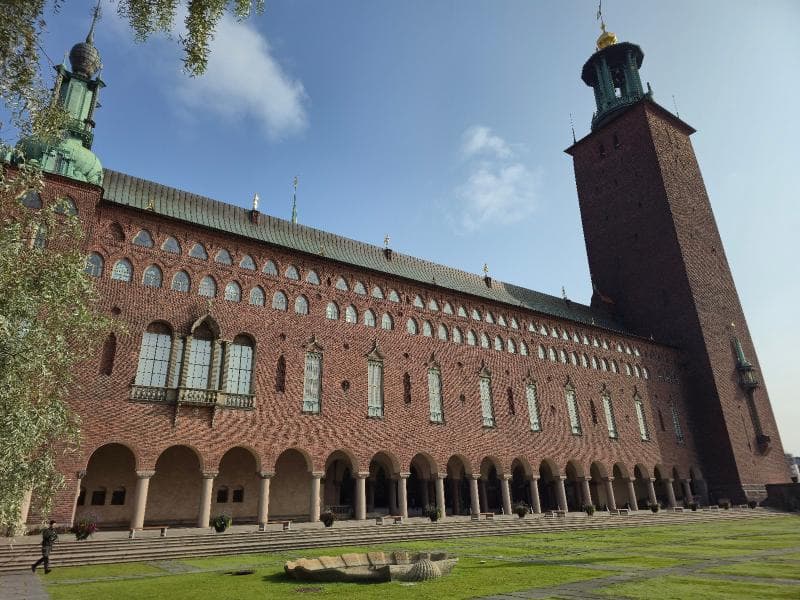
Deep within the imposing brick structure of Stockholm City Hall, a jewel of Swedish artistry and history awaits: the Golden Hall. Known as Gyllene Salen in Swedish, this magnificent banqueting hall captivates visitors with its shimmering surfaces and intricate narratives. Spanning 44 meters in length, it is not merely a room but a grand canvas that tells the story of a nation through millions of dazzling mosaics. The Golden Hall is perhaps most famously recognized as the vibrant setting for the annual Nobel Prize Ball, where laureates, royalty, and esteemed guests gather to dance after the Nobel Banquet held in the adjacent Blue Hall.
Stepping into the Golden Hall feels like entering a realm where light dances on history, a testament to Sweden's rich cultural heritage and artistic ambition. Its walls, glowing with gold, offer a unique journey through allegories and historical depictions, establishing it as a cornerstone of Stockholm's civic and cultural identity.
History & Cultural Background
The vision for the Golden Hall emerged as part of the broader construction of Stockholm City Hall, a monumental project conceived in 1907. The name 'Gyllene Salen' was first designated in 1909, long before its golden transformation. Initially, the hall was envisioned with stone and granite, quite different from its current radiant appearance. However, a significant anonymous donation of 300,000 SEK between 1917 and 1919 provided the means to rework the hall into the extraordinary golden spectacle we see today.
The entire Stockholm City Hall, designed by architect Ragnar Östberg, was completed in 1923 and stands as a prime example of the National Romantic style, blending historical influences with contemporary artistic expression. The intricate mosaics of the Golden Hall were meticulously installed between 1921 and 1923 by the Berlin-based mosaic firm Puhl & Wagner Gottfried Heinersdorff. The artistic genius behind these dazzling depictions was Einar Forseth, a Swedish artist who, at a young age, embarked on this monumental task, infusing the space with Byzantine-inspired art alongside Nordic legends.
What Makes It Special
The unparalleled brilliance of the Golden Hall comes from its more than 18 million mosaic tiles, predominantly crafted from gold and glass. These tiny, less than a millimeter thick, tiles were handmade in Germany, where real gold leaf was fused between layers of glass before being meticulously transported and set into the walls of the hall. This painstaking process created a seamless, shimmering tapestry that reflects light and brings the hall to life.
The mosaics present a captivating blend of allegories depicting events and figures from Swedish history, intertwined with Byzantine iconography and local legends. Dominating the northern wall is the majestic figure of the 'Queen of Lake Mälar', or Mälardrottningen, a symbolic personification of Stockholm with the city cradled in her lap, reflecting Stockholm's identity as a city between Lake Mälaren and the Baltic Sea. Other walls illustrate diverse motifs, from scenes of Stockholm's harbor and landmarks to representations of historical events and mythical figures like Saint Erik.
Beyond its visual splendor, the hall holds significant cultural weight as the venue for the Nobel Prize Ball. After the formal Nobel Banquet in the Blue Hall, guests ascend to the Golden Hall for an evening of celebration and dance, making it a place where grand scientific and cultural achievements are symbolically celebrated amidst golden glory.
Stories, Fun Facts & Local Details
Interestingly, despite their current revered status, the mosaics of the Golden Hall were not universally acclaimed upon their completion; they were initially quite unpopular with some critics. One fascinating detail to look for in the intricate mosaic work is an often-cited 'planning error' where, due to the alignment of tiles, Saint Erik appears to have lost his head in a comical fashion.
The very name 'Golden Hall' offers a striking contrast to its neighbor, the 'Blue Hall', which despite its name, is famously not blue. The Blue Hall was originally intended to be painted blue, but architect Ragnar Östberg was so taken by the beauty of its unpainted red brick walls that he decided to leave them exposed, yet the name endured. The Golden Hall's opulent design, a result of an anonymous benefactor's generous donation, transformed it from a planned stone interior into the dazzling golden spectacle it is today, adding a layer of mystery to its origins.
Visitor Perspective
To experience the breathtaking beauty and rich history of the Golden Hall firsthand, visitors must join a guided tour of Stockholm City Hall. These engaging tours, typically lasting about 45 minutes, offer a comprehensive insight into not just the Golden Hall, but also other significant areas like the Blue Hall, the Council Chamber, and the Prince's Gallery.
As you walk through this radiant space, your guide will unveil the stories behind the mosaics, bringing to life the historical figures and allegories depicted across the walls. It is a moment of immersion, allowing one to appreciate the monumental effort and artistic vision that created this Swedish treasure. For those visiting during the summer months (May to September), the City Hall Tower is also accessible, providing panoramic views across Stockholm after your tour of the glittering hall.
Coordinates: 18.055, 59.3275
View on Google Maps💬 How Travelers Describe This Place
Based on community votes
Beautiful
981Unique
617Interesting
357Photogenic
147Must See
28
Traveler Stories
Discover memorable experiences shared by travelers who have visited this place.
No traveler stories yet.
Be the first traveler to share what made this place memorable.

Tour
By
Spot
Discover amazing places around the world. Your journey starts here.
Explore
© 2026 TourBySpot. All rights reserved.