Golden Gate
Kiev, Ukraine
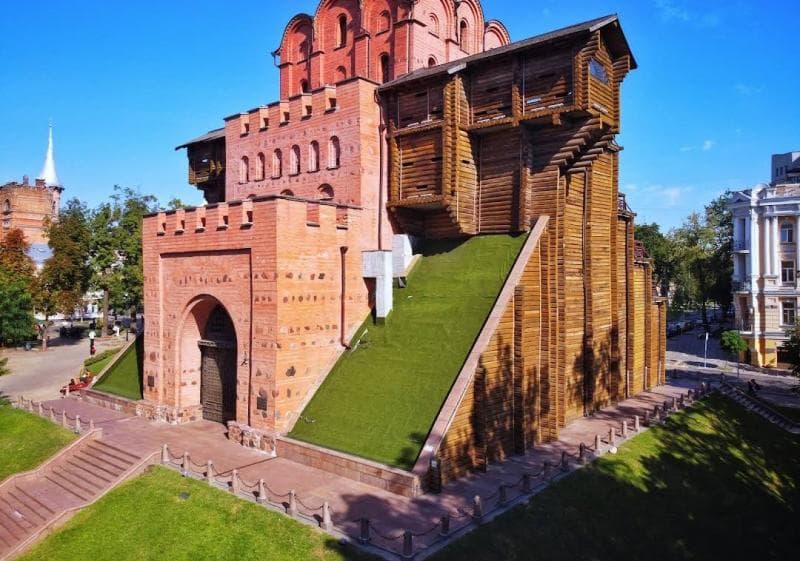
Explore Kyiv's iconic Golden Gate (Zoloti Vorota), an 11th-century historical landmark and museum in Ukraine's capital.
Overview
The Golden Gate, or Zoloti Vorota, stands as a profound symbol of Kyiv's ancient power and enduring legacy. Located in the heart of Ukraine's capital, this reconstructed medieval gateway served as the main ceremonial entrance to the fortified city of Kyiv during the Kyivan Rus' era. Today, it functions as a museum, offering visitors a tangible connection to a millennium of history. Surrounded by a tranquil park, the Golden Gate invites exploration into its storied past and architectural grandeur.
While appearing as a robust stone structure, the modern Golden Gate is a protective pavilion built around the preserved fragments of the original 11th-century walls. It represents an ambitious effort to visually restore one of Kyiv's most significant landmarks, providing both historical context and an impressive sight.
History & Cultural Background
The original Golden Gate was constructed between 1017 and 1024 (or 1037 according to some sources) during the reign of Prince Yaroslav the Wise, a pivotal figure in Kyivan Rus' history. It was an integral part of the city's extensive fortifications, which also included other gates like the Lyadski and Zhydivski (Jewish) gates, though only the Golden Gate has survived.
Initially known as the Southern Gate, it likely acquired the 'Golden' moniker due to the gilded domes of the Church of the Annunciation built above its passageway, or as a deliberate imitation of the famous Golden Gate of Constantinople, signaling Kyiv's status as a significant European capital.
For nearly half a millennium, the gate functioned as Kyiv's triumphal arch, witnessing the comings and goings of ambassadors, merchants, and princely troops. Its imposing presence was meant to deter enemies and impress allies.
However, the gate suffered partial destruction in 1240 during the invasion by Batu Khan's Golden Horde, and over subsequent centuries, it gradually fell into disrepair, eventually becoming a ruin.
In 1832, excavations led to the discovery and initial conservation of the gate's remnants. Significant reconstruction efforts were undertaken in 1982 to commemorate Kyiv's 1500th anniversary, resulting in the appearance we see today. This reconstruction was a controversial decision among historians and architects, as no definitive images of the original gate existed, leading to various interpretations of its medieval form.
What Makes It Special
The Golden Gate is unique as one of the few surviving monuments of defensive architecture from ancient Kyivan Rus'. It embodies the city's historical resilience and its strategic importance in medieval Eastern Europe.
Its special quality lies in the harmonious blend of the authentically preserved 11th-century fragments, which visitors can see within the museum, and the enveloping 20th-century protective structure. This allows for both the preservation of the original ruins and a visual representation of the gate's majestic past.
The reconstructed gate features a church above its passage, complete with a golden dome, echoing the historical detail that likely gave the gate its name. This architectural feature highlights the spiritual significance intertwined with Kyiv's defensive structures.
Stories, Fun Facts & Local Details
- Name Origin: The 'Golden' in Golden Gate has two popular theories. One suggests it came from the shining gilded dome of the Church of the Annunciation situated atop the gate. The other proposes it was named in emulation of Constantinople's grand entrance, reflecting Kyiv's ambition and status.
- Yaroslav the Wise: A bronze monument to Yaroslav the Wise, the gate's builder, stands proudly in front of the structure, commemorating his pivotal role in Kyiv's golden age.
- Panteleimon the Cat: Near the Golden Gate, visitors can find a charming bronze statue of a cat named Panteleimon. This popular local legend honors a cat that lived in a nearby restaurant and tragically died in a fire. The statue was erected by staff and diners in its memory and is now a beloved photo opportunity.
- Ceremonial Entrance: The gate was not just a defensive structure; it was the grand ceremonial entrance for foreign dignitaries and princes, signifying the majesty and importance of Kyiv.
Visitor Perspective
Stepping through the Golden Gate today offers a journey back in time. Inside, the museum showcases preserved fragments of the original 11th-century walls, offering a rare glimpse into the actual ancient stonework. Exhibits provide insights into the gate's construction, its history, and the broader context of ancient Kyiv.
From the upper levels of the gate, visitors can enjoy panoramic views of central Kyiv, providing a different perspective of the city that once lay behind these formidable walls.
The Golden Gate is set within a pleasant, well-maintained park, complete with benches and a fountain, making it an ideal spot for a leisurely stroll or quiet contemplation. Its central location and proximity to the Zoloti Vorota metro station (which shares its name) make it easily accessible for travelers.
Coordinates: 30.5146, 50.4442
View on Google Maps💬 How Travelers Describe This Place
Based on community votes
Beautiful
998Must See
711Unique
641Photogenic
481Interesting
196
Traveler Stories
Discover memorable experiences shared by travelers who have visited this place.
No traveler stories yet.
Be the first traveler to share what made this place memorable.
Things to see at Golden Gate



Tour
By
Spot
Discover amazing places around the world. Your journey starts here.
Explore
© 2026 TourBySpot. All rights reserved.