Defensive Walls
Kiev, Ukraine
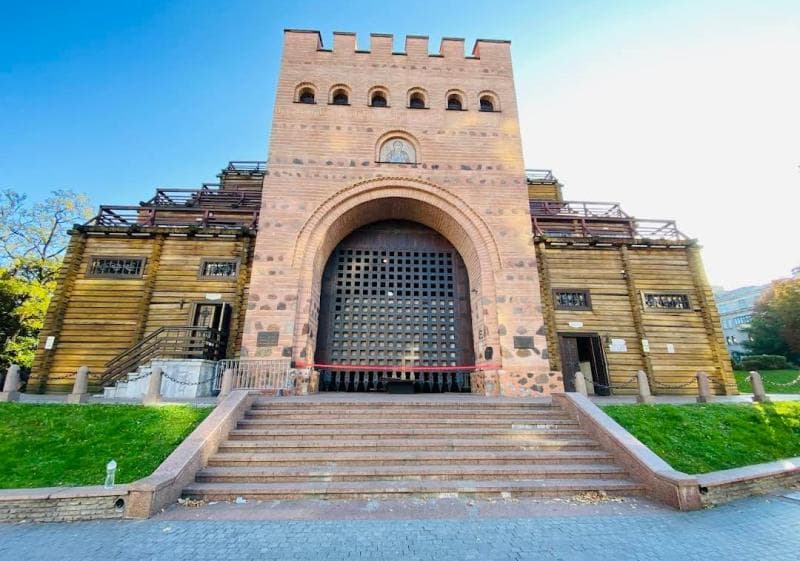
Explore the historic Defensive Walls of the Golden Gate in Kyiv, Ukraine. Discover ancient fortifications and Kievan Rus' history.
Overview
The Golden Gate, or Zoloti Vorota as it is known locally, stands as a powerful symbol of Kyiv’s ancient past and its historical significance. Originally constructed in the 11th century, it served as the main entrance and a formidable defensive fortification of the capital of Kievan Rus'. Commissioned by Prince Yaroslav the Wise, this monumental gate was designed not only to protect the city from invaders but also to impress with its grandeur, echoing the famous Golden Gate of Constantinople.
Today, visitors to Kyiv can explore this remarkable structure, which has been meticulously reconstructed to evoke its medieval splendor. The site is more than just an architectural marvel; it houses a museum where you can discover fragments of the original 11th-century walls, offering a tangible connection to a millennium of history. The defensive walls, once part of a larger fortification system that stretched for kilometers, now provide a fascinating glimpse into the city's strategic importance and its resilience through the ages.
History & Cultural Background
The Golden Gate was an integral part of the extensive fortifications built around Kyiv during the reign of Prince Yaroslav the Wise, between 1017 and 1024, though some sources indicate 1037. Initially known as the Southern Gate, it was one of three principal gateways into the walled city, the others—the Ladski and Zhydivski Gates—having long since vanished.
Its construction marked a period of flourishing power for Kievan Rus', and the gate served a dual purpose: a critical defensive barrier against nomadic tribes and a triumphant arch for ceremonial entries. Ambassadors and returning military retinues would pass through its imposing arch, underscoring Kyiv's status as a formidable capital. The gate's design, believed to be modeled after the Golden Gate of Constantinople, further emphasized Kyiv's aspiration to rival the great Byzantine Empire.
Despite its strength, the Golden Gate suffered significant damage during the devastating invasion of Batu Khan's Golden Horde in 1240. Over subsequent centuries, it gradually fell into ruin, becoming a picturesque yet decaying landmark. In 1832, archaeological excavations began to uncover and preserve its remnants. The gate's modern appearance is largely due to a complete reconstruction carried out in 1982 for Kyiv's 1500th anniversary. This ambitious project, however, was met with some controversy, as no definitive blueprints or images of the original gate survived, leading to an interpretive rather than exact restoration.
What Makes It Special
The Golden Gate is unique not only as Kyiv's sole surviving ancient city gate but also for its layered history, where authentic medieval foundations are protected within a striking modern shell. Inside the reconstructed pavilion, visitors are presented with a fascinating museum that thoughtfully integrates the remaining fragments of the 11th-century walls. This allows for an immersive experience, contrasting the old and new and inviting contemplation on the passage of time. The sheer scale of the original defensive system becomes evident when one considers the gate's formidable structure, which included thick stone walls, a battle tower, and a passageway that was about 12 meters high and 6 meters wide.
Furthermore, the Gate Church of the Annunciation, with its distinctive gilded dome, was built atop the gate. This church not only provided spiritual protection for the city but also contributed to the gate's 'golden' appellation, making it a radiant beacon visible from afar. The preserved sections of the original wall, now housed within the museum, allow travelers to touch history and truly appreciate the engineering prowess of Kievan Rus'.
Stories, Fun Facts & Local Details
The name 'Golden Gate' itself carries a rich history, likely influenced by the famous Golden Gate of Constantinople, a testament to Kyiv's Byzantine connections. Another theory suggests the name derived from the gilded dome of the Blahovist Church, or Church of the Annunciation, which sat majestically above the gate and would have shimmered in the sunlight, welcoming all who approached.
Interestingly, the 1982 reconstruction, while creating the impressive monument we see today, was subject to debate among historians due to the lack of precise historical data on the original appearance of the gate. This means the current structure is an architectural interpretation, a 'presumed historical appearance,' rather than an exact replica, making it a unique blend of historical speculation and modern preservation.
Just outside the gate, you'll find a monument to Prince Yaroslav the Wise, unveiled in 1997, honoring the ruler who commissioned its construction. A more whimsical local detail is the bronze statue of Panteleimon the Cat, situated in a cozy square nearby, known for granting wishes—a charming modern legend adding a touch of folklore to the ancient site.
Visitor Perspective
Visiting the Golden Gate today offers a captivating journey back in time. Located at Volodymyrska Street, 40A, it is conveniently accessible via the Kyiv Metro, with the 'Zoloti Vorota' station situated right by the monument. Upon arrival, you'll find yourself in a peaceful, leafy park that contrasts with the gate's historical role as a bustling entry point and defensive stronghold.
Stepping inside the museum, housed within the gate's thick walls, provides a cool, quiet respite, where the air smells faintly of old stone and earth. Here, you can examine the authentic 11th-century wall fragments, along with informative displays, models, and maps that vividly narrate the gate's history and its role within ancient Kyiv's defensive system. Visitors can also walk through the dark vaulted hall of the passage and ascend to the upper levels, which offer panoramic views over central Kyiv. The surrounding area, with its charming square, fountains, and array of cafes and restaurants, invites further exploration and relaxation after delving into Kyiv's rich past.
Coordinates: 30.513378, 50.448976
View on Google Maps💬 How Travelers Describe This Place
Based on community votes
Beautiful
897Photogenic
657Must See
605Unique
498Interesting
481
Traveler Stories
Discover memorable experiences shared by travelers who have visited this place.
No traveler stories yet.
Be the first traveler to share what made this place memorable.

Tour
By
Spot
Discover amazing places around the world. Your journey starts here.
Explore
© 2026 TourBySpot. All rights reserved.