Golden Gate
Split, Croatia
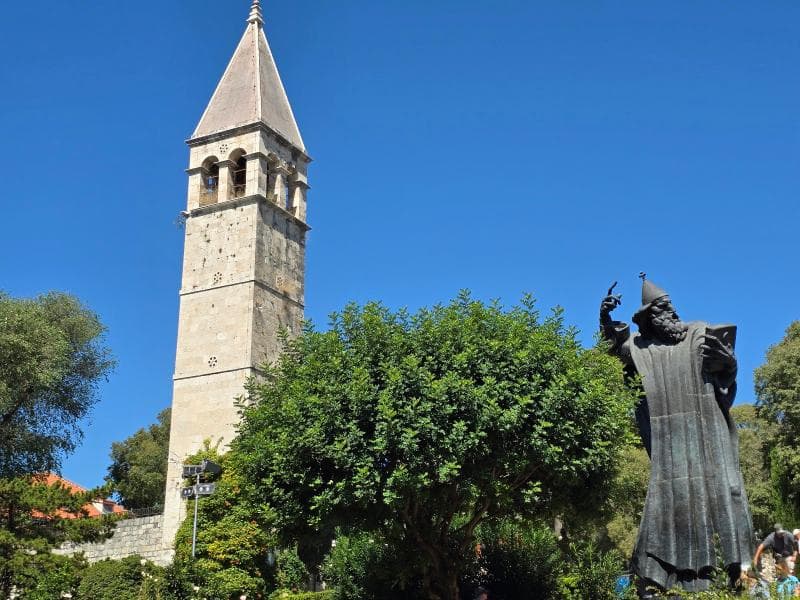
Explore Split's Golden Gate (Porta Aurea) within Diocletian's Palace. Discover its Roman history, unique architecture, and the legendary Gregory of Nin statue in Croatia.
Overview
Stepping through the Golden Gate, or Porta Aurea as it was known in Latin, offers a magnificent entry point into the heart of Diocletian's Palace in Split, Croatia. This majestic archway, the grandest and most ornately decorated of the palace's four principal gates, served as the primary northern entrance to Emperor Diocletian's sprawling retirement complex. Today, it stands as a testament to Roman ingenuity and imperial power, seamlessly blending ancient history with the vibrant pulse of modern Split, inviting visitors to traverse centuries with every step.
Originally called Porta Septemtrionalis, or 'Northern Gate', its later moniker, 'Golden Gate', was bestowed in the Renaissance to reflect its significant status rather than any actual gold in its construction. It was the ceremonial entry, reserved for the emperor himself and his closest retinue, and formed the triumphant conclusion of the road leading from the ancient Roman capital of Salona.
History & Cultural Background
Constructed between the late 3rd and early 4th centuries AD, the Golden Gate was an integral part of Emperor Diocletian's vast fortified palace, built as his luxurious retirement residence. Emperor Diocletian, born in nearby Salona, abdicated his throne in 305 AD and is believed to have entered his new palace through this very gate on June 1st of that year.
Unlike the less elaborate Bronze, Iron, and Silver Gates, the Golden Gate was designed to impress. It connected the imperial residence directly with the important road leading to Salona, reinforcing Diocletian's connection to his birthplace and the provincial capital. Over the centuries, particularly during the Middle Ages, the gate underwent transformations, even being sealed off for a period, leading to the loss of much of its original statuary and decorative elements. It was later reopened and repaired, restoring its prominence as a historical landmark.
What Makes It Special
The Golden Gate's architecture reveals its original purpose as both a grand ceremonial entrance and a formidable defensive structure. It featured a double-gate system with a central courtyard, known as a 'propugnaculum', designed to trap potential intruders between two sets of doors. This was flanked by two imposing octagonal towers, further enhancing its defensive capabilities, though these towers are largely lost today.
The façade of the gate was once richly adorned, featuring four niches that likely housed statues of Roman gods or even Emperor Diocletian and the four tetrarchs, symbolizing the imperial power and political order of the time. Two unique decorative elements, known as 'Felicitas Saeculi', are still visible above the entrance. These curious faces, combining the head of a bull and a human face, symbolized the happiness and prosperity of Diocletian's reign. The gate's sheer scale and intricate carvings, such as astragals lining the arches, emphasized its grandeur. It's also noteworthy that the original Roman ground level is about 1.5 to 2 meters below the current street level, a subtle reminder of the city's layered history.
Stories, Fun Facts & Local Details
Just outside the Golden Gate, visitors are greeted by one of Split's most beloved and recognizable landmarks: the towering bronze statue of Bishop Gregory of Nin (Grgur Ninski). Sculpted by the renowned Croatian artist Ivan Meštrović in 1929, this 8-meter tall statue honors a 10th-century bishop who championed the use of the Croatian language in religious services, making him a symbol of Croatian national identity and culture.
A popular local tradition, eagerly embraced by tourists, involves rubbing the bishop's polished left big toe. It is widely believed that touching Gregory of Nin's toe brings good luck and ensures a return visit to Split. The constant rubbing has given the toe a distinctive golden shine, contrasting with the dark patina of the rest of the statue, adding a touch of playful charm to this historic site.
Visitor Perspective
Today, the area around the Golden Gate is a vibrant hub, bustling with locals and travelers alike. It serves as a natural gateway into the UNESCO World Heritage site of Diocletian's Palace, offering an immediate immersion into Split's rich Roman past. The gate is not merely a relic but a living part of the city, where history intertwines with daily life. Passing through its ancient archways, visitors can almost hear the echoes of imperial footsteps and imagine the grandeur of Diocletian's era. It provides an excellent starting point for exploring the palace's intricate streets, hidden courtyards, and ancient structures, offering a profound sense of connection to a civilization that shaped a significant part of European history.
Coordinates: 16.44056, 43.50917
View on Google Maps💬 How Travelers Describe This Place
Based on community votes
Beautiful
898Unique
667Must See
308Photogenic
190Interesting
32
Traveler Stories
Discover memorable experiences shared by travelers who have visited this place.
No traveler stories yet.
Be the first traveler to share what made this place memorable.

Tour
By
Spot
Discover amazing places around the world. Your journey starts here.
Explore
© 2026 TourBySpot. All rights reserved.