Gloriette
Vienna, Austria
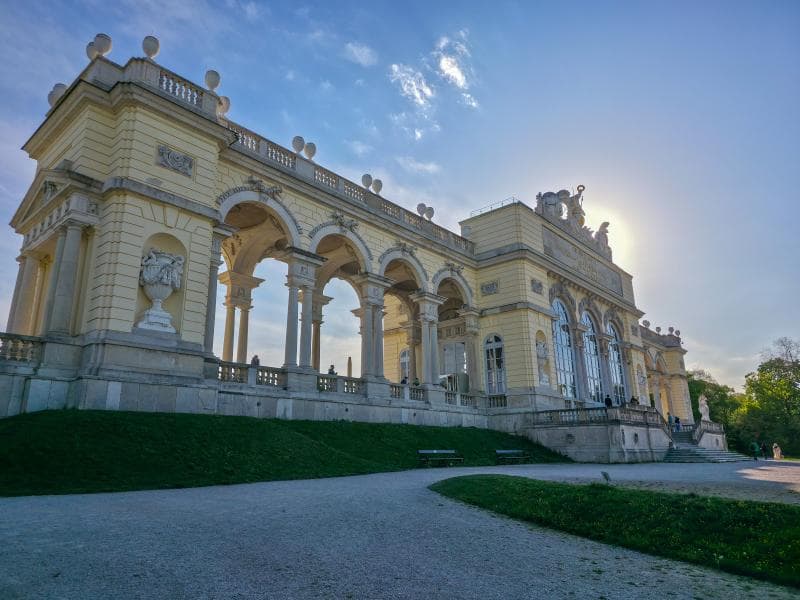
Discover the Gloriette in Schönbrunn Palace, Vienna, Austria. Explore its imperial history, stunning architecture, and panoramic city views from its hilltop perch.
Overview
Perched majestically atop a hill within the sprawling gardens of Schönbrunn Palace in Vienna, Austria, the Gloriette stands as an elegant neoclassical pavilion-colonnade. Its name, derived from the French word 'gloriette,' which translates to 'little glory' or 'arbor,' perfectly encapsulates its refined purpose and appearance. This iconic structure is an integral part of the larger Schönbrunn Palace and Park complex, recognized as a UNESCO World Heritage site and one of Europe's most exquisite examples of Baroque architecture. From its elevated position, the Gloriette offers breathtaking panoramic views that sweep across the magnificent Schönbrunn Palace, its meticulously manicured gardens, and the vibrant cityscape of Vienna, with the distant Wienerwald hills visible on clear days. Today, the Gloriette houses a charming cafe on its ground floor, and a seasonal rooftop viewing platform allows visitors an even higher vantage point from which to admire the imperial vista.
History & Cultural Background
The Gloriette was constructed in 1775 under the direct orders of Empress Maria Theresa, one of Austria's most influential rulers. Its design is attributed to the talented architect Johann Ferdinand Hetzendorf von Hohenberg, a former theatre designer whose background is evident in the structure's dramatic proportions. Initially, the Gloriette was conceived as more than just a garden ornament; it served as a powerful symbol of Habsburg strength and a monument to 'just war.' It specifically commemorates Austria's decisive victory over Prussia at the 1757 Battle of Kolin during the Seven Years' War. The choice of its location on the crest of the hill was deliberate, intended to provide an impressive conclusion to the main axis of the palace and park ensemble, an idea originally envisioned by Fischer von Erlach but brought to fruition by Hohenberg. Throughout the 19th century, the Gloriette's glazed inner hall was frequently used as a dining room and famously served as Emperor Franz Joseph I's breakfast room, a tradition that continued until the end of the monarchy in 1918. The structure itself is a triumphal arch, flanked by arcaded wings with semi-circular arches, and its central section is crowned with a mighty imperial eagle perching on a globe, surrounded by trophies. Interestingly, many of the architectural features, such as the twin columns, capitals, and entablatures, were repurposed from the unfinished Renaissance palace of Neugebäude. Although the Gloriette suffered damage from Allied bombing in 1945 during the Second World War, it was meticulously rebuilt and restored, with significant restoration work also undertaken in 1994/95, which included reglazing its central section.
What Makes It Special
What truly sets the Gloriette apart is its unparalleled vantage point. Standing here, visitors are treated to one of Vienna's most iconic views: the grand Baroque palace unfolding below, framed by its expansive gardens, and the sprawling city skyline beyond. Its architectural grandeur, designed in a neoclassical Baroque style with elements reminiscent of a triumphal arch, makes it a significant landmark in itself. The Latin inscription on its front, 'JOSEPHO II. AVGVSTO ET MARIA THERESIA IMPERANTIB. ERECT. CI)I)CCLXXV.', explicitly states its dedication, translating to 'Erected in 1775 under the reign of Emperor Joseph II and Empress Maria Theresa.' This historical marker, coupled with the building's original function as a 'temple of glory' celebrating Habsburg power, imbues it with profound cultural and historical significance. The presence of the charming Café Gloriette on the ground floor allows guests to immerse themselves in imperial history while enjoying traditional Viennese coffee and pastries in a setting once reserved for royalty. Furthermore, the opportunity to ascend to the rooftop viewing platform offers a unique perspective, making it a must-visit for anyone exploring Schönbrunn.
Stories, Fun Facts & Local Details
Beyond its grand facade, the Gloriette holds intriguing stories and details. The very word 'Gloriette' itself, meaning 'little glory,' suggests a structure of beauty and prominence within a garden setting. The architect, Johann Ferdinand Hetzendorf von Hohenberg, was notably a former theatre designer, and his dramatic flair is said to have influenced the building's commanding presence and striking proportions. It is even said that a 'court grumble' about the lack of a fitting architectural object to crown the hill behind the palace contributed to its eventual creation. Another fascinating detail is the Latin inscription on the facade, which uses a historical method for writing the date 1775, common in early book printing, where large numbers were represented by combinations involving the letters C and I, and an ancient Roman apostrophe. The building's decor, with its military-themed sculptures and trophies, including arrangements of antique Roman armour, shields, and standards, directly reflects its purpose as a monument commemorating a military victory. Emperor Franz Joseph I's fondness for breakfasting here is commemorated by the modern Café Gloriette, which occasionally offers a special 'Sisi buffet' on weekends and public holidays, inviting visitors to partake in a taste of imperial life.
Visitor Perspective
Visiting the Gloriette provides a delightful experience for any traveler to Vienna. The journey to the Gloriette typically involves a leisurely, gentle uphill walk through the stunning Schönbrunn Palace gardens, often starting from the Neptune Fountain. This pleasant stroll offers picturesque views of the gardens and palace from below, gradually revealing the Gloriette as you ascend. While the exterior of the Gloriette and the panoramic views from the hill are freely accessible when the palace gardens are open, gaining access to the rooftop viewing platform requires a separate ticket. The Café Gloriette, located on the ground floor, however, is freely accessible without a ticket, providing a perfect spot for refreshments. Many visitors find the late afternoon, particularly approaching sunset, to be the ideal time to visit, as the light creates a warm glow over the palace and city, and crowds may be thinner. A visit to the Gloriette itself, including the walk and time spent enjoying the views, can take approximately 45 to 60 minutes. For those with mobility challenges, a lift is available to reach the viewing terrace, ensuring accessibility for all. To fully appreciate the beauty and history of Schönbrunn, it is recommended to allocate at least half a day for exploring the entire complex, including the palace, gardens, and other attractions.
Coordinates: 16.30872, 48.17828
View on Google Maps💬 How Travelers Describe This Place
Based on community votes
Beautiful
910Must See
755Interesting
658Photogenic
589Unique
374
Traveler Stories
Discover memorable experiences shared by travelers who have visited this place.
No traveler stories yet.
Be the first traveler to share what made this place memorable.

Tour
By
Spot
Discover amazing places around the world. Your journey starts here.
Explore
© 2026 TourBySpot. All rights reserved.