Giotto’s Campanile
Florence, Italy
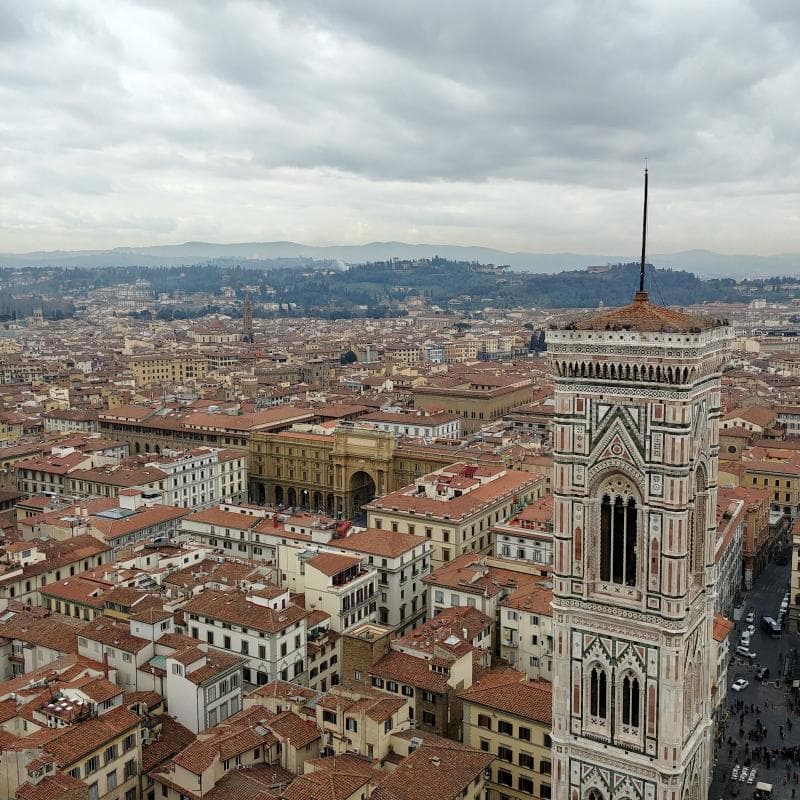
Discover Giotto's Campanile in Florence, Italy. This iconic Gothic bell tower offers stunning views and rich history. Explore its art, architecture, and climb its 414 steps.
Overview
Giotto's Campanile, an exquisite freestanding bell tower, is an integral part of the monumental Florence Cathedral complex in Florence, Italy. Standing proudly adjacent to the Basilica di Santa Maria del Fiore and the Baptistery of St. John, it is a magnificent example of Florentine Gothic architecture. Reaching a height of 84.7 meters (approximately 278 feet), the tower boasts a square base of about 14.45 meters (47 feet) on each side. Its striking appearance is defined by a lavish cladding of white marble from Carrara, green marble from Prato, and red marble from Siena, creating a polychrome effect that harmonizes beautifully with the adjacent cathedral. This iconic landmark is not merely a bell tower but a vertical masterpiece of art and engineering, designed to captivate with its intricate sculptural decorations and elegant proportions.
History & Cultural Background
The story of Giotto's Campanile begins in 1334 when the celebrated painter and architect Giotto di Bondone laid the first stone on July 19th. Appointed as Master of the Works for the Cathedral after the death of Arnolfo di Cambio, Giotto concentrated his efforts on designing and commencing the bell tower. His vision was to create a structure that mirrored the polychromy of the cathedral, giving the tower a painted-like quality with its geometric marble patterns. Sadly, Giotto only oversaw the construction for three years, completing just the lower floor with its marble revetment before his death in 1337. Following Giotto's passing, Andrea Pisano continued the work, adhering to the original design and finishing the first two levels. Construction was then interrupted around 1348 due to the devastating Black Death plague. The task of completion fell to Francesco Talenti, who took over in 1348 and ultimately finished the bell tower in 1359. Talenti introduced changes to Giotto's initial plans, particularly with the creation of the terraced crowning, which differed from Giotto's original idea for a much taller spire. Despite these changes, the campanile stands as a testament to the collaborative genius of these three masters, embodying the artistic and architectural ambition of 14th-century Florence.
What Makes It Special
What truly sets Giotto's Campanile apart is its extraordinary decorative program. The tower's exterior is adorned with rich sculptural works arranged in multiple registers, offering a visual narrative of medieval knowledge and human endeavor. The lowest levels feature 56 bas-reliefs. These include 26 hexagonal panels, primarily by Andrea Pisano and his workshop, depicting the creation of man, the mechanical arts, and human activities. Above these are 28 rhombus-shaped panels, attributed to Andrea Pisano and Luca della Robbia, which illustrate the celestial powers, including the planets, virtues, liberal arts, and sacraments, reflecting the philosophical and theological thought of the era. These intricate carvings, originally intended as a 'medieval encyclopedia' in stone, showcase man's dominion over nature and his path to redemption. The original sculptures are now preserved in the Museo dell'Opera del Duomo, with copies adorning the tower itself. Additionally, 16 life-size statues, crafted by various Florentine masters of the 14th and 15th centuries, are placed in niches on the upper levels. The masterful use of polychrome marble cladding, creating intricate geometric and floral patterns, contributes significantly to its aesthetic appeal, making it appear almost painted.
Stories, Fun Facts & Local Details
- Giotto's Brief Tenure: Despite being named after him, Giotto only worked on the campanile for a mere three years before his death, completing only the first level.
- The Missing Spire: Giotto's original design envisioned a much taller tower, potentially reaching 122 meters (400 feet), crowned with a spire. However, Francesco Talenti's completion did not include this, resulting in its current terraced top.
- A Symphony of Bells: The campanile houses seven active bells, with names like Campanone and Misericordia, some dating back centuries, though the oldest have been decommissioned and replaced.
- Artistic Evolution on Display: The different levels of the tower visibly showcase the stylistic progression of art, from the Byzantine forms to more realistic Renaissance sculptures, a subtle nod to the changing artistic landscape of Florence over the decades of its construction.
- Forced Perspective: The upper levels of the bell tower were designed to appear the same size as the lower ones, using an architectural technique known as forced perspective to enhance its visual grace from ground level.
Visitor Perspective
For many travelers, climbing Giotto's Campanile is an unforgettable experience, offering one of the most breathtaking panoramic views of Florence and the surrounding Tuscan hills. The ascent involves a demanding but rewarding climb of 414 steps; there is no elevator. Visitors can pause at various levels during the climb, which feature large windows offering progressively expansive vistas. The view from the summit provides a unique, eye-level perspective of Brunelleschi's iconic Dome on the Florence Cathedral, a photographic opportunity unmatched elsewhere. Due to the physical nature of the climb, it is not recommended for individuals with heart conditions, claustrophobia, or vertigo. Advance booking for a time slot is highly recommended, especially during peak seasons, to ensure entry and minimize waiting times. Visitors should also note that a strict dress code (shoulders and knees covered) applies as it is part of a religious complex, and large bags or backpacks are generally not permitted inside, with luggage storage facilities available nearby.
Coordinates: 11.255805, 43.77285
View on Google Maps💬 How Travelers Describe This Place
Based on community votes
Must See
491Photogenic
443Beautiful
414Interesting
310Unique
277
Traveler Stories
Discover memorable experiences shared by travelers who have visited this place.
No traveler stories yet.
Be the first traveler to share what made this place memorable.

Tour
By
Spot
Discover amazing places around the world. Your journey starts here.
Explore
© 2026 TourBySpot. All rights reserved.