Giant Skeletons
Frankfurt, Germany
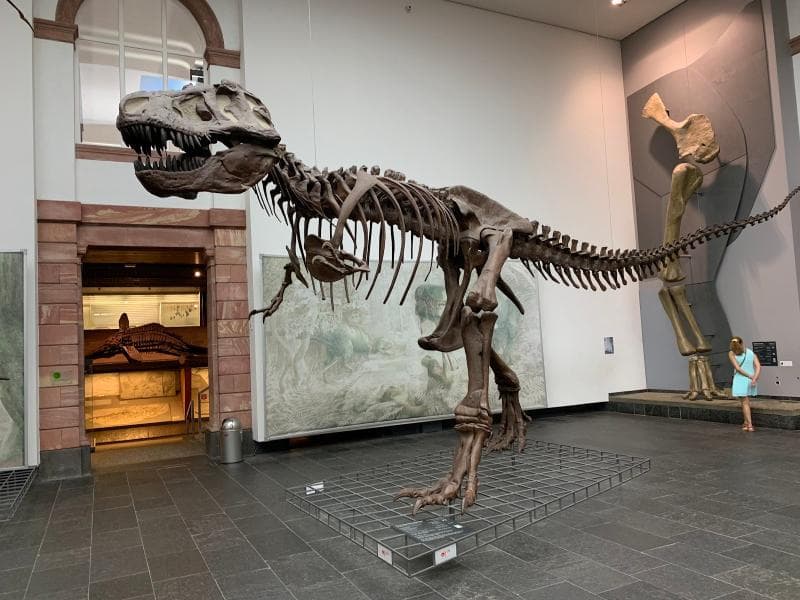
Explore the awe-inspiring Giant Skeletons at the Senckenberg Natural History Museum in Frankfurt, Germany, home to Europe's largest dinosaur collection.
Overview
The Senckenberg Natural History Museum, nestled in the vibrant city of Frankfurt, Germany, stands as a testament to the wonders of the natural world. It is celebrated as the second-largest natural history museum in Germany, boasting one of Europe's most extensive collections of dinosaur fossils. The museum's grandeur is immediately apparent, with life-size dinosaur replicas greeting visitors even before they step inside, hinting at the prehistoric giants that await within.
Known affectionately for its 'Giant Skeletons,' the Senckenberg Museum offers an unparalleled journey through Earth's history. Its halls are home to a remarkable array of complete dinosaur skeletons, meticulously preserved and dynamically displayed, providing a powerful and immersive experience for all who visit.
History & Cultural Background
The origins of the Senckenberg Natural History Museum trace back to the vision of Johann Christian Senckenberg, a distinguished physician and philanthropist in Frankfurt. In 1763, Senckenberg bequeathed a significant portion of his fortune to establish scientific and medical institutions. This legacy culminated in the founding of the non-profit Senckenberg Society for Nature Research in 1817, with the explicit aim of advancing natural sciences through research, education, and public engagement.
The museum itself opened its doors in 1821, quickly becoming a cornerstone for natural history studies. The current neo-baroque building, an architectural marvel, was constructed between 1904 and 1907 outside the city center, closely associated with the Johann Wolfgang Goethe University. This long-standing partnership has fostered a rich environment where cutting-edge scientific research continuously enriches the public exhibitions, reflecting the society's slogan: 'world of biodiversity.'
What Makes It Special
The Senckenberg Museum's 'Giant Skeletons' are undeniably its star attraction, offering a truly special and educational encounter with the past. The museum proudly displays an impressive collection of original and reconstructed dinosaur skeletons, positioned in striking, lifelike poses.
Among the most iconic is the towering Diplodocus, a long-necked herbivore reaching up to 28 meters in length. Notably, the Senckenberg's Diplodocus skeleton is the only original specimen of its kind displayed anywhere outside of the United States. Visitors can also marvel at a formidable Tyrannosaurus Rex and the three-horned Triceratops, both presented in a way that evokes a sense of awe and a glimpse into their ancient world.
Another unparalleled treasure is the virtually complete original skeleton of the Edmontosaurus, which includes remarkably preserved fossilized skin — a rarity that provides crucial insights into dinosaur appearance. Adding to the uniqueness, the museum houses the world's only complete skeleton of the marine reptile Placodus gigas. These extraordinary exhibits collectively position the Senckenberg Museum as a leading institution for paleontological study and display in Europe.
Stories, Fun Facts & Local Details
A fun fact that often captures the imagination of visitors is that two life-size dinosaur replicas stand guard outside the museum's entrance, providing an immediate photo opportunity and a grand welcome to the prehistoric world within. The museum embraces a 'science for everyone' philosophy, making complex scientific concepts engaging and accessible for all ages.
Beyond the impressive skeletons, the museum itself has a rich narrative. It was Goethe who, in 1815, lamented that Johann Christian Senckenberg's scientific legacy was not being adequately continued, prompting 32 Frankfurt citizens to establish the Senckenberg Society for Natural History. This highlights a community-driven effort to preserve and promote scientific knowledge.
Inside, the dynamic arrangement of the skeletons, such as the Edmontosaurus with its preserved skin, allows visitors to imagine these colossal creatures in their ancient habitats. The museum also offers interactive areas like the 'Aha?! Science Lab,' where guests can engage with real research projects and even converse with scientists, transforming a visit into an active learning experience.
Visitor Perspective
Stepping into the Senckenberg Natural History Museum is an immersive experience that transports visitors through millions of years of Earth's evolution. The sheer scale and number of the 'Giant Skeletons' are often cited as the most captivating aspect, offering a profound sense of wonder and a humbling reminder of life's vast history.
Families, in particular, find the museum incredibly engaging, with many interactive exhibits designed to captivate younger audiences and foster a love for natural science. The meticulous detailing and dynamic staging of the dinosaur exhibits create a memorable impression, inviting contemplation on the prehistoric world and the processes of evolution. Whether it's the unique Diplodocus or the strikingly preserved Edmontosaurus, the 'Giant Skeletons' provide a compelling narrative of ancient life, making the Senckenberg Museum a must-visit destination for curious minds of all ages in Frankfurt.
Coordinates: 8.65129, 50.11754
View on Google Maps💬 How Travelers Describe This Place
Based on community votes
Interesting
879Photogenic
741Beautiful
482Unique
396Must See
274
Traveler Stories
Discover memorable experiences shared by travelers who have visited this place.
No traveler stories yet.
Be the first traveler to share what made this place memorable.

Tour
By
Spot
Discover amazing places around the world. Your journey starts here.
Explore
© 2026 TourBySpot. All rights reserved.