Gefion Fountain Nearby
Copenhagen, Denmark
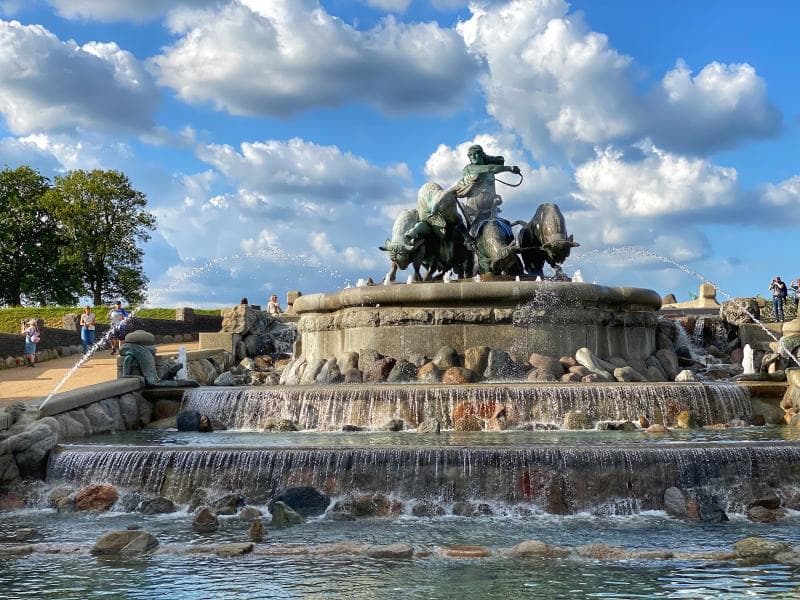
Discover Copenhagen's Gefion Fountain, a monumental sculpture depicting the Norse goddess Gefion creating Zealand. Explore its myth and history.
Overview
Nestled by the picturesque waterfront of Copenhagen, Denmark, the Gefion Fountain stands as a powerful and dramatic bronze sculpture, just a stone's throw from the iconic Little Mermaid statue. This monumental artwork, often regarded as Copenhagen's largest monument, captivates visitors with its sheer scale and intricate details. It depicts the Norse goddess Gefion fiercely driving a plough pulled by four mighty oxen, a scene that vividly brings to life an ancient myth. The fountain is strategically located in the Nordre Toldbod area, adjacent to the historic Kastellet fortress and south of the Langelinie promenade, making it a prominent landmark within Churchillparken.
The grandeur of the Gefion Fountain, with water dramatically spraying from the oxen's nostrils and cascading into a large basin, offers a compelling visual narrative that speaks to Denmark's rich cultural and mythological heritage. It serves not only as a striking piece of public art but also as a popular spot for contemplation and photography, drawing curious travelers into its ancient tale.
History & Cultural Background
The Gefion Fountain was a generous gift to the City of Copenhagen from the Carlsberg Foundation, commemorating the brewery's 50th anniversary in 1897. Danish sculptor Anders Bundgaard designed this masterpiece, meticulously crafting the naturalistic figures between 1897 and 1899, with the basins and surrounding ornamentation completed by 1908. The fountain was officially inaugurated on July 14, 1908.
Initially, there was a plan to install the fountain in Copenhagen's main square outside the City Hall. However, it was ultimately decided to place it by the Øresund, near Kastellet, where it could be beautifully framed by the sea and sky. This location allows the fountain to serve as a symbolic gateway, marking the historical western edge of the city. The artwork underwent extensive renovation work starting in 1999, remaining inactive for several years before its re-inauguration in September 2004.
What Makes It Special
What truly sets the Gefion Fountain apart is its powerful embodiment of Norse mythology, specifically the legend of the creation of the island of Zealand, where Copenhagen is situated. The fountain vividly portrays the moment the goddess Gefion carved out Zealand from Sweden, transforming her four sons into formidable oxen to accomplish the task.
The dynamic composition, with Gefion brandishing a whip over her straining oxen, captures a relentless sense of forward motion and immense exertion. The water features are integral to the sculpture, emphasizing the power and strength of the oxen, with water jetting from their nostrils. This blend of artistic mastery and a foundational mythological narrative makes the fountain a profound experience, deeply connecting visitors to Denmark's ancient roots and the landscape itself.
Stories, Fun Facts & Local Details
The central myth depicted by the Gefion Fountain tells of the Swedish King Gylfi, who promised the goddess Gefion as much land as she could plough in a single day and night. Gefion ingeniously transformed her four sons, fathered by a giant, into oxen. With their immense strength, they ploughed so fiercely that they tore a massive piece of earth from Sweden, casting it into the sea between Scania and the island of Funen. This displaced land became the island of Zealand.
The void left in Sweden by this epic ploughing is often identified by modern tourist information with Lake Vänern, Sweden's largest lake, due to its resemblance in shape and size to Zealand. This enduring legend highlights the deep connection between the Danish people and their land, a 'creation story in bronze'. The fountain is also considered a wishing well by many visitors, adding a touch of personal magic to the experience.
Visitor Perspective
Visiting the Gefion Fountain offers a serene and historically rich experience. Its location within Churchillparken provides a beautiful backdrop, especially during spring when cherry blossom trees enhance the scenery. The fountain's imposing presence and the captivating story it tells consistently draw praise from visitors. It's often highlighted as a more interesting sight than some of Copenhagen's more famous landmarks, offering a deeper dive into Danish mythology.
Its proximity to other key attractions, such as The Little Mermaid statue and Kastellet, makes it an ideal stop on a leisurely stroll along the harbor front. Many visitors enjoy a circular walk that takes them from the Gefion Fountain, along the Langelinie promenade, past the Little Mermaid, and back through Churchillparken, enjoying continuous scenic views. The area is generally well-maintained and accessible, making it suitable for all ages and fitness levels. The fountain is also beautifully illuminated at night, offering a different, equally enchanting atmosphere.
Coordinates: 12.59757, 55.68925
View on Google Maps💬 How Travelers Describe This Place
Based on community votes
Must See
934Beautiful
276Photogenic
152Unique
30Interesting
16
Traveler Stories
Discover memorable experiences shared by travelers who have visited this place.
No traveler stories yet.
Be the first traveler to share what made this place memorable.

Tour
By
Spot
Discover amazing places around the world. Your journey starts here.
Explore
© 2026 TourBySpot. All rights reserved.