Fusiliers’ Arch
Dublin, Ireland
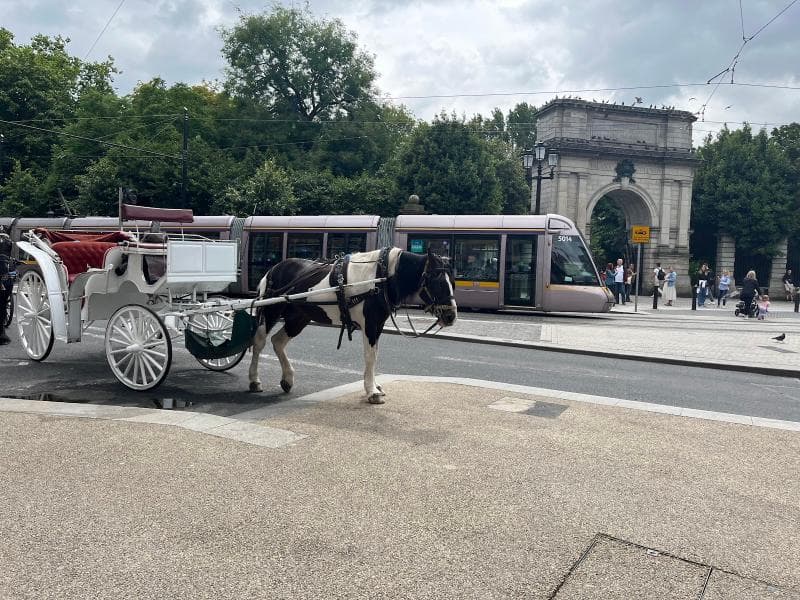
Discover Fusiliers' Arch in St. Stephen's Green, Dublin, Ireland. This historic triumphal arch commemorates the Royal Dublin Fusiliers and tells a complex story of loyalty and nationalism.
Overview
At the bustling Grafton Street entrance to St. Stephen's Green in Dublin, Ireland, stands the imposing Fusiliers' Arch. This distinctive war memorial, erected in 1907, serves as a grand gateway into one of the city's most beloved public parks. It was built to commemorate the officers, non-commissioned officers, and enlisted men of the Royal Dublin Fusiliers who bravely fought and ultimately died in the Second Boer War, which took place between 1899 and 1902. Designed primarily by architect John Howard Pentland, with consultation from Thomas Drew, the arch takes the form of a Roman triumphal arch, crafted from durable ashlar granite. Look closely, and you'll find the names of 222 fallen soldiers intricately inscribed on its underside, a poignant roll call that many visitors often pass by without noticing. The arch also proudly displays the regimental crest and the names of key battles such as Talana, Colenso, Hartshill, and Ladysmith on its frieze. Freely accessible to all, the Fusiliers' Arch offers a profound connection to a pivotal, yet often complex, chapter of Irish history.
History & Cultural Background
The story of Fusiliers' Arch is deeply intertwined with Ireland's journey towards independence and its complicated relationship with the British Empire. Erected at a time of burgeoning Irish nationalism, the monument quickly became a symbol of contention. The Royal Dublin Fusiliers, an Irish regiment within the British Army, found themselves fighting for the Empire in the Second Boer War, a conflict far from home between the British and the two Boer republics in South Africa. For many Irish nationalists, these soldiers were seen as 'traitors' to Ireland's own struggle for self-rule, leading to the arch being controversially nicknamed 'Traitor's Gate'.
Remarkably, the arch witnessed firsthand the turmoil of the 1916 Easter Rising, an armed insurrection by Irish republicans against British rule. During the intense cross-fire within St. Stephen's Green, the arch sustained damage, and bullet marks from that period can still be observed on its stone facade today. Despite the revolutionary fervour, and its highly controversial nature to many, Fusiliers' Arch stands as one of the few British imperial monuments in Dublin that was never destroyed by republicans, making its survival a testament to its enduring, albeit complex, place in the city's historical landscape.
What Makes It Special
What truly sets Fusiliers' Arch apart is its layered narrative, serving not just as a monument but as a historical document etched in stone. Architecturally, it is a magnificent piece, drawing inspiration from the classical Roman triumphal arches, specifically modelled on Rome's Arch of Titus. Its construction from ashlar granite, complemented by limestone inscriptions and a bronze adornment, speaks to the craftsmanship of its era.
However, its most compelling feature is its profound historical significance. The names of the 222 Royal Dublin Fusiliers inscribed on the underside offer a silent, powerful tribute to individual lives lost. This detail, often overlooked by those passing beneath, transforms the arch from a mere structure into a deeply personal memorial. Furthermore, the arch uniquely embodies the conflicting loyalties and profound identity struggles prevalent in early 20th-century Ireland, representing both the bravery of Irish soldiers in a distant war and the intense nationalist sentiment that saw their service as a betrayal. Its very existence, having withstood the upheavals of the Easter Rising, makes it a rare and preserved relic of a tumultuous period, telling a story of Irish history that is anything but straightforward.
Stories, Fun Facts & Local Details
Beyond its grand facade, Fusiliers' Arch holds intriguing stories and details that bring its history to life. The nickname 'Traitor's Gate' is perhaps the most well-known local anecdote, reflecting the strong anti-imperialist sentiment of the time among some Irish citizens who viewed service in the British Army as disloyalty to Ireland's cause.
Visitors with an eye for detail will find a Latin inscription on the western face that reads: 'Fortissimis suis militibus hoc monumentum Eblana dedicavit MCMVII.' This translates to 'To its strongest soldiers, Dublin dedicates this monument, 1907.' 'Eblana' is an ancient name for Dublin, appearing on a 2nd-century AD map, adding a touch of antiquity to the modern memorial.
The arch's dimensions are notable, standing approximately 8.5 metres wide and 10 metres high, with an internal opening of about 5.6 metres high and 3.7 metres wide, making it a substantial and imposing structure. While the exact number of inscribed names varies slightly across sources, the consensus is that over 200 soldiers are memorialized. One intriguing local tale, though possibly apocryphal, speaks of a soldier whose name was inscribed on the arch after being reported dead, only for him to later return to Dublin, having deserted and made his way back home. This illustrates the human dimension behind the monumental stone.
Visitor Perspective
Approaching St. Stephen's Green from Grafton Street, visitors are immediately greeted by the Fusiliers' Arch, acting as the park's primary and most iconic entrance. It's a structure that commands attention, inviting a moment of pause before entering the tranquil expanse of the green. For many, it's a popular meeting point, a recognizable landmark in the heart of Dublin, and a favoured spot for photographs, especially when beautifully illuminated at night.
As you pass beneath the arch, take a moment to look upwards; the names of the fallen soldiers inscribed on the soffit are a powerful, often missed, detail that connects you directly to the past. Stepping through the arch is like crossing a threshold from the busy commercial hub of Grafton Street into the peaceful Victorian park. It bridges the gap between Dublin's vibrant contemporary life and its profound historical depth. The area surrounding the arch is a lively cultural hub, with numerous shops, cafes, and restaurants, offering a perfect blend of exploration and relaxation for any curious traveller. The arch prompts reflection on Dublin's complex past, setting the stage for the stories and beauty found within St. Stephen's Green itself.
Coordinates: -6.2605099, 53.3396743
View on Google Maps💬 How Travelers Describe This Place
Based on community votes
Unique
670Beautiful
655Photogenic
594Must See
266Interesting
166
Traveler Stories
Discover memorable experiences shared by travelers who have visited this place.
No traveler stories yet.
Be the first traveler to share what made this place memorable.

Tour
By
Spot
Discover amazing places around the world. Your journey starts here.
Explore
© 2026 TourBySpot. All rights reserved.