Frieze Sculptures
Athens, Greece
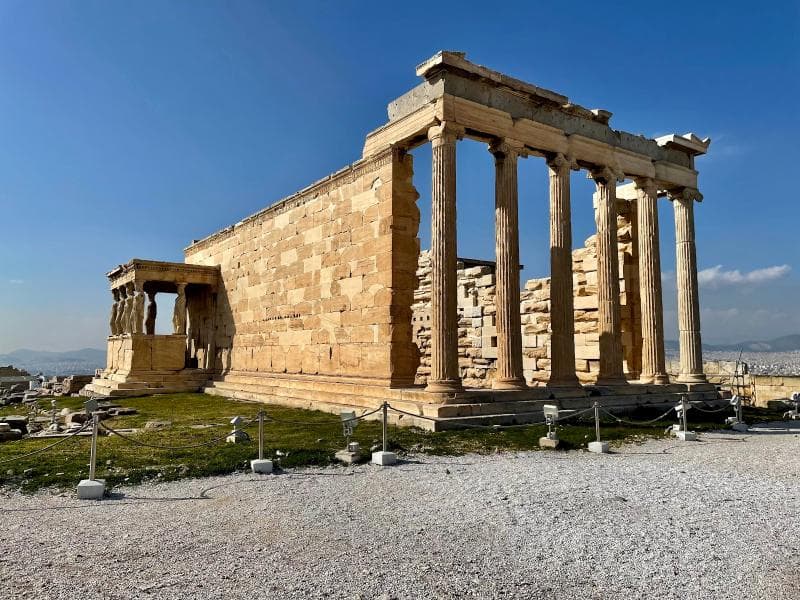
Explore the Parthenon Frieze Sculptures in Athens, Greece – an ancient masterpiece depicting the Panathenaic procession and Athenian glory.
Overview
The Frieze Sculptures of the Parthenon in Athens, Greece, are a magnificent testament to ancient Greek artistry and culture. This low-relief sculpture, carved from brilliant Pentelic marble, once adorned the upper section of the Parthenon's inner chamber, known as the cella, positioned just within the outer colonnade. Originally stretching approximately 160 meters (524 feet) in length and standing about 1 meter (3.3 feet) high, the frieze presented a continuous, elaborate narrative. It depicts a grand procession featuring some 378 human and divine figures, alongside over 220 animals, predominantly horses, all meticulously rendered. Created between approximately 443 and 437 BC, the design is widely attributed to the celebrated sculptor Phidias, with the carving executed by his skilled pupils. While about 80 percent of the original frieze, or 128 meters, still exists today, it is geographically dispersed. Significant portions are housed in the Acropolis Museum in Athens, while a substantial collection, often referred to as the Elgin Marbles, resides in the British Museum in London.
History & Cultural Background
The Parthenon itself, constructed between 447 and 432 BCE, was dedicated to Athena, the patron goddess of Athens, embodying the city's power and cultural zenith. The frieze's central theme is widely interpreted as the Greater Panathenaic procession, a pivotal festival held every four years to honor Athena's birthday. This grand civic and religious event began at the Dipylon gate, wound through the ancient Agora, and culminated on the Acropolis. The most sacred moment of the festival, believed to be depicted at the east end of the frieze, involved the presentation of a new *peplos*, a specially woven garment, to the ancient cult statue of Athena. Artistically, the frieze represents the High Classical style of Attic sculpture. A notable architectural innovation was the inclusion of an Ionic frieze on what was primarily a Doric temple, a feature that set the Parthenon apart. Over its long history, the Parthenon and its sculptures endured significant damage, particularly during the Venetian bombardment in 1687 when it was being used as an ammunition store. In the early 19th century, Thomas Bruce, the 7th Earl of Elgin, removed a large portion of the sculptures, leading to the ongoing international debate regarding their repatriation to Athens.
What Makes It Special
The Parthenon Frieze is exceptional for its continuous narrative relief, an innovative artistic choice for its placement high on the inner wall of the cella, inside the colonnade. This meant viewers experienced it in fragments and shifting light, rather than as a single, easily viewed panorama. Its depiction of Athenian citizens participating alongside Olympian deities was revolutionary, subtly elevating the people of Athens and their civic rituals to a near-divine status. The frieze is not merely a documentary record but an idealized representation of the Panathenaic procession, showcasing a perfected civic image. The intricate detail and dynamic composition, especially evident in the spirited horsemen, highlight the mastery of the sculptors. Furthermore, the sculptors' innovative use of drapery to suggest movement and the underlying forms beneath the fabric added a new layer of realism and expressiveness to the figures. Crafted from radiant Pentelic marble, the frieze would have originally been brightly painted, bringing the scenes to vibrant life for ancient Athenians.
Stories, Fun Facts & Local Details
The narrative of the frieze unfolds dynamically: the procession begins at the southwest corner of the temple, divides into two streams along the north and south sides, and converges dramatically at the temple's east end. This eastern section portrays the climactic moment of the *peplos* presentation to Athena, surrounded by seated gods. Scholars continue to debate whether the frieze represents a specific historical Panathenaic procession, a mythical one, or an archetypal portrayal of the festival. An intriguing theory suggests that the 192 horsemen depicted might symbolically represent the Athenian heroes who fell at the Battle of Marathon, thus intertwining civic pride with heroic memory. The Parthenon's long and varied history includes serving not only as a temple but also as a Christian church, a mosque, and even an Ottoman ammunition depot, which unfortunately led to its partial destruction. In recent years, there has been a global movement to reunite the frieze, with some fragments, like one from the Vatican Museums, being repatriated to the Acropolis Museum in Athens in 2023.
Visitor Perspective
For modern travelers, experiencing the Parthenon Frieze offers a profound connection to ancient Greece. While the Parthenon itself stands as a majestic ruin on the Acropolis, the best place to appreciate the surviving sections of the frieze is at the state-of-the-art Acropolis Museum in Athens. Here, visitors can see original fragments displayed in a gallery designed to replicate their original placement on the Parthenon, allowing for a clearer understanding of the continuous narrative. Another substantial collection can be viewed at the British Museum in London. Understanding the context of the Panathenaic festival and the symbolic significance of each scene enriches the viewing experience, transforming carved marble into a vibrant story of a proud civilization. Imagine how ancient Athenians, seeing these sculptures high above them, would have felt a sense of belonging and divine favor, a feeling that still resonates today.
Coordinates: 23.7266, 37.9715
View on Google Maps💬 How Travelers Describe This Place
Based on community votes
Interesting
872Unique
846Photogenic
684Must See
121Beautiful
87
Traveler Stories
Discover memorable experiences shared by travelers who have visited this place.
No traveler stories yet.
Be the first traveler to share what made this place memorable.

Tour
By
Spot
Discover amazing places around the world. Your journey starts here.
Explore
© 2026 TourBySpot. All rights reserved.