Fresco Gallery
Bucharest, Romania
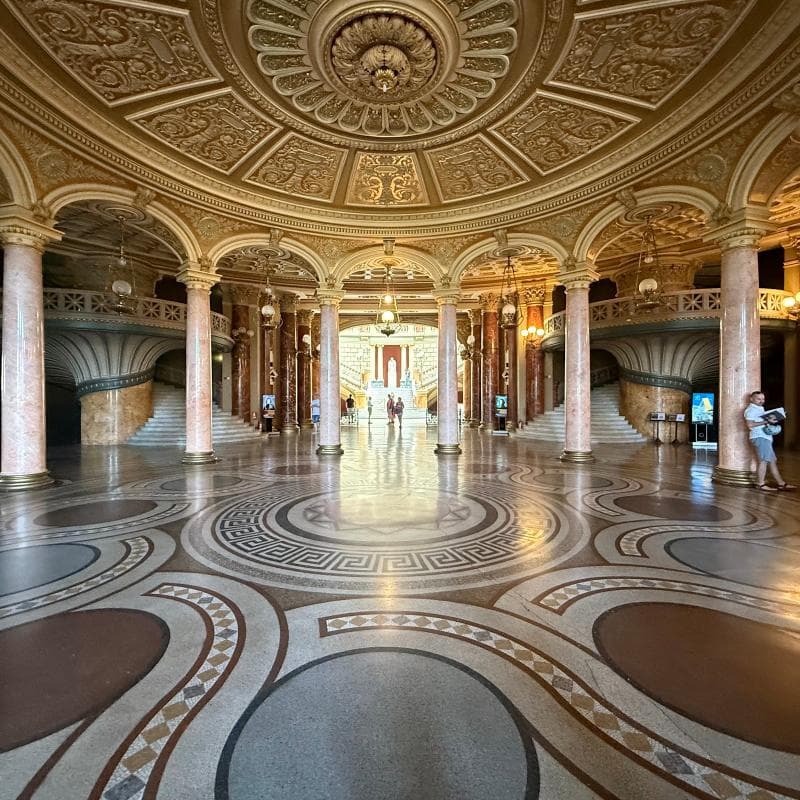
Discover the Grand Fresco within the Romanian Athenaeum in Bucharest, Romania. This 75-meter fresco vividly depicts 25 pivotal scenes from Romanian history.
Overview
Deep within the architectural marvel that is the Romanian Athenaeum in Bucharest, Romania, lies a breathtaking artistic treasure: the Grand Fresco. This monumental artwork is not a separate gallery in the traditional sense, but rather a continuous, panoramic painting that encircles the interior of the magnificent concert hall, just below its iconic dome. It serves as a visual epic, narrating the rich and complex history of the Romanian people from ancient times to the early 20th century. Visitors stepping into the Athenaeum are immediately captivated by its grandeur, and the fresco stands out as a powerful testament to national identity and artistic ambition.
Measuring an impressive 75 meters long and 3 meters high, the fresco transforms the concert hall into an immersive historical journey. Painted by Costin Petrescu using the traditional al fresco technique, it comprises 25 distinct scenes, each meticulously crafted to depict pivotal moments that shaped the nation. The artwork is more than mere decoration; it is an 'open book of national history', inviting contemplation on Romania's spiritual and moral values.
History & Cultural Background
The creation of the Athenaeum's Grand Fresco is a story intertwined with Romanian national pride and a persistent vision. The idea for a monumental historical painting to adorn the hall existed almost from the Athenaeum's inauguration in 1888. Early discussions saw the space reserved for what was envisioned as an 'enchantment of scenes from national history'.
However, securing the funds and the right artist for such an ambitious project took decades. It wasn't until 1933 that painter Costin Petrescu began work on the fresco, completing it in 1939. The project was largely funded through public subscription, a testament to the community's collective commitment to the arts and national heritage, echoing the initial fundraising efforts that built the Athenaeum itself with the famous slogan 'Donate one leu for the Ateneu!'
The fresco's narrative spans from the Roman conquest of Dacia, marking the origins of the Romanian people, through various medieval battles and principalities, to the crucial moments of national unification and the realization of Greater Romania in 1918. This artistic endeavor solidified the Athenaeum's role not just as a center for music, but as a temple of art and a symbol of national identity.
What Makes It Special
The Grand Fresco's uniqueness lies in its extraordinary scale and its profound historical narrative. Its continuous 75-meter length makes it a panoramic visual feast, wrapping around the entire circumference of the concert hall. The use of the al fresco technique, a demanding method where pigments are applied to wet plaster, speaks to the mastery of artist Costin Petrescu.
What truly sets it apart is its comprehensive depiction of 25 key episodes from Romanian history. It functions as a dynamic, visual textbook, presenting events and figures foundational to Romanian national identity in intricate detail. From Emperor Trajan's entry into Dacia to the formation of modern Romania, the fresco visually encapsulates nearly two millennia of struggle, triumph, and cultural evolution. Each scene transitions seamlessly into the next, forming a coherent and powerful historical tapestry that few other artistic works can rival in scope and public accessibility.
Stories, Fun Facts & Local Details
One fascinating aspect of the Athenaeum's fresco is its resilience through turbulent political times. During the communist regime, the last two scenes of the fresco, which depicted royal history, were covered with red velvet for nearly 20 years. This act of censorship highlights the fresco's potent symbolism and its role in conveying national narratives that sometimes conflicted with prevailing ideologies. The removal of these coverings after the fall of communism was a significant moment, restoring the artwork to its full historical integrity.
Another endearing detail relates to the Athenaeum's very foundation. The building's distinctive circular shape, which perfectly accommodates the sweeping fresco, came about because it was built upon the existing circular foundations of a former equestrian circus. This pragmatic adaptation by French architect Albert Galleron resulted in the iconic rotunda we see today, proving that sometimes even practical constraints can lead to architectural masterpieces. The initial fundraising campaign, 'Dați un leu pentru Ateneu!' ('Donate one leu for the Athenaeum!'), underscores the deep connection between the Romanian people and this cultural landmark, a connection further solidified by the fresco's nationalistic theme.
Visitor Perspective
For any traveler to Bucharest, witnessing the Grand Fresco within the Romanian Athenaeum is an experience that resonates deeply. While the Athenaeum is primarily a concert hall and home to the 'George Enescu' Philharmonic, tours are often available, allowing visitors to admire its opulent interior and, crucially, the fresco. Viewing the fresco is best done with a guide or prior knowledge of Romanian history, as understanding the significance of each of the 25 scenes enhances the appreciation of this 'open book' of the nation.
The sheer scale and detail demand attention, and visitors often find themselves tracing the historical narrative depicted around the hall. It's a journey not just through art, but through the very soul of Romania. The fresco, combined with the Athenaeum's exceptional acoustics and neoclassical grandeur, creates an atmosphere of cultural immersion. Whether attending a world-class concert or simply visiting to admire the architecture, the Grand Fresco offers a unique window into Romania's enduring spirit and its people's pride in their heritage.
Coordinates: 26.0973, 44.4413
View on Google Maps💬 How Travelers Describe This Place
Based on community votes
Must See
995Unique
839Beautiful
388Interesting
289Photogenic
141
Traveler Stories
Discover memorable experiences shared by travelers who have visited this place.
No traveler stories yet.
Be the first traveler to share what made this place memorable.

Tour
By
Spot
Discover amazing places around the world. Your journey starts here.
Explore
© 2026 TourBySpot. All rights reserved.