Foyer
Venice, Italy
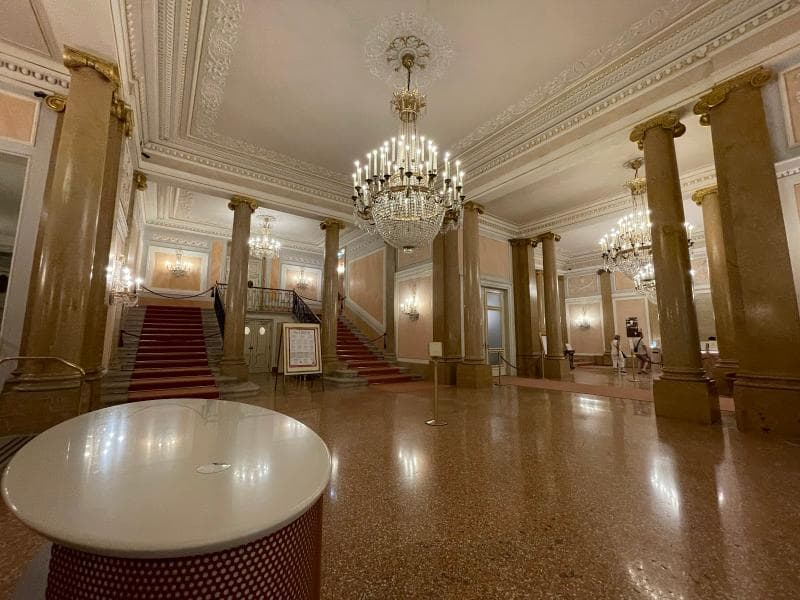
Discover the Foyer of Teatro La Fenice in Venice, Italy – a grand entrance steeped in history and operatic lore, resilient through fire and rebirth.
Overview
Stepping into the Foyer of Teatro La Fenice is to begin a journey through Venetian history and operatic splendor. This elegant entrance hall, much like the legendary phoenix from which the theatre draws its name, has witnessed destruction and rebirth, serving as the first grand impression for countless opera-goers and visitors alike. It is more than just a passageway; it is a space imbued with a sense of anticipation and the echoes of centuries of cultural brilliance. The Foyer’s dignified architecture and subtle artistry provide a prologue to the magnificent auditorium within, inviting guests to immerse themselves in the rich narrative of one of Italy’s most cherished opera houses.
As you cross its threshold, you are met with a sense of enduring grace, a testament to the meticulous efforts to restore and preserve its original charm through the various historical upheavals. It is the welcoming embrace of La Fenice, a place where the magic of performance truly begins, and where the outside world of Venice gently recedes, replaced by the theatre's timeless grandeur.
History & Cultural Background
The Foyer's story is deeply intertwined with the tumultuous yet resilient history of Teatro La Fenice itself. Originally designed by Gianantonio Selva, the architect responsible for the theatre’s initial construction, this entrance hall dates back to the late 18th century. Remarkably, the Foyer proved to be a survivor during the devastating fire of December 1836, which tragically consumed much of the original opera house. Its ability to withstand this calamity underscores its robust construction and perhaps, foreshadows the theatre's enduring spirit.
Following the 1836 fire, when the Meduna brothers, Tommaso and Giovanni Battista, undertook the theatre's reconstruction and redesign, they also paid attention to the Foyer's decorations, integrating it seamlessly into the newly emerging Late-Empire style luxury of the interior. Further significant alterations occurred in 1937, when the entrance, still bearing Selva's original design, was enlarged under the direction of engineer Eugenio Miozzi. During these upgrading works, some internal walls were demolished to create a symmetrical space, mirroring its decorative elements and enhancing its grand scale. Even in the face of the catastrophic arson of 1996, which left much of La Fenice in ruins, several original elements of the Foyer miraculously survived, contributing to the 'as it was, where it was' philosophy that guided the theatre's meticulous reconstruction.
What Makes It Special
What sets the Foyer apart is its unique blend of historical integrity and functional elegance. It is not merely a waiting area but an integral part of the La Fenice experience, often the first hall visitors encounter. Its neoclassical architectural lines, characteristic of Selva's original vision, are both understated and grand, providing a stark yet harmonious contrast to the more opulent interior of the main auditorium. Unlike many Venetian theatres tucked away in narrow alleys, La Fenice, and by extension its Foyer, boasts a façade that opens onto the prominent Campo San Fantin, marking its significant presence in the urban landscape.
The Foyer's design also reflects a remarkable sense of balance and proportion, enhanced by the 1937 enlargement that created its symmetrical layout. Beyond its aesthetic appeal, this space is highly versatile. It serves as an impressive venue for special events, welcoming up to 300 guests for gala dinners, product presentations, or elegant cocktail receptions. This adaptability ensures the Foyer continues to play an active role in the theatre's contemporary life, hosting gatherings that further enrich its cultural legacy.
Stories, Fun Facts & Local Details
One fascinating detail within the Foyer is a stele located on its back wall. This historical marker proudly lists the names of the 'Società dei Palchettisti', the association of box-holders who were instrumental in the theatre's initial construction and patronage. This serves as a tangible link to La Fenice's origins and the powerful Venetian families who ensured its creation and early success. It's a subtle nod to the community spirit that has always underpinned this operatic institution.
The Foyer's repeated survival, particularly during the 1836 fire, earned it a special place in the theatre's narrative of resilience. While the main house was consumed, the Foyer stood as a beacon of hope, promising a return, much like the phoenix itself. The philosophy of rebuilding 'as it was, where it was' after the 1996 fire meant that painstaking efforts were made to replicate every detail, ensuring that the Foyer visitors see today faithfully represents its historical appearance, right down to surviving original elements.
Visitor Perspective
For the curious traveler, visiting the Foyer of Teatro La Fenice offers a moment of reflection before the main event. It's the moment of transition, stepping from the bustling streets of Venice into a sanctuary of art. The light that filters through the entrance, the carefully preserved details, and the sheer elegance of the space prepare you for the grandeur that lies beyond. As you pause, you might imagine the historical figures who once graced this very spot – composers, divas, noblemen, and discerning audiences, all gathered under its vaulted ceilings, anticipating the rise of the curtain.
The Foyer creates an immediate connection to the theatre's storied past, serving as an atmospheric prelude to the main auditorium. It is the first chapter in the visitor's experience, setting a tone of historical reverence and artistic expectation. Whether you are there to attend a performance or simply to explore La Fenice on a guided tour, the Foyer provides an essential starting point, allowing you to absorb the initial sense of history and architectural beauty before delving deeper into the heart of this iconic Venetian landmark.
Coordinates: 12.3338, 45.4336
View on Google Maps💬 How Travelers Describe This Place
Based on community votes
Unique
886Interesting
564Must See
443Beautiful
233Photogenic
201
Traveler Stories
Discover memorable experiences shared by travelers who have visited this place.
No traveler stories yet.
Be the first traveler to share what made this place memorable.

Tour
By
Spot
Discover amazing places around the world. Your journey starts here.
Explore
© 2026 TourBySpot. All rights reserved.