Fourvière Tower
Lyon, France
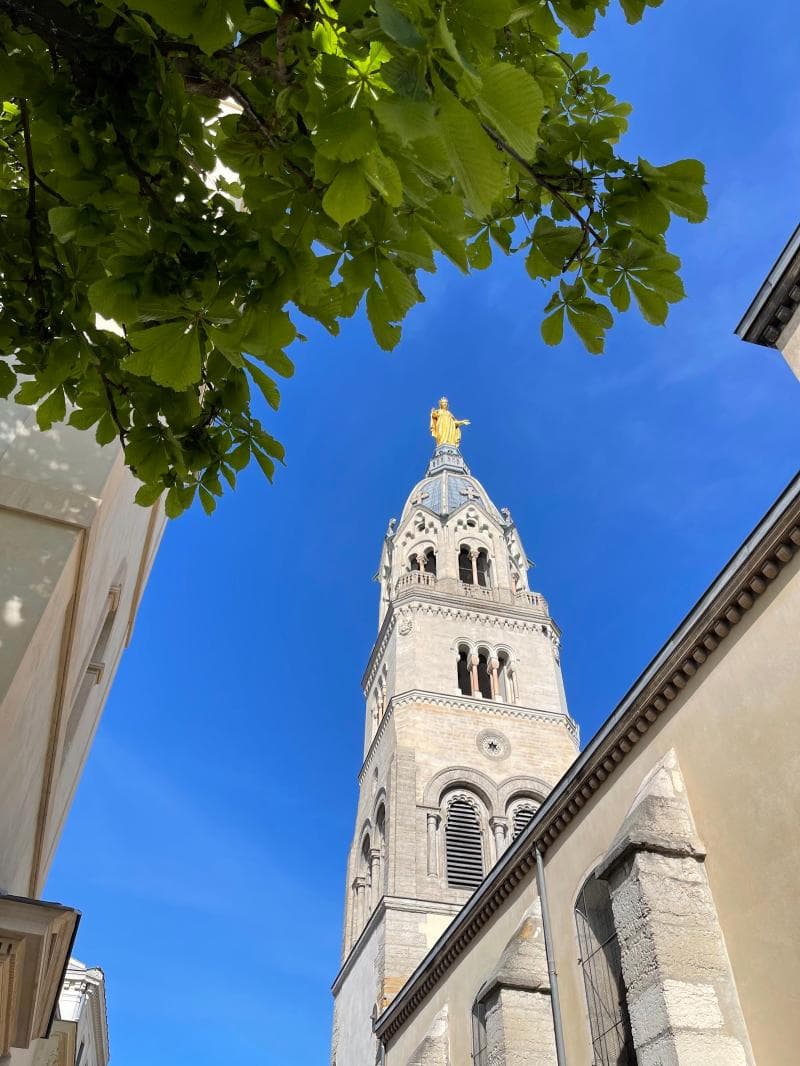
Discover Lyon's Fourvière Tower, a 101-meter 'mini Eiffel Tower' on Fourvière Hill. Learn its history, unique design, and cultural significance in Lyon, France.
Overview
Perched majestically atop Fourvière Hill in Lyon, France, the Fourvière Tower, officially known as the Tour métallique de Fourvière, stands as a distinctive landmark visible from across the city. This impressive metal structure, often affectionately dubbed Lyon's 'mini Eiffel Tower,' reaches a height of 101 meters, making it one of the tallest points in Lyon and culminating at an altitude of 372 meters above sea level. While it shares a striking resemblance to its Parisian counterpart, the Fourvière Tower has a unique history and purpose, embodying the innovative spirit of late 19th-century engineering. Today, it primarily serves as a crucial telecommunications hub, broadcasting various signals across the region.
Situated just north of the iconic Basilique Notre-Dame de Fourvière, the tower forms part of the panoramic skyline that defines this historic hill. Though no longer accessible to the public for observation, its presence remains an integral part of Lyon's identity, intriguing visitors with its architectural grandeur and historical narrative.
History & Cultural Background
The construction of the Fourvière Tower took place between 1892 and 1894, with its inauguration on May 2, 1894. It was erected specifically for the Exposition Universelle, Internationale et Coloniale de Lyon, which was held that same year. Beyond its role in the exhibition, the tower carried a significant cultural and political statement. It was conceived as a secular monument, intended to stand as a counterpoint to the profound religious symbolism of the nearby Basilique Notre-Dame de Fourvière, which had been completed a decade earlier.
Despite popular local rumors, the Fourvière Tower was not designed by Gustave Eiffel. Instead, its design was attributed to Collet and Roux-Meulien, with construction led by E. Collonge and metallic engineer Jules Buffaud. Initially, the tower offered a public observation deck, complete with a restaurant and a hydraulic elevator capable of transporting 22 people to the summit. It quickly became a popular attraction, offering breathtaking panoramic views of Lyon and its surroundings. However, its role shifted dramatically over time. By 1953, public access ceased, and the tower was repurposed as a vital broadcasting facility, a function it continues to serve today.
What Makes It Special
The Fourvière Tower's most immediately striking feature is its remarkable resemblance to the Eiffel Tower, a design choice that has led many to refer to it as Lyon's 'Eiffel Tower' or 'Picon.' This architectural homage is not merely aesthetic; it reflects the industrial optimism and engineering prowess of the late 19th century, showcasing intricate steel framework construction. Furthermore, its strategic placement on Fourvière Hill makes it the highest point in Lyon, offering an unparalleled visual marker for the city.
Beyond its physical attributes, the tower is special for its initial cultural significance as a secular rival to the Basilica. This unique historical tension between religious and secular aspirations is a compelling aspect of its identity. Its ingenious original design included a state-of-the-art hydraulic elevator, an engineering marvel of its time, which provided visitors with an exciting ascent to its lofty observatory.
Stories, Fun Facts & Local Details
One of the enduring myths surrounding the Fourvière Tower is that it was designed by Gustave Eiffel himself, given its undeniable similarity to the Parisian icon. However, this is simply a local legend, as historical records confirm different architects and engineers were responsible for its construction. An intriguing historical tidbit reveals that during World War II, specifically in 1943, the German army planned to dismantle the tower for its valuable scrap metal. Fortunately, a legal battle ensued, and the requisition order was repealed, saving the tower from destruction.
The tower's massive foundation, anchored into 7,200 tonnes of masonry, speaks to the ambition of its builders. Its 2,100 metallic trusses create a structure reminiscent of the Eiffel Tower's third level, a testament to the era's sophisticated metalwork. Although the observation deck is now closed to the public, there was a petition launched in 2026 to advocate for its reopening, highlighting ongoing local affection and interest in this historical monument.
Visitor Perspective
While the Fourvière Tower no longer welcomes visitors to ascend its heights, its commanding presence on Fourvière Hill ensures it remains a key focal point for anyone exploring Lyon. Travelers visiting the Basilique Notre-Dame de Fourvière or the ancient Roman theatres on the hill will find the tower an unavoidable and impressive sight. Its unique silhouette is visible from many vantage points across the city, providing a constant reminder of Lyon's rich history and architectural diversity. Even from the base, one can appreciate the intricate lattice work and the sheer scale of this 19th-century engineering marvel. A visit to Fourvière Hill offers a comprehensive experience, allowing you to take in the tower's exterior beauty alongside other significant historical and religious sites.
Coordinates: 4.822222, 45.763889
View on Google Maps💬 How Travelers Describe This Place
Based on community votes
Unique
685Photogenic
472Beautiful
446Interesting
399Must See
33
Traveler Stories
Discover memorable experiences shared by travelers who have visited this place.
No traveler stories yet.
Be the first traveler to share what made this place memorable.

Tour
By
Spot
Discover amazing places around the world. Your journey starts here.
Explore
© 2026 TourBySpot. All rights reserved.