Fountains
Stockholm, Sweden
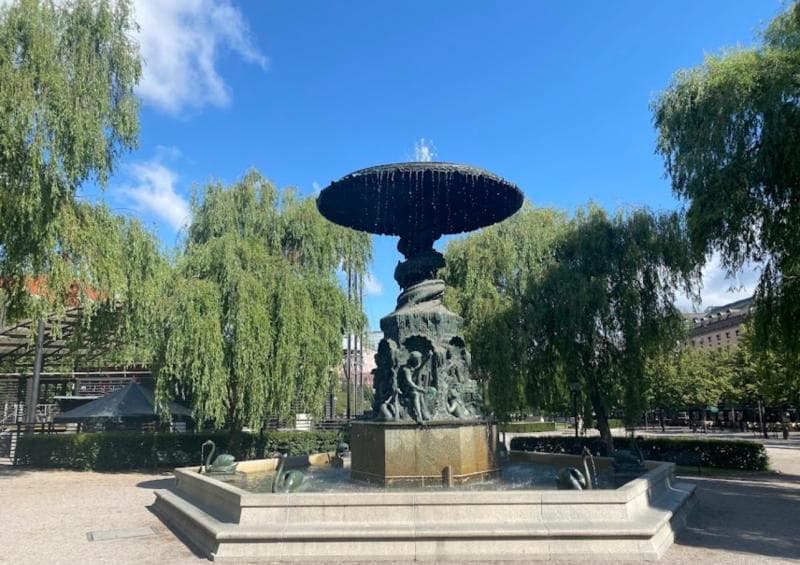
Discover the enchanting Fountains of Kungsträdgården in Stockholm, Sweden, including the historic Molin's Fountain and its mythical tales. Explore this central park's beauty.
Overview
Kungsträdgården, often affectionately called 'Kungsan' by locals, stands as a vibrant urban park in the heart of Stockholm, Sweden. It serves as a dynamic meeting place, blending historical grandeur with contemporary city life. Within its leafy confines, water features play a significant role in defining its character and offering points of artistic and recreational interest. The most prominent of these is Molin's Fountain, a magnificent bronze sculpture that tells tales of Norse mythology, while a central water feature adapts to the seasons, transforming from a refreshing summer spot into a beloved ice-skating rink in winter.
These 'Fountains' are more than mere decorative elements; they are integral to the park's identity, providing a serene ambiance or a lively focal point depending on the time of year. They represent a harmonious blend of art, history, and public utility, inviting both residents and visitors to pause, reflect, or partake in the city's seasonal festivities.
History & Cultural Background
The history of Kungsträdgården dates back to the 15th century when it began as the 'King's Cabbage Garden,' a royal vegetable patch for the monarchy. Over time, it evolved into an opulent Baroque pleasure garden, reserved exclusively for the royal court. The park gradually opened to the public in the 18th century, undergoing significant transformations, especially after the Makalös Palace, which bordered the park, was destroyed by fire in 1825.
Molin's Fountain, the park's central artistic masterpiece, holds a unique historical narrative. Sculpted by Johan Peter Molin, its plaster model was initially showcased as the centerpiece of a Scandinavian art and industrial exhibition in 1866. Such was its popularity and critical acclaim that a public subscription was launched to cast the intricate work in durable bronze. The bronze fountain was subsequently inaugurated on September 25, 1873, permanently gracing Kungsträdgården and becoming the city's oldest functioning fountain.
What Makes It Special
Molin's Fountain is a captivating bronze sculpture renowned for its rich detail and profound symbolism. It stands as Stockholm's oldest functioning fountain, a testament to enduring artistry and engineering from the 19th century. The sculpture depicts a tableau of Norse mythological figures, including the ocean god Ægir, his wife Rán, and their nine wave-daughters, all enthralled by the river spirit Nix playing his harp. This intricate composition symbolically represents Stockholm's geographical position, nestled between the freshwater Lake Mälaren, depicted as the upper bowl, and the brackish Baltic Sea, symbolized by the lower basin. The fountain also features six swans, which, notably, continue to provide fresh water to passers-by, a detail added by Molin himself.
Beyond Molin's Fountain, the park's central water feature further enhances its unique appeal. During the warmer months, this area serves as a tranquil pool, reflecting the surrounding greenery and historic architecture. However, as winter descends upon Stockholm, it undergoes a magical transformation, becoming a popular outdoor ice-skating rink. This dual functionality exemplifies Kungsträdgården's adaptability and its integral role in the city's seasonal recreational offerings.
Stories, Fun Facts & Local Details
The mythology woven into Molin's Fountain offers a glimpse into ancient Norse beliefs. The story of Ægir and Rán, rulers of the sea, with their nine daughters embodying the waves, creates a powerful connection to Scandinavia's maritime heritage. The river spirit Nix's music, drawing them in, adds a lyrical touch to the bronze narrative.
A fascinating tidbit about Molin's Fountain is its journey from a temporary plaster exhibition piece to a permanent bronze landmark. The public's overwhelming appreciation for its artistic merit led to a fundraising campaign, ensuring its creation in a more durable material and its lasting presence in Kungsträdgården. Remarkably, the fountain continues to operate using its original 1873 mechanisms, a testament to robust design and maintenance over more than a century and a half. This makes it not only an artistic treasure but also a piece of living history, quietly humming with the flow of time. Furthermore, the large central water feature, sometimes informally referred to as the 'Fountain of Wolodarski,' transforms each winter into one of Stockholm's most cherished traditions: a free, open-air ice-skating rink, complete with evening lighting and music.
Visitor Perspective
For visitors to Kungsträdgården, the fountains offer a sensory delight and a natural gathering point. The gentle cascade of water from Molin's Fountain provides a calming backdrop, a soothing counterpoint to the city's bustle. It's a place where one can sit on a nearby bench, observe the intricate bronze figures, and soak in the park's lively atmosphere.
In summer, the open central water feature becomes a refreshing visual element, often surrounded by people enjoying concerts, festivals, or simply relaxing. When winter arrives, the area becomes a joyous ice rink, drawing skaters of all ages and abilities. The transformation is a spectacle in itself, embodying Stockholm's embrace of its distinct seasons. Whether admiring the historical artistry of Molin's Fountain or partaking in the seasonal charm of the central ice rink, the fountains of Kungsträdgården offer a unique and memorable experience, deeply connecting visitors to the cultural and natural rhythms of this beautiful Swedish capital.
Coordinates: 18.0695, 59.3254
View on Google Maps💬 How Travelers Describe This Place
Based on community votes
Interesting
995Must See
989Unique
603Beautiful
581Photogenic
388
Traveler Stories
Discover memorable experiences shared by travelers who have visited this place.
No traveler stories yet.
Be the first traveler to share what made this place memorable.

Tour
By
Spot
Discover amazing places around the world. Your journey starts here.
Explore
© 2026 TourBySpot. All rights reserved.