Fountain Of Neptune
Florence, Italy
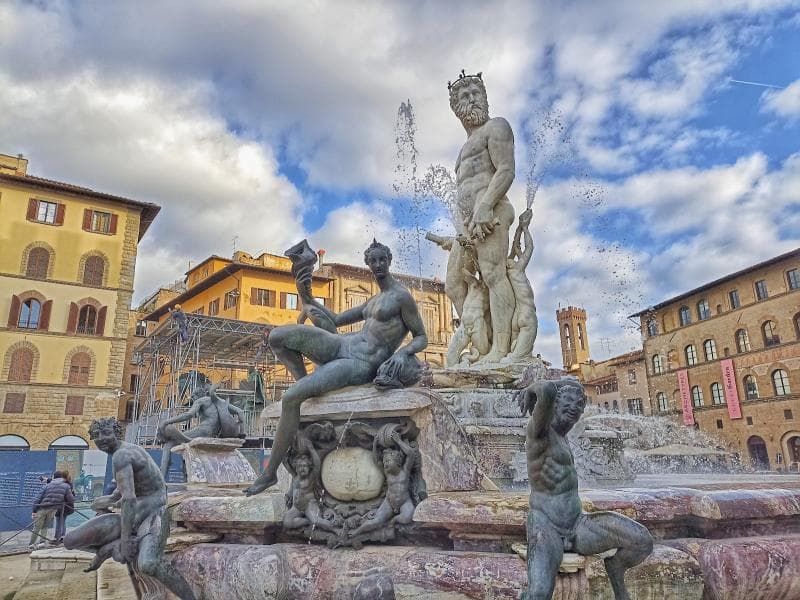
Discover the Fountain of Neptune in Florence, Italy, a stunning Renaissance masterpiece symbolizing Medici maritime power in Piazza Della Signoria.
Overview
Nestled in the heart of Florence, Italy, within the iconic Piazza Della Signoria, stands the majestic Fountain of Neptune. This grand Renaissance masterpiece, often affectionately known by locals as 'Il Biancone' or 'the big white one,' is much more than a mere decorative feature; it is a profound symbol of Florentine power and ambition. Created primarily by Bartolomeo Ammannati between approximately 1560 and 1575, the fountain centers around a colossal marble statue of Neptune, the Roman god of the sea, astride a shell-shaped chariot pulled by four spirited horses. The fountain's prominent location, adjacent to the Palazzo Vecchio, makes it a focal point in one of Florence's most historically significant public squares.
A visit to the Fountain of Neptune offers a glimpse into Florence's rich artistic and political past, providing a compelling narrative for any curious traveler. It is freely accessible to all, inviting contemplation at any time of day or night.
History & Cultural Background
The story of the Fountain of Neptune begins in 1559 when Cosimo I de' Medici, the powerful Grand Duke of Tuscany, commissioned the project. Initially intended to celebrate his provision of clean water to the city via a newly constructed aqueduct, the fountain's significance soon expanded. It was later dedicated to commemorate the marriage of his son, Francesco I de' Medici, to Joanna of Austria, further cementing the Medici family's legacy and influence.
A competition was held for the design, drawing submissions from renowned artists of the era, including Benvenuto Cellini, Baccio Bandinelli, and Giambologna. While Baccio Bandinelli was initially chosen, his death in 1560 led to his student, Bartolomeo Ammannati, taking over the ambitious project. Ammannati incorporated some of Bandinelli's original designs and, with the help of various assistants, including Giambologna, brought this monumental vision to life. The arduous sculptural work took many years, emphasizing the era's dedication to artistic grandeur and civic display.
What Makes It Special
The Fountain of Neptune stands out for its impressive scale and intricate detail. The central figure of Neptune, carved from pristine white Carrara marble, commands attention. He stands proudly on a chariot drawn by four horses—two sculpted from white marble and two from *mischio*, a rare, multi-colored marble discovered near the Duke's excavations.
Surrounding Neptune in the octagonal basin is a rich ensemble of mythological figures, each contributing to the fountain's narrative. These include Tritons, Satyrs, Nereids, Putti, and depictions of the sea monsters Scylla and Charybdis on the pedestal. What truly makes this sculpture unique is the deliberate resemblance of Neptune's face to that of Cosimo I de' Medici. This artistic choice powerfully symbolized Florence's dominion over the sea and the Medici's aspirations for maritime trade and naval strength, asserting their prominence in the Mediterranean.
Stories, Fun Facts & Local Details
Despite its current revered status, the Fountain of Neptune wasn't an instant hit with the Florentine public. Ammannati's work garnered some criticism upon its unveiling, with locals jokingly referring to it as 'Il Biancone' (the big white one), possibly a jab at its imposing brightness or perceived artistic shortcomings. A common saying among Florentines was 'Ammannato, Ammannato, che bel marmo hai rovinato!' (Ammannati, Ammannati, what beautiful marble you have ruined!).
Throughout its long history, the fountain has endured its share of mistreatment and mishaps. In the centuries following its creation, Florentines were known to use the basin as a place to wash clothes and even inkpots, leading to damage and discoloration. A plaque was eventually installed nearby, prohibiting such activities. The fountain has also suffered vandalism over the years, including damage during celebrations in 1830 and 1848, and notably in 2005, when a vandal attempting to climb the statue broke Neptune's hand and trident. Fortunately, diligent restoration efforts, often funded by private donors like Salvatore Ferragamo, have maintained its splendor, with the most recent major restoration completed in 2019.
Visitor Perspective
Visiting the Fountain of Neptune offers a memorable experience for anyone exploring Florence. Located in the open, expansive Piazza Della Signoria, it is easily accessible and wheelchair-friendly. The square itself is a lively hub, bordered by the magnificent Palazzo Vecchio, the Loggia dei Lanzi with its impressive sculptures, and numerous cafes and restaurants where visitors can pause and soak in the atmosphere.
While the fountain is beautiful at any time, an early morning or late evening visit is recommended to avoid peak crowds and enjoy a more tranquil viewing. During summer months, be aware that the square offers little shade, so a hat and sunscreen are advisable. This artistic and historical landmark is not just a sight to behold; it is a vibrant part of Florence's cultural tapestry, inviting travelers to connect with centuries of history and Renaissance artistry.
Coordinates: 11.2555, 43.7696
View on Google Maps💬 How Travelers Describe This Place
Based on community votes
Beautiful
951Unique
491Must See
427Interesting
414Photogenic
277
Traveler Stories
Discover memorable experiences shared by travelers who have visited this place.
No traveler stories yet.
Be the first traveler to share what made this place memorable.

Tour
By
Spot
Discover amazing places around the world. Your journey starts here.
Explore
© 2026 TourBySpot. All rights reserved.