Fountain Complex
Oslo, Norway
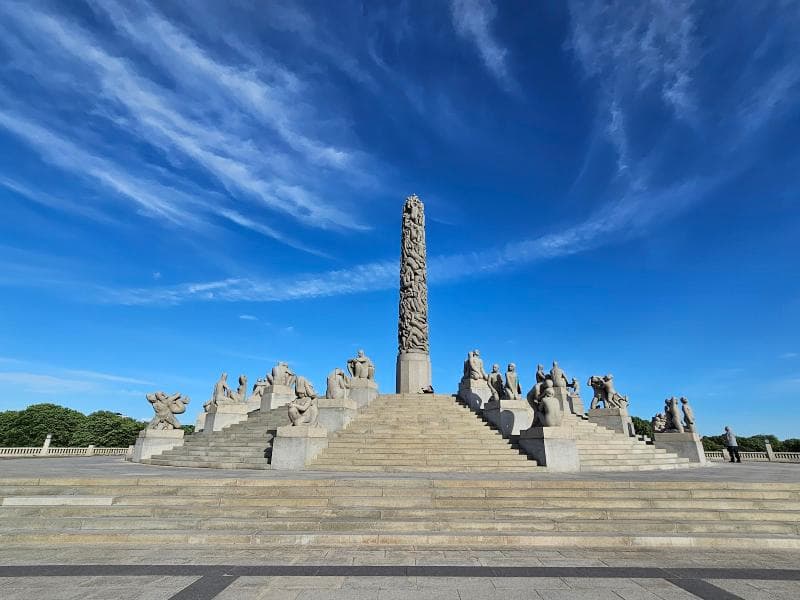
Explore the Fountain Complex in Vigeland Sculpture Park, Oslo, Norway. Discover Gustav Vigeland's profound artistry and symbolism of life's eternal cycle.
Overview
The Fountain Complex, known in Norwegian as 'Fontenen', is a compelling and significant sculptural installation within the renowned Vigeland Sculpture Park in Oslo, Norway. It stands as a central element of Gustav Vigeland's monumental artistic vision, encapsulating themes of human life and our connection to nature. Positioned beyond the famous Bridge and leading towards the majestic Monolith, the Fountain is an integral stop along the park's 850-meter-long artistic axis. The complex features a large central basin where six colossal male figures tirelessly uphold a grand saucer-shaped vessel, from which water cascades in a continuous flow. Surrounding this basin are twenty bronze tree groups, forming a harmonious blend of water, stone, and metal. The entire Fountain area is further adorned by an 1800 square meter mosaic laid in black and white granite, creating a visually striking and contemplative space that invites visitors to pause and reflect on the profound symbolism embedded within its design.
History & Cultural Background
Gustav Vigeland, Norway's most celebrated sculptor, dedicated a significant portion of his life to the creation of the Vigeland Sculpture Park, including the elaborate Fountain Complex. His work on the Fountain spanned several decades, from approximately 1906 to 1947, making it one of the earliest conceptualized units of the park. Interestingly, the Fountain was initially intended for a different, prominent location: Eidsvolls plass, in front of the Norwegian Parliament building. However, these plans were never realized, and the Fountain subsequently became a foundational component of Vigeland's more extensive park design, ultimately finding its home within what is now known as Vigeland Sculpture Park. Vigeland's grand undertaking in the park was made possible through a unique agreement with the city of Oslo, where he donated all his future artwork to the municipality in exchange for a studio and living quarters. This enabled him to transform Frogner Park into the world's largest sculpture park by a single artist.
What Makes It Special
The Fountain Complex is unique not only for its sheer artistic grandeur but also for its deep philosophical underpinnings. At its core, the Fountain symbolizes the eternal cycle of life, with the ceaseless flow of water representing vitality, renewal, and fertility. The six giant men supporting the basin are often interpreted as figures burdened by life, perpetually engaged in the struggle and toil of human existence. However, the true depth of its meaning is revealed in the twenty bronze tree groups that encircle the main basin. These 'trees of life' graphically depict the various stages of human development, from the innocence of childhood and the vigor of youth, through the complexities of adulthood, to the wisdom of old age and the inevitable embrace of death. Furthermore, reliefs surrounding the Fountain illustrate children and skeletons intertwined within the branches of these massive trees, powerfully conveying the concept that new life emerges from death, completing life's continuous loop. This intricate narrative makes the Fountain far more than a decorative element; it's a profound artistic statement on the human condition and our inseparable bond with nature.
Stories, Fun Facts & Local Details
The Fountain Complex holds a special place in the hearts of many, not just for its artistic merit but for the stories it tells without a single spoken word. Gustav Vigeland believed in symbolism's power to transcend language and cultural barriers, reaching the core of human emotion. Visitors often spend considerable time observing the detailed bronze reliefs, each figure conveying a raw and relatable emotion or stage of life. It's said that 'everything is a cycle here,' and 'it never really ends,' an observation that perfectly captures the essence of the Fountain's narrative. Some interpretations even link the Fountain to 'Urd,' a source of divine wisdom in Scandinavian mythology, with the twenty bronze trees being seen as a metaphorical Garden of Eden. Imagine the sculptor, Gustav Vigeland, toiling for decades, meticulously shaping each figure, each leaf, to convey this universal story. The sheer dedication to such a grand, consistent vision by a single artist is truly remarkable. The park itself, while often referred to as Vigeland Park, is actually part of Frogner Park, a much larger public green space. Locals typically use the name Frogner Park, while tourists more commonly use Vigeland Park.
Visitor Perspective
Approaching the Fountain Complex, after crossing the lively Bridge filled with diverse human sculptures, visitors enter a space that shifts from dynamic movement to thoughtful contemplation. The broad, paved pathways ensure that the Fountain is easily accessible to all, including those in wheelchairs, allowing everyone to fully appreciate its details from various viewpoints. The open surroundings encourage a leisurely pace, inviting close inspection of the bronze figures or a step back to take in the entire artistic composition. You'll find yourself drawn into the narrative of life's journey, recognizing familiar emotions and stages within the sculptures. It's common to see people pondering the symbolism, perhaps identifying with a particular figure or phase depicted among the tree groups. The tranquility of the water, coupled with the profound imagery, creates a uniquely meditative experience. This is a place not just to see art, but to feel it, to connect with the shared human experience that Vigeland so masterfully expressed. The Fountain Complex is a testament to the enduring power of art to provoke thought and stir the soul, making it an unforgettable highlight of any visit to Vigeland Sculpture Park.
Coordinates: 10.70119, 59.92689
View on Google Maps💬 How Travelers Describe This Place
Based on community votes
Photogenic
755Must See
728Beautiful
481Unique
183Interesting
28
Traveler Stories
Discover memorable experiences shared by travelers who have visited this place.
No traveler stories yet.
Be the first traveler to share what made this place memorable.

Tour
By
Spot
Discover amazing places around the world. Your journey starts here.
Explore
© 2026 TourBySpot. All rights reserved.