Fort Santiago
Manila, Philippines
Discover Fort Santiago, a historic citadel in Intramuros, Manila, Philippines. Explore its rich history, significant role, and poignant Rizal connections.
Overview
Nestled within the historic walled city of Intramuros in Manila, Philippines, Fort Santiago stands as a powerful testament to centuries of Philippine history. Built by Spanish governor Miguel López de Legazpi in 1571, this ancient citadel served as a crucial defense fortress during the Spanish colonial era. Its strategic location at the mouth of the Pasig River made it an indispensable stronghold, guarding against invaders and facilitating the rich global trade routes of its time. Today, Fort Santiago is one of Manila’s most significant historical sites, offering visitors a profound glimpse into the nation’s past and the struggles and triumphs that shaped it.
History & Cultural Background
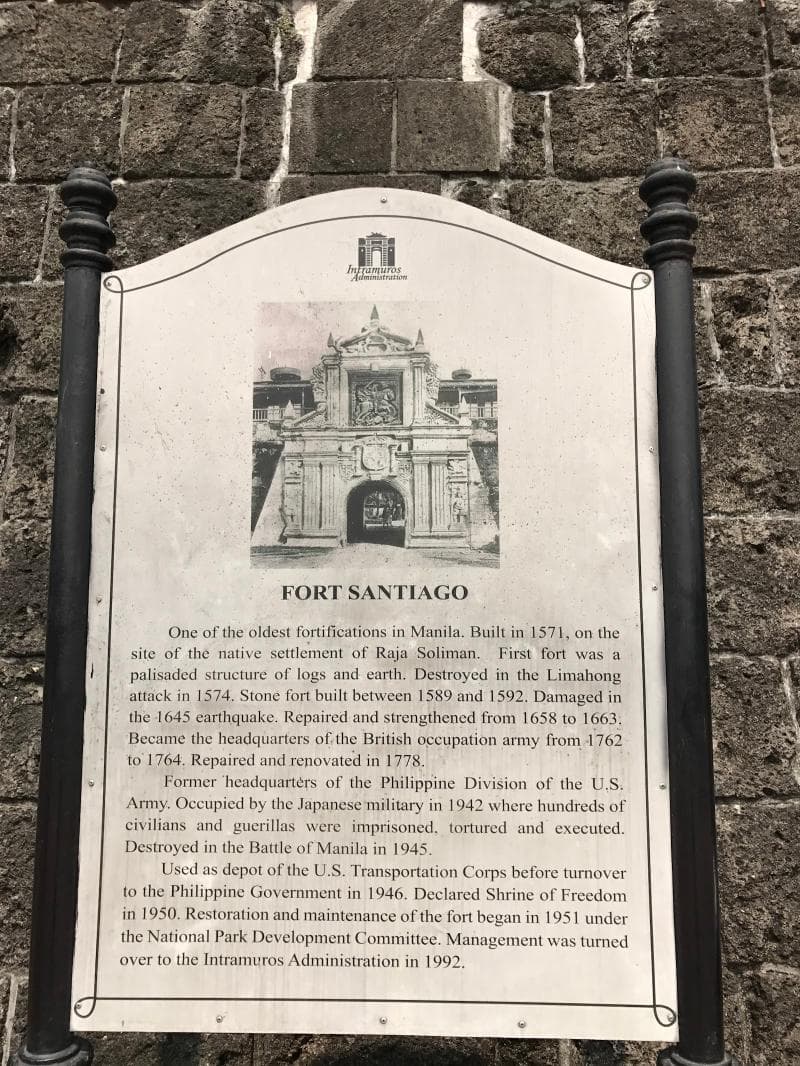
The foundations of Fort Santiago rest on a site of earlier significance: the pre-colonial settlement of Rajah Sulayman. Following the defeat of Rajah Sulayman by Spanish forces in 1571, the Spanish began constructing their own fort. Initially made of palm logs and earth, the fort was rebuilt with volcanic tuff stones between 1589 and 1593 after being damaged by Chinese pirate Limahong. Named after Saint James the Great ('Santiago' in Spanish), the patron saint of Spain, the fort became the primary military stronghold for the Spanish government.
For over three centuries, Fort Santiago was a pivotal hub for the lucrative Manila Galleon trade, connecting the Philippines with the Americas and Europe. Its robust walls and bastions were designed to protect Manila from external threats. However, its history is also marked by darker periods. During Spanish rule, its dungeons became infamous for housing political prisoners, including Filipino revolutionaries. The fort witnessed the British occupation from 1762 to 1764 and was later repurposed by the Americans into a command center, even seeing its moats drained and grounds converted into a golf course. Perhaps its most harrowing chapter came during World War II, when the Japanese Imperial Army used it as a prison and torture chamber, leading to countless casualties among Filipino and American prisoners of war. In 1951, the Philippines officially recognized Fort Santiago's profound historical importance, declaring it a National Monument and a 'Shrine of Freedom' to honor those who suffered and died within its walls.
What Makes It Special
Fort Santiago's distinctiveness lies in its layered history and its enduring symbolism. Its nearly triangular form, with a perimeter stretching approximately 2,030 feet, showcases Italian-Spanish school of fortification architecture. The fort's strategic positioning at the confluence of the Pasig River and Manila Bay offered unparalleled defensive capabilities. Beyond its architectural grandeur and military significance, Fort Santiago holds immense cultural weight as the final prison of Dr. José Rizal, the Philippines' national hero.
Visitors can literally follow in Rizal's footsteps, marked by bronze imprints on the ground, tracing his last walk from his cell to the execution site. This poignant memorial, along with the Rizal Shrine museum housed within the fort, which displays his memorabilia, transforms Fort Santiago from merely an old structure into a living narrative of national heroism and sacrifice. It’s a place where history isn't just told; it's felt.
Stories, Fun Facts & Local Details
One of the most compelling aspects of Fort Santiago is the palpable sense of history that permeates its grounds. Imagine the bustling activity of the Manila Galleon trade, with goods from across Asia being loaded onto ships bound for Acapulco, Mexico, all originating from this very fort. The name 'Santiago' itself evokes tales of valor, referring to Saint James the Great, a revered figure in Spanish history.
Beneath the fort's stoic walls lie the infamous dungeons, silent witnesses to centuries of suffering. These subterranean chambers, once submerged by the Pasig River's high tides, housed prisoners during various occupations, their stories echoing through time. The fort's main gate, a testament to 18th-century craftsmanship, was built in 1714, though it has seen its share of damage and restoration, notably after an earthquake in 1880 and the ravages of World War II. Walking through Fort Santiago is not just a tour; it's an immersive experience into the heart of Filipino resilience and the enduring spirit of freedom.
Visitor Perspective
Exploring Fort Santiago offers a deeply reflective experience. Visitors are encouraged to wear comfortable shoes, as there is much to discover across its sprawling grounds, from the well-preserved barracks and defensive structures to tranquil gardens. The site is open daily, inviting travelers to spend ample time delving into its many facets. The Intramuros Administration diligently oversees the restoration and development of the entire walled city, including Fort Santiago, ensuring that its historical integrity is maintained for future generations. A visit here is more than just sightseeing; it's an opportunity to connect with the soul of Manila and understand the profound historical forces that shaped the Philippines.
Coordinates: 120.97, 14.5945
View on Google Maps💬 How Travelers Describe This Place
Based on community votes
Must See
934Beautiful
276Photogenic
152Unique
30Interesting
16
Traveler Stories
Discover memorable experiences shared by travelers who have visited this place.
No traveler stories yet.
Be the first traveler to share what made this place memorable.

Tour
By
Spot
Discover amazing places around the world. Your journey starts here.
Explore
© 2026 TourBySpot. All rights reserved.