Five-Story Pagoda
Tokyo, Japan
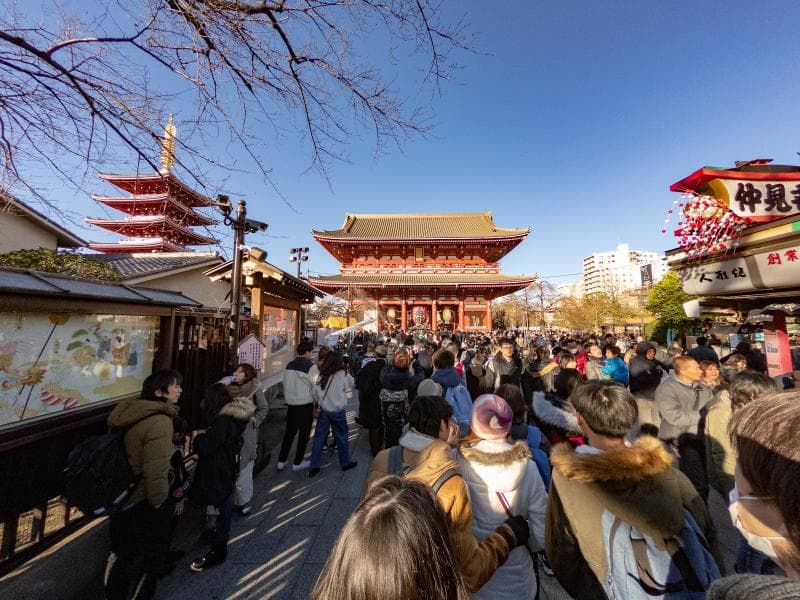
Discover Tokyo's Five-Story Pagoda in Asakusa, a stunning symbol of resilience and Buddhist tradition within the historic Senso-ji Temple. Learn its history and unique features.
Overview
Standing majestically within the renowned Senso-ji Temple complex in Tokyo's historic Asakusa district, the Five-Story Pagoda (Gojū-no-tō) is an iconic symbol of resilience and spiritual grace. Its towering presence is a focal point of the temple grounds, offering a blend of ancient aesthetics and profound Buddhist symbolism. As one of Japan's most famous pagodas, it gracefully punctuates the Tokyo skyline and is a must-see for anyone exploring Asakusa.
History & Cultural Background
The origins of the Five-Story Pagoda trace back to 942 AD, when it was first constructed by the military commander Taira no Kinmasa. Throughout its long history, this sacred structure has faced numerous challenges, enduring repeated destruction by fires, natural disasters, and conflicts. A significant reconstruction occurred in 1648 under the patronage of Tokugawa Iemitsu, the third shogun of the Tokugawa Shogunate, cementing its status as a prominent landmark of Edo (old Tokyo) and Asakusa. Tragically, this Edo-era masterpiece was destroyed during the Great Tokyo Air Raid on March 10, 1945, a fate shared by many of Tokyo's historic structures. The current Five-Story Pagoda, a powerful symbol of continuous spiritual practice and rebirth, was faithfully reconstructed in 1973. While modern in its underlying construction, often utilizing steel frames and reinforced concrete for seismic resilience, it meticulously maintains its traditional aesthetic.
What Makes It Special
The Five-Story Pagoda is more than just an architectural marvel; it embodies profound Buddhist cosmology. Each of its five tiers represents one of the five Buddhist elements of the universe: Earth (Chi) as the foundation, Water (Sui) signifying adaptability, Fire (Ka) for energy, Wind (Fū) symbolizing freedom, and Void (Kū) representing the spiritual realm beyond physical existence. This symbolism reflects the Buddhist belief in life's interconnectedness and the path toward enlightenment. Furthermore, the pagoda serves as a significant reliquary. Its topmost floor enshrines Busshari, sacred Buddha's ashes, which were officially donated by the Isurumuniya Temple in Sri Lanka in 1966. The lower levels also house memorial tablets (ihai) for those who have engaged in perpetual memorial services (Eitai Kuyo) with the temple, with reportedly over 100 statues and more than 100,000 tablets present.
Stories, Fun Facts & Local Details
Standing at approximately 53 meters tall, the Five-Story Pagoda is among the tallest pagodas in Japan. Its vivid vermilion color stands out beautifully against the sky. While its original purpose was to house relics and serve as a spiritual beacon, its enduring presence and repeated reconstructions tell a story of unwavering faith and community dedication. One of the most enchanting experiences is to see the pagoda illuminated at night. Beginning in 2003, as part of celebrations for the 400th anniversary of Edo's founding, the pagoda, along with other key structures like the Kaminarimon and Hozomon Gates, is brilliantly lit from sunset until around 11 p.m.. This nighttime illumination transforms the pagoda, offering a mystical and vibrant scene that differs dramatically from its daytime appearance.
Visitor Perspective
While the interior of the Five-Story Pagoda is generally not open to the public, its external grandeur and spiritual significance are deeply felt by visitors. Its striking form provides an excellent photo opportunity, particularly when juxtaposed against the modern Tokyo skyline or under its evening illumination. The pagoda stands slightly apart from the main hall, lending it a quiet dignity even amidst the temple's bustling grounds. Its presence completes the harmonious blend of culture, spirituality, and tradition that makes the entire Senso-ji complex and Asakusa a captivating destination for curious travelers. Exploring the temple grounds, you'll feel its historical weight and cultural importance, a testament to Tokyo's enduring heritage.
Coordinates: 139.79675, 35.71472
View on Google Maps💬 How Travelers Describe This Place
Based on community votes
Unique
958Must See
743Photogenic
728Beautiful
719Interesting
382
Traveler Stories
Discover memorable experiences shared by travelers who have visited this place.
No traveler stories yet.
Be the first traveler to share what made this place memorable.

Tour
By
Spot
Discover amazing places around the world. Your journey starts here.
Explore
© 2026 TourBySpot. All rights reserved.