Façade
Barcelona, Spain
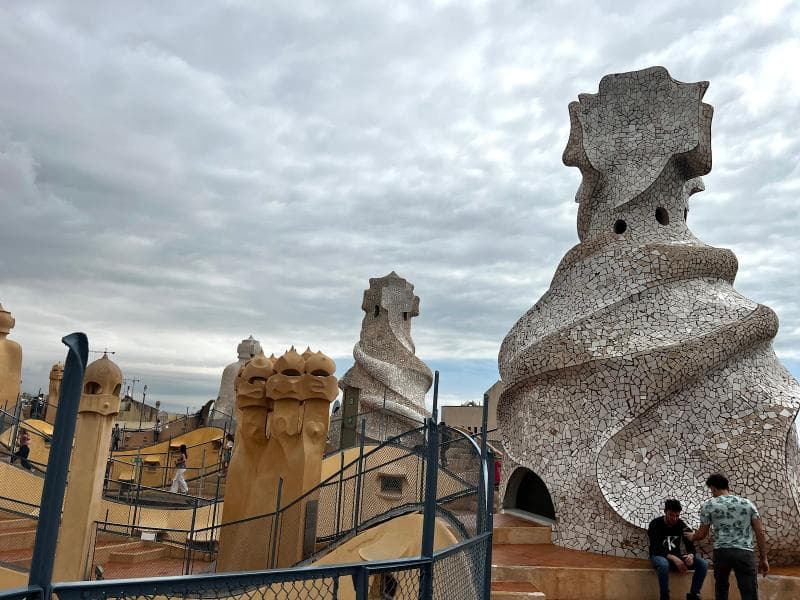
Explore the unique, undulating façade of Casa Milà, 'La Pedrera,' in Barcelona, Spain. Discover Gaudí's innovative, nature-inspired design and its rich history.
Overview
The façade of Casa Milà, affectionately known as La Pedrera, or 'The Quarry,' stands as a testament to Antoni Gaudí’s boundless imagination and revolutionary architectural vision in the heart of Barcelona, Spain. More than just an exterior wall, it is a sculptural masterpiece that defies conventional architectural norms, presenting a captivating wave of stone and iron on Passeig de Gràcia. Its undulating forms, devoid of straight lines, evoke a sense of natural movement, as if carved by the wind and sea, making it immediately recognizable and one of the city's most iconic landmarks.
History & Cultural Background
Commissioned by the wealthy couple Pere Milà and Roser Segimon in 1906, Casa Milà was Gaudí's last private residential project before he dedicated himself entirely to the Sagrada Família. Constructed between 1906 and 1912, the building's façade was highly controversial at the time of its completion. Locals and critics alike ridiculed its unconventional appearance, comparing it disparagingly to a 'stone quarry' – a nickname that, over time, transformed from a term of derision into an affectionate identifier. This period marked a significant shift in architectural thought, with Gaudí’s Modernisme style challenging the rigid geometric conventions prevalent in early 20th-century Barcelona. Despite initial skepticism and public debate, Casa Milà was recognized for its pioneering design and declared a UNESCO World Heritage Site in 1984, cementing its status as an exceptional example of modern architectural heritage.
What Makes It Special
What truly sets the façade of Casa Milà apart is its radical structural innovation and organic design philosophy. Gaudí conceived it as a self-supporting stone façade, often referred to as a 'curtain wall,' which means it bears no structural load. This groundbreaking approach allowed for an unprecedented degree of flexibility in the interior layout, enabling residents to reconfigure their living spaces without compromising the building's stability. The stone blocks, primarily limestone from Garraf and Vilafranca del Penedès, are connected to the internal structure by metal elements, creating a dynamic surface that appears to breathe and shift with the light. The façade’s continuous curves and absence of straight lines are a direct homage to nature, inspired by elements like eroded cliffs, ocean waves, and mountain landscapes. Complementing the stone are the fantastical wrought-iron balconies, designed by Josep Maria Jujol and his collaborators. These intricate ironworks are not merely decorative but are expressive, abstract sculptures, often likened to tangled seaweed, anchors, or even fantastical vegetation. The interplay between the solid, flowing stone and the delicate, organic ironwork creates a captivating visual rhythm that changes throughout the day and with the seasons.
Stories, Fun Facts & Local Details
The nickname 'La Pedrera' initially stemmed from its rough-hewn, quarry-like appearance, which many found ugly or bizarre. However, this seemingly negative appellation has since been embraced, highlighting the building's unique character and its departure from conventional beauty. Gaudí, a deeply religious man, originally intended to crown the building with a large sculpture of the Virgin Mary, a plan that did not materialize due to disagreements with the Milà family and local residents. Nevertheless, subtle religious symbols can still be found within the façade, such as a hint of the 'Hail Mary' prayer on the upper part facing Provença street and an 'M' (possibly for Mary) over a rose on one elevation. An interesting anecdote relates that Roser Segimon, Pere Milà's wife, once complained about the lack of straight walls to place her Steinway piano, to which Gaudí reportedly retorted, 'Then play the violin!' This story perfectly encapsulates Gaudí's unwavering commitment to his organic, curvilinear vision, even in the face of client demands.
Visitor Perspective
Experiencing the façade of Casa Milà is an immersive visual journey. Standing across Passeig de Gràcia, visitors are encouraged to observe how the building recomposes itself with every step, its fluid lines and sculptural elements constantly revealing new perspectives. The stone's creamy, white color takes on different hues throughout the day, transforming with the changing positions of the sun. In the morning, it may glow with a warm light, while at midday, silver tones emerge, creating crisp, lace-like patterns from the shadows of the balconies. As evening approaches, it often takes on a honey hue, its edges sharpening into a distinct silhouette against the Barcelona sky. It is a living, breathing work of art that invites contemplation, reminding us of Gaudí's genius in harmonizing structure with nature and art.
Coordinates: 2.157, 41.3905
View on Google Maps💬 How Travelers Describe This Place
Based on community votes
Must See
670Photogenic
620Unique
594Beautiful
166Interesting
83
Traveler Stories
Discover memorable experiences shared by travelers who have visited this place.
No traveler stories yet.
Be the first traveler to share what made this place memorable.

Tour
By
Spot
Discover amazing places around the world. Your journey starts here.
Explore
© 2026 TourBySpot. All rights reserved.